
Influence of Seaweed Flakes and Extract on the Nutritional, Antioxidant, and Shelf-Life Properties of Fish Crackers
 , Mandakini Devi Hanjabam2*, Layana Porayil1, Suman Manna2, Leesa Priyadarsani2, Kochery Augustin Martin Xavier3, Krishnamoorthy Elavarasan4, Binaya Bhusan Nayak1and Tapas Kumar Ghoshal2
1Fisheries Resource Harvest and Post-Harvest Management Division, ICAR-Central Institute of Fisheries Education, Mumbai, India
2ICAR-Central Institute of Fisheries Education, Kolkata Centre, Kolkata, India
3Quality Assurance and Management Division, ICAR-Central Institute of Fisheries Technology, Cochin, India
4Fish Processing Division, ICAR-Central Institute of Fisheries Technology, Cochin, India
Corresponding Author Email:mandakinidevi@cife.edu.in
Download this article as:
ABSTRACT:Seaweeds offer a range of nutritional and bioactive benefits that can contribute to improved human health. Sargassum wightii, a commonly found brown seaweed is used for enhancing the properties of fish crackers. Two forms of Sargassum wightii i.e flakes (SF) and extract (SE) at 2% inclusion level were incorporated and assess the nutritional, antioxidant properties, sensory, and storage quality of the final crackers. The moisture content does not differ significantly among the crackers. Overall, the addition of Sargassum wightii in flakes (SF) form significantly (p<0.05) increased the protein and insoluble fiber content in the crackers as compared to other formulations. However, SE crackers exhibited the highest antioxidant activity, with a total phenolic content of 3.53 mg GAE/g, ferrous chelating activity of 48.65%, and reducing power of 1.60 mg AAE/g. All the cracker formulations exhibited rich in macro minerals, with sodium predominating, followed by minerals like potassium and magnesium. The formulations also contained measurable amounts of manganese and copper. In term of amino acids composition, the SF crackers had higher levels of amino acids having bitter taste compared to both the control and the seaweed extract incorporated crackers. Sensory evaluations indicated a significantly greater (p<0.05) hedonic score in texture and taste of SE fried crackers on 0th day as well as 60th day of storage. In conclusion, the findings highlight that incorporating Sargassum wightii, particularly in extract form, is highly advantageous for enhancing antioxidant activity and storage quality. While seaweed flakes improve the nutritional quality of crackers, they show limited acceptability in terms of sensory attributes. Therefore, the acceptability of seaweed in food products can be improved by using it in extract form rather than in powder or flakes form. The limitation of the study is that the sensory acceptability is performed by semi-trained panelist, therefore consumer validation study on larger scale would improve the scope of commercialization of the product.
KEYWORDS:Antioxidant; Fish crackers; Seaweed flakes; Seaweed extract; Sensory
Introduction
Since ancient times, seaweeds have been used as food, particularly in China, Japan, and Korea. They are rich in proteins, vitamins, minerals, dietary fibre, and bioactive compounds like polyphenols and carotenoids.1,2 Brown seaweeds account for the largest proportion of global seaweed consumption (66.5%), followed by red seaweeds (33%) and green seaweeds (5%).3 A total of 56 Sargassum species, a brown seaweed, have been documented from Indian waters.4 These species are recognized for their high content of sulfated polysaccharides, which possess diverse antioxidant activities.5-6 Due to their nutritional and functional properties, seaweeds are considered a “superfood” and are increasingly added in various food matrices such as meat, fish, and bakery items to enhance health benefits, nutrition, techno-functional, shelf-life, and overall quality.7-8 While using seaweeds focus is given on their nutrition-promoting properties and often neglect its impact on the nutritional attributes of the final products. Seaweed utilization in powder form affects the sensory properties greatly. In our earlier study, inclusion of Sargassum wightii powder in above 3 % in fish jerky resulted in a spongy texture and grassy flavour, although it could improve the nutritional and antioxidant properties.9 Similarly, seaweed (Portieria hornemanii) powder can be incorporated only upto 2.5 % into the fish protein cookies without compromising sensory qualities.10 Despite being recognized as a superfood, the acceptance of seaweed in fresh form or powder form in Indian cuisine remains limited, possibly due to its unfamiliar sensory attributes. Therefore, a promising approach to harness this valuable plant source in Indian diet may be by integrating it into already established food products.11 In Indian culinary tradition, fried crackers is a very popular food item. Crackers go well in every meal or as a snack with hot beverages in the evening time. Crackers are crunchy in texture and generally prepared from cereal. In recent time, animal proteins are being incorporated into crackers preparations to enhance the nutritional value of the crackers. Fish crackers developed from catla mince was found to be sensorily acceptable.12 A popular fish, tilapia is grown in more than 135 countries. Because of their white flesh quality and lack of intermuscular bones, they are known as “aquatic chicken”13. In India, tilapia farming is promoted by government with a target of producing 1.2 millions tons of tilapia by the year 2030.14 This initiative aims to enhance rural livelihoods and generate employment opportunities for women and youth in rural areas. With this background, the present research has been formulated to evaluate the effects of incorporating various forms of Sargassum wightii, namely flakes and extracts, on the nutritional quality and storage stability of tilapia fish crackers.
Materials and Methods
Raw materials
Fresh tilapia (Oreochromis mossambicus) fish was procured from local fish vendor in Bidhannagar, Sector-2, Kolkata, India. The fishes were transported to the laboratory in ice (1:1) using thermocol boxes within 1 hour. The fish was dressed, washed, filleted, minced and stored at -20 °C in deep freezer (Voltas, India) and completed the experiment within 1 month. Brown seaweed (Sargassum wightii) was procured from a seaweeds firm called R.K. Algae in Mandapam, India and sun dried for 4 days before bringing to ICAR-CIFE laboratory. Food-grade ingredients were procured from local supermarket. Analytical grade chemicals were procured from Sigma Aldrich (USA), Merck, Hi-Media (India), and Qualigens (India).
Seaweed treatment
The sun-dried S. wightii obtained from the supplier was meticulously rinsed with potable water to eliminate any residual contaminants, such as stones, shells, and sand particles. The material was thereafter distributed uniformly in a cabinet dryer (Scientific Instruments, Kolkata, India) and dehydrated at 45 °C for 7 hours. The desiccated seaweeds were ground into a powder using a Budhrani 3Hp stainless steel pulverizer (India). The powder was filtered through a 250 μm screen, and the material which could not pass the sieve is referred to as seaweed flakes (SF). The powdered sample acquired post-sieving was utilized for the manufacture of seaweed extract (SE) by the hydrothermal extraction procedure outlined in our previous study.5 Approximately, 100 g of seaweed powder was combined with acidified distilled water (pH 2) at a 1:25 (w/v) ratio and kept undisturbed for 15 minutes to facilitate adequate swelling. The sample was maintained in a digital water bath at 85 °C for two hours. The solution was neutralized with 1 N NaOH and subsequently spun at 5000 rpm, and the extract was concentrated utilizing a rotary evaporator (Rolex, India). The seaweed extract (SE) was preserved in an airtight amber bottle and maintained at a temperature of 4 ℃ in the refrigerator. The entire solid content of the extract was evaluated per milliliter and incorporated into the cracker formulation according to the specified levels of concentration as a liquid extract.
Development of fish crackers incorporated with different forms of seaweed
Fish crackers were formulated using 0 % seaweed (control, C) 2 % seaweed flakes (SF) and 2 % seaweed extract (SE). The fundamental recipe for making fish crackers incorporated with different forms of seaweeds is outlined in Table 1. The amount of water was adjusted according to the water absorption capacity of corn starch and seaweed flakes that is 0.8 ml/g of corn starch and 10 ml/g of seaweed flakes. All the ingredients were added together in a mixing bowl (Scharfen, Germany) and blended for 15 minutes. The resultant cracker batter is encased in polyvinylidene casings (8 cm diameter) via a manual sausage stuffer, with both ends securely tied. The casings were thereafter cooked in a hot water bath (Strike 300, Steroglass, Italy) at 90 °C for 30 minutes, after cooking the casings were immersion in 4°C cold water for 20 minutes. The cylindrical cake was sliced to a thickness of 0.5 mm using a meat cutting machine (Fimar H250, 250 mm, Italy). Sliced pieces were then oven-dried at 60 oC for 6 hours based on the previous findings, and ready to fry fish crackers were obtained. Dried slices were preserved in high-density polyethylene (HDPE) pouches at room temperature for quality assessment.
Table 1: Formulation for fish crackers with different forms of seaweeds
|
Ingredients (%) |
C | SF | SE |
| Fish mince | 64.00 | 64.00 |
64.00 |
|
Corn Starch |
30.00 | 28.00 | 28.00 |
| Seaweed | 0 | 2.00 |
2.00 |
|
Salt |
2.00 | 2.00 | 2.00 |
| Ginger powder | 0.60 | 0.60 |
0.60 |
|
Black pepper powder |
0.30 | 0.30 | 0.30 |
| Cumin powder | 0.50 | 0.50 |
0.50 |
|
Chilli flakes |
0.30 | 0.30 | 0.30 |
| Dry mango powder | 0.30 | 0.30 |
0.30 |
C: Control, SF: seaweed flakes, SE: seaweed extract
Proximate Composition
The Association of Official Analytical Chemists (AOAC), 200515 technique was used to evaluate the proximate composition. The ash amount of the samples was estimated following combustion in a muffle furnace maintained at 550 ± 50 °C for 6 hours. The moisture content was calculated by drying the samples at 100 ± 5 °C for 12 hours. While the crude protein content was measured using the Kjeldahl method, which is based on total nitrogen estimation, the total fat content was determined using Soxhlet extraction with petroleum ether as the solvent. Crude fibre content was determined by ISO 6865:2000 method by acid-alkali treatment at 420 ℃ for 30 minutes in automatic fiber analyzer (Fibraplus-FES 8R, Pelican, Chennai, Tamil Nadu). The carbohydrate content is ascertained by calculating the residual percentage after measuring all other components.
Amino acid estimation of fish crackers
Amino acid composition of the fish crackers was performed according to Ishida et al.16 Briefly, 100 mg of defatted cracker sample was hydrolyzed with 10 mL of 6 N HCl in a sealed test tube at 110 °C for 24 hours. Following hydrolysis, the filtrate was evaporated to dryness using a flash evaporator to remove residual HCl. The resulting residue was reconstituted with distilled water and the volume was made up to 10 mL. A membrane filter (Thermo Scientific, MK, England) with a nominal pore size of 0.45 µm was then used to filter the mixture. The amino acids content is analyzed using HPLC (Shimadzu Prominence, Japan).
Mineral profile analysis of fish crackers
The mineral profiles of the fish crackers were examined by using ICP-OES (iCAP 6300 Duo, Thermo fisher Scientific Germany), following the process as described in our earlier work.9 The mineral concentration is represented in mg per Kg of sample.
Antioxidant properties of fish crackers
Estimation of total phenolic content
With a few minor modifications, the method described by Hanjabam et al.5 was used to determine the total phenolic content of the fish crackers. After grinding one gram of the cracker with twenty millilitres of distilled water and heating it for an hour, it was centrifuged for ten minutes at eight thousand rpm. Filtration was used to clarify the supernatant. After diluting 0.1 ml of the extracted liquid with 2.9 ml of distilled water and 2 ml of 2% sodium carbonate, 0.1 ml of 50% Folin-Ciocalteu reagent was added. After mixing, the mixture was incubated at room temperature in the dark for 30 minutes. The absorbance was measured at 750 nm using a spectrophotometer (Lasany, LI-2700, India). The corresponding solvents were utilized in lieu of supernatant for the blank sample. Gallic acid served as the standard. Total phenolic content was expressed as mg of gallic acid equivalent (GAE) per gram of fish crackers.
Ferrous (Fe2+) ion chelation activity
With a slight modifications, the fish crackers’ ferrous ion chelation action was evaluated in accordance with Razali et al.17. A, 1 mL portion of supernatant was combined with 3.7 mL of distilled water, 0.1 mL of 2 mM ferrous chloride, and 0.2 mL of 5 mM ferrozine, then vortexed for 30 seconds. A spectrophotometer (Lasany, LI-2700, India) was used to measure the absorbance at 562 nm after the mixture was incubated for ten minutes at ambient temperature. A control was concurrently created by including only reagents without test samples. Chelation activity was measured using the following formula-

Reducing power assay
1 mL of the supernatant was combined with a reaction mixture that contained 2.5 mL of 0.2 M sodium phosphate buffer (pH 6.6) and 2.5 mL of 1% potassium ferricyanide, in accordance with the procedure outlined by Elavarasan and Shamasundar18. After that, the mixture was incubated for 20 minutes at 50 °C in a water bath. After incubation, 2.5 ml of 10% TCA was added, and the mixture was centrifuged at 3000 rpm for 10 minutes. After extracting 2.5 ml of the supernatant and diluting it with an equivalent volume of distilled water, 0.5 ml of a 0.1% ferric chloride solution was added. After vortexing for 30 seconds, the mixture was incubated for 10 minutes. At 700 nm, the absorbance was measured. The findings were expressed as mg AAE/g DW, or milligrams of ascorbic acid equivalent per gram of dry weight.
Shelf-life evaluation
pH measurement
A homogeniser (Polytron system PT 2100, Kinematica, AG, Germany) was used to homogenise a 5 g sample of fish crackers with 25 ml of distilled water for 30 seconds. The homogenate’s pH was then measured at room temperature using a digital pH meter (Deluxe pH meter 101, Test master, Kolkata). Before the measurement, buffer solutions with pH values of 4.0, 7.0, and 10.0 were used to standardise the pH meter.
Thiobarbituric acid reactive substances (TBARS) content
The TBARS content was assessed using the method outlined by Tarladgis et al.19. Using a mortar and pestle and 50 milliliters of distilled water, 10 grams of the fish cracker sample were triturated. After transferring the liquid into a 500 ml round-bottom flask, the pH was made to 1.5 by using 2.5 ml of 4 N HCl and 47.5 ml of distilled water. A heating mantle was used to bring the content to a boil, and within ten minutes of the boiling point, the first fifty milliliters of distillate were collected in a graduated cylinder. Next, 5 ml from the collected distillate was mixed with 5 ml of TBA reagent into a stoppered tube. The tubes were subjected to incubation at 100 °C for 35 minutes. A blank was concurrently prepared utilizing distilled water in place of the distillate. The optical density (OD) of the sample was assessed with a spectrophotometer (Lasany, LI-2700, India) at a wavelength of 538 nm.

Microbiological analysis
The Bacteriological Analytical Manual’s (BAM)20 spread plate method was used to count all of the fish crackers’ plates. A sterile stomacher bag was filled with 25 g of cracker samples and 225 mL of sterile saline. A stomacher was used to homogenise the mixture for sixty seconds. The plates were incubated for 24 hours at 37°C. Log colony-forming units per gram (log cfu/g) was used to display the number of colonies on the plates.
Sensory evaluation
Dry crackers were fried in sunflower oil for 30 seconds and served to the panel members for sensory evaluation. The semi-trained panel members (n=20) consist of personnel and students from the ICAR-CIFE Kolkata center. The panelists’ ages range from 25 to 40 years. The sensory evaluation included a 9-point hedonic scale to assess factors including appearance, color, texture, taste, and overall acceptability. The nine points of the hedonic scale are represented as follows: 9 (like exceedingly), 8 (like very much), 7 (like moderately), 6 (like somewhat), 5 (neither like nor dislike), 4 (dislike slightly), 3 (dislike moderately), 2 (dislike very much), and 1 (dislike severely).
Statistical analysis
The Statistical Package for the Social Sciences (SPSS, Version 25.0, Chicago, USA) was used to statistically analyse the data. Duncan’s Multiple Range Test (DMRT) was used to find significant differences between treatments at a significance threshold of p < 0.05 after analysis of variance (ANOVA) was performed. The results are shown as mean ± standard deviation, and each experiment was run in triplicate.
Results
Tilapia (Oreochromis mossambicus) processing yield
Understanding the yield of mince is essential to evaluating the feasibility and economic viability of manufacturing minced fish products. The processing yield of several tilapia fish body parts is shown in Figure 1. The average mince yield reported in the present study was 34.26%. The head accounts for up to 26.01% of the total co-products. The frame part makes up 12.64% of the structure, while the skin makes up 6.78%. Scale, viscera, fins, and trim were among the other waste items that made up 20.31%.
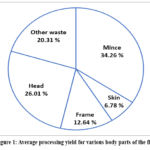 |
Figure 1: Average processing yield for various body parts of the fish |
Proximate analysis of fish crackers
The proximate analysis of fish crackers, as shown in Table 2, indicated that the incorporation of seaweed flakes (SF) and seaweed extract (SE) into the fish cracker formulation influenced the proximate composition of the final dried product. Seaweed incorporation in different forms did not markedly affect moisture or lipid content of the crackers. Moisture ranged from 9.04±0.15% to 9.73±0.05%, while fat ranged from 5.17±0.31% to 5.26±0.30% in the crackers. The low moisture content in all treatments suggests good drying quality and may contribute to better shelf stability.
The protein content of the crackers showed a significant (p<0.05) different due to inclusion of seaweed in two different forms. The SF sample recorded the highest protein content (27.07 ± 0.86%) followed by the control sample (26.28 ± 1.18%). while the SE sample showed the lowest protein value (24.71 ± 0.73%). The results suggest that incorporating seaweed in SF form contributed to an increase in the protein content of the crackers. The reduced protein content in SE may be due to dilution of protein through extraction process.
The carbohydrate content significantly increases from 52.97 ± 2.78% (control), to 55.16 ± 1.64% (SE). All treatments had significantly different ash contents (p<0.05), showing a clear influence of seaweed form on mineral composition. The SF sample had the highest ash content, 6.02 ± 0.28%, followed by the control, 5.97 ± 0.42%, while SE had the lowest value, 5.11 ± 0.22%. Treatment also strongly affected insoluble fibre. The SF sample showed the highest insoluble fiber content, 1.04 ± 0.12%, which was significantly higher than both control and SE samples. This result suggests that seaweed in SF form might bring changes in texture or crispness of the fish crackers.
Overall, the SF sample showed simultaneous improvement in protein, ash, and insoluble fiber. Higher ash and fiber contents in SF are consistent with the known mineral and polysaccharide rich nature of seaweed. In contrast, the SE sample showed the highest carbohydrate content but lower protein and ash contents. This indicates a compositional trade-off, where reduction in protein and mineral fractions may have increased the calculated carbohydrate percentage.
Table 2: The approximate makeup of various fish crackers
| Sample | Moisture
(%) |
Protein
(%) |
Fat
(%) |
Carbohydrate
(%) |
Ash
(%) |
Insoluble Fiber
(%) |
| C | 9.27±0.10a | 26.28±1.18a | 5.21±0.59a | 52.97±2.78a | 5.97±0.42b | 0.35±0.26a |
| SF | 9.04±0.15a | 27.07±0.86b | 5.17±0.31a | 53.04±1.74ab | 6.02±0.28c | 1.04±0.12b |
| SE | 9.73±0.05a | 24.71±0.73a | 5.26±0.30a | 55.16±1.64b | 5.11±0.22a | 0.38±0.12a |
values bearing different superscript letters (a-b) within the same column differ significantly among the crackers p<0.05),
C: Control, SF: seaweed flakes, SE: seaweed extract
Amino acid profiling of fish crackers
The amino acid composition of the fish crackers supplemented with seaweed flakes (SF) and seaweed extract (SE) is presented in Table 3. The data indicate that the incorporation of seaweed influenced several amino acid contents in the fish crackers. Aspartic acid, glutamic acid, serine, glycine, arginine, alanine, valine, isoleucine, lysine, and proline were generally higher in the SF and SE treatments compared to the control (C). Among these, SF exhibited significantly higher levels of aspartic acid, glutamic acid, arginine, alanine, valine, isoleucine, and proline. Meanwhile, SE showed significantly higher glycine and lysine contents than the control.
No significant differences (p>0.05) were observed in histidine, threonine, tyrosine, cystine, and phenylalanine among the treatments. Methionine content in the SE treatment was significantly lower compared to the control and SF samples. Interestingly, leucine content was significantly reduced in the SF treatment, whereas the SE sample showed a comparable value to the control.
Overall, the total amino acid content was slightly higher in the SF (22.04±1.99) and SE (21.82±2.69) treatments compared to the control sample (20.94±2.52), indicating that the addition of seaweed ingredients contributed positively to the amino acid profile of the fish crackers.
Table 3: Amino acid profiling of fish crackers with different forms of seaweeds (g/100g).
|
Amino Acid |
C | SF | SE | |
| Aspartic acid | 2.16±0.21a | 2.43±0.14c |
2.27±0.17ab |
|
|
Glutamic acid |
3.77±0.21a | 4.17±0.17b | 3.90±0.13a | |
| Serine | 0.77±0.01a | 0.88±0.02b |
0.90±0.01b |
|
|
Histidine |
0.65±0.07a | 0.59±0.03a | 0.66±0.01a | |
| Glycine | 1.23±0.18a | 1.25±0.05a |
1.36±0.23b |
|
|
Threonine |
0.93±0.12a | 1.10±0.09a | 0.97±0.08a | |
| Arginine | 1.32±0.16a | 1.47±0.26b |
1.38±0.29a |
|
|
Alanine |
1.53±0.31a | 1.72±0.27b | 1.55±0.36a | |
| Tyrosine | 0.60±0.13a | 0.67±0.11a |
0.63±0.19a |
|
|
Cystine |
0.04±0.002a | 0.05±0.004a | 0.05±0.002a | |
| Valine | 1.09±0.27a | 1.26±0.15b |
1.11±0.31a |
|
|
Methionine |
0.55±0.11b | 0.54±0.07b | 0.45±0.08a | |
| Phenylalanine | 0.93±0.07a | 1.02±0.06ab |
0.96±0.14a |
|
|
Isoleucine |
1.10±0.12a | 1.21±0.08b | 1.12±0.15a | |
| Leucine | 1.75±0.16a | 1.02±0.12b |
1.82±0.27a |
|
|
Lysine |
1.71±0.32a | 1.76±0.24b | 1.80±0.18b | |
| Proline | 0.83±0.07a | 0.90±0.13b |
0.89±0.09b |
|
| Total | 20.94±2.52 | 22.04±1.99 | 21.82±2.69 | |
values bearing different superscript letters (a-b) within the same column differ significantly among the crackers p<0.05),
C: Control, SF: seaweed flakes, SE: seaweed extract
Mineral content of fish crackers
Table 4 shows the mineral profile of the fish crackers. The mineral content of the fish crackers was significantly influenced by the incorporation of seaweed flakes (SF) and extract (SE). Both macro and micro-mineral concentrations showed noticeable variations among the treatments, with SF generally contributing to higher mineral enrichment. The incorporation of seaweed flakes significantly enhanced the mineral content (mg/Kg) of fish crackers, particularly in terms of calcium (3086± 60.17), magnesium (7760±30.59), potassium (6980±110.9), iron (314.1 ± 7.29). In addition to macro minerals, micronutrient content in the fish crackers is also enriched. The micro minerals like boron (20.21± 0.76) and zinc (19.59 ±0.09) were also increased in SF. While SE crackers offered moderate enrichment of mineral like Mg (3799 ± 21.16), Na (30280 ±170.40), Fe (197.5± 4.06), Cu (4.41 ± 0.16), B (8.12 ± 0.81) as compare to control crackers. There are no detectable heavy metals in SE fish crackers, making it a safer option to be used for mineral fortification.
Table 4: Minerals profiling of fish crackers with different forms of seaweeds (mg/Kg)
| Minerals | C | SF | SE |
| Macro-minerals | |||
| Ca | 1342.93±17.65b | 3086± 60.17c | 1074 ± 5.58a |
| Mg | 3542±9.691a | 7760±30.59c | 3799 ± 21.16b |
| Na | 28840±52.92a | 29080 ±251.6b | 30280 ±170.40c |
| K | 4854±36.71a | 6980±110.9b | 4852±27.57a |
| Fe | 188.9 ±4.157a | 314.1 ± 7.29b | 197.5± 4.06a |
| P | 3595±16.45b | 4485± 15.43c | 3389 ± 8.52a |
| Micro-minerals | |||
| Cu | 3.35±5.32a | 4.73 ± 0.13b | 4.41 ± 0.16b |
| Mn | 40.83±2.21b | 43.62 ± 0.84b | 27.81 ± 0.28a |
| Se | 0.60±.01a | 0.89 ± 0.04b | 0.86 ± 0.05b |
| Zn | 14.83±0.10a | 19.59 ±0.09b | 14.81 ±0.06a |
| B | 3.903 ±0.22a | 20.21± 0.76b | 8.12 ± 0.81a |
| Co | 0.04 ± 0.01a | 0.10 ± 0.004b | ND |
| Ni | 0.27± 0.01a | 0.38 ± 0.03b | 0.29 ± 0.02a |
| Heavy metals | |||
| As | ND | 0.134 ± 0.004 | ND |
| Cr | 0.639 ±0.07 | ND | ND |
| Pb | ND | ND | ND |
| Hg | ND | ND | ND |
| Cd | ND | 0.148± 0.005 | ND |
values bearing different superscript letters (a-b) within the same column differ significantly among the crackers p<0.05),
C: Control, SF: seaweed flakes, SE: seaweed extract
Anti-oxidant properties of the fish crackers
Total phenol content, ferrous ion chelating activity, and reducing power were used to assess the fish crackers’ antioxidant qualities. Table 5 provides a summary of the findings. The total phenolic content increased considerably (p < 0.05) when seaweed and its extracts were added.
The control sample (C) exhibited the lowest phenolic content at 0.87 ± 0.03 mg GAE/g, whereas the SF and SE samples showed significantly higher values of 2.07 ± 0.05 mg GAE/g and 3.53 ± 0.06 mg GAE/g, respectively. The ferrous chelation activity is 25.62 % for the control, which increased significantly in the SF (39.11 %) and SE (48.65 %) samples. The control fish cracker shows the lowest reducing power (0.29 mg AAE/g), while the SF and SE samples noted 0.49 mg AAE/g and 1.60 mg AAE/g, respectively.
Table 5: Antioxidants capacity of fish crackers with different forms of seaweeds
| Sample | Total phenol content (mg GAE/ g) | Ferrous chelation activity (%) | Reducing power (mg AAE/g) |
| C | 0.87± 0.03a | 25.62±0.83a | 0.29±0.03a |
| SF | 2.07± 0.05b | 39.11±0.22b | 0.49±0.02b |
| SE | 3.53± 0.06c | 48.65±0.31c | 1.60±0.08c |
values bearing different superscript letters (a-b) within the same column differ significantly among the crackers p<0.05),
C: Control, SF: seaweed flakes, SE: seaweed extract
Shelf-life evaluation of the fish crackers
The effects of different forms of seaweed supplementation in fish crackers on the pH, TBARS and The samples’ TPC was tracked over 60 days as they were kept at room temperature (Table 6). There was a significant difference in pH values from 0th day to 60th day (6.31 ±0.02- 6.63 ±0.05 for control, 6.12 ±0.04- 6.28 ±0.07 for SF, and 6.40 ±0.01- 6.20 ±0.03 for SE samples). One of the most popular techniques for determining lipid oxidation in fish products is the TBARS assay. TBARS values increased over time in all samples, but the rate of oxidation varied significantly. The control showed a sharp increase from 0.30 mg MDA/kg at day 0 to 0.82 mg MDA/kg at day 60, indicating considerable oxidative degradation. Samples with seaweeds supplementation exhibited significantly lower TBARS throughout storage. The SF sample rose from 0.26 to 0.67, while the SE sample showed the least oxidation, increasing from 0.19 to 0.54, showing an average reduction of 2.2% in the seaweed fortified samples compared to the control one. After 60 days of storage, microbial growth, expressed as log cfu/g, was still within the acceptable range. The TPC of control sample rose from 2.17 to 3.54 log cfu/g on 60th day of storage. In comparison, the SF and SE samples showed slightly lower counts of 3.47 and 3.19 log cfu/g respectively on 60th day of storage.
Table 6: Effect of storage on pH, TBARS values, and microbial load of fish crackers
| Parameters | Samples | 0th Day | 30th Day | 60th Day |
| pH | C | 6.31±0.02b | 6.42±0.04b | 6.63±0.05c |
| SF | 6.12±0.04a | 6.09±0.04a | 6.28±0.07b | |
| SE | 6.40±0.01c | 6.16±0.03a | 6.20±0.03c | |
| TBARS (mg MDA/kg) | C | 0.30±0.00b | 0.45±0.00c | 0.82±0.00c |
| SF | 0.26±0.01b | 0.32±0.01b | 0.67±0.07b | |
| SE | 0.19±0.00a | 0.25±0.00a | 0.54±0.02a | |
| TPC (log 10 cfu/g) | C | 2.17 | 2.32 | 3.54 |
| SF | 2.26 | 2.43 | 3.47 | |
| SE | 2.24 | 2.34 | 3.19 |
values bearing different superscript letters (a-b) within the same column differ significantly among the crackers p<0.05),
C: Control, SF: seaweed flakes, SE: seaweed extract
Sensory evaluation of fried fish crackers
All the fried fish crackers are acceptable by the panelists scoring above 7 (like moderatley) in all the sensory attributes (Fig 2 a, b, c). On the 0th day fried fish crackers incorporated with SE displayed significantly higher sensory profile score in term of texture, taste and overall acceptability (p < 0.05). Panel members noted that the SE sample possessed a pleasant and characteristic aroma, a crispier texture, and a balanced savory taste compared to the control and SF crackers. However, the SF fish crackers showed slightly lower score than control and SE in terms of texture, appearance and colour suggesting that the seaweed flakes altered the product’s mouthfeel and colour. Till the 60th day of ambient temperature storage, all the crackers were acceptable though slight decrease in hedonic score of the sensory attributes was noted.
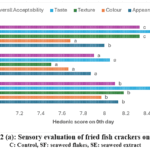 |
Figure 2(a): Sensory evaluation of fried fish crackers on 0th day. C: Control, SF: seaweed flakes, SE: seaweed extract |
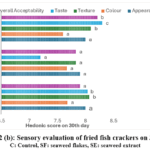 |
Figure 2(b): Sensory evaluation of fried fish crackers on 30th day. C: Control, SF: seaweed flakes, SE: seaweed extract |
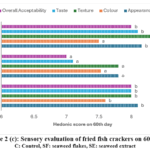 |
Figure 2(c): Sensory evaluation of fried fish crackers on 60th day. C: Control, SF: seaweed flakes, SE: seaweed extract. |
Discussion
Processing yield of tilapia (Oreochromis mossambicus)
Tilapia mince is regarded as an ideal raw material for value-added fish products development as it has white meat, good protein content, and no pronounced odour.21 In the present study, the mince yield obtained from tilapia (Oreochromis mossambicus) was 34.26%, which is comparable to values previously reported for the same species. Earlier studies documented mince yields ranging from 33.57% to 34.96%, indicating consistency in flesh recovery from tilapia under similar processing conditions.21-23 The yield of fish mince is influenced by several intrinsic and extrinsic factors. Intrinsic factors include fish size, age, physiological condition, body composition, and seasonal variation, all of which can affect muscle mass and fillet recovery. Extrinsic factors such as handling practices, storage conditions before processing, and the method of deboning or mincing also play important roles.24 In fish processing a substantial proportion of the fish biomass remains as processing by-products, including scales, skin, viscera, head, and skeletal frame. The head constituted the largest co-product fraction of tilapia (26.01%) followed by the frame (12.64%) and skin (6.78%). Other processing wastes, including scales, viscera, fins, and trimmings, collectively contributed 20.31% of the total biomass. Traditionally, these components were considered waste and discarded, creating environmental concerns and economic losses. However, recent advances in fish by-product utilization have demonstrated that these processing discards can be repurposed for the production of high-value products such as collagen, gelatin, and protein hydrolysates.25-26 These products have growing applications in the food, pharmaceutical, biomedical, and cosmetic industries owing to their functional and bioactive properties. Therefore, the detailed information on processing yield and distribution of body parts generated in the present study may provide valuable baseline data for industries interested in by-product recovery and secondary product development from tilapia processing waste. Such information may also assist in evaluating the economic feasibility and sustainability of tilapia-based value-added product manufacturing.
Proximate composition of fish crackers
The moisture level of the prepared fish crackers ranged from 9.04±0.15% to 9.73±0.05%. All samples displayed moisture levels below 10%, which is considered desirable for dry food products as it helps inhibit microbial growth and enhances storage stability.27 The SF sample exhibited the highest protein content (27.07 ± 0.86%), ash content (6.02 ± 0.28%), and insoluble fiber content (1.04 ± 0.12%) among all samples. This may be due to the fact that seaweeds in flakes form could retain the amino acids, minerals and fiber when incorporated into food products. In contrast, the SE sample showed the highest carbohydrate content (55.16 ± 1.64%) but lower protein (24.71 ± 0.73%) and ash contents (5.11 ± 0.22%). Cookies formulated with 5% tilapia fish protein concentrate and Portieria hornemanii seaweed exhibited improved protein, carbohydrate, dietary fiber, and mineral contents.10 The reduction of ash in SE suggest that whole seaweed retains more structural fiber compared to extracts, because the latter are more water-soluble and refined.
Amino acid profiling of fish crackers
The total amino acid content showed a modest increase in the SF (22.04 ± 1.99) and SE (21.82 ± 2.69) treatments relative to the control sample (20.94 ± 2.52). The elevated amino acid concentration observed in the SF treatment may be associated with its greater protein retention capacity, as reflected by the higher protein content reported in Table 1. Similar findings have been reported by Murugaiyan and Sivakumar28, who demonstrated that the same seaweed species possesses a substantial proportion of essential amino acids, highlighting its potential as a valuable nutritional ingredient. Similarly, the incorporation of seaweed powder has been shown to improve the amino acid profile of various meat products, thereby enhancing their nutritional quality. Sea-spaghetti-enriched meat emulsion samples exhibited higher levels of aspartic acid and glutamic acid compared with the control.29 Seaweed proteins are rich in lysine, an essential amino acid that is rarely found in plant-based proteins. Therefore, the utilization of seaweed protein in food products which have limited lysine can be beneficial on health perspective. The reduction in amino acids contain in SE sample may be due to ineffective release of protein from cell wall during extraction process used in this study. Seaweed’s intricate cell wall architecture make it challenging to extract protein from them. Studies by Celente et al30 stated that conventional methods for seaweed protein extraction have limitations, including low extraction yields. Furthermore, the effectiveness of extraction methods is dependent on process variables (time, temperature, pH and solvent ratio) as well as species-dependent owing to the diverse cell wall compositions among different seaweed species.31
Mineral content of fish crackers
The significantly higher concentrations of both macro and micro minerals observed in the seaweed treated samples in contrast to the control can be ascribed to the inherently rich mineral content of seaweeds. Higher levels of calcium, magnesium, potassium, and iron were found in SF sample. The potassium content observed in the seaweed-treated crackers is nutritionally significant, as potassium is essential for cellular electrical conductivity, nerve signaling, muscle function, and brain activity. Similar findings were reported by Kumar et al32, who demonstrated that Sargassum wightii collected from the Gulf of Mannar, India, contains substantial amounts of essential minerals, highlighting its potential as a natural ingredient for mineral fortification of food products. Although the seaweed extract (SE) treatment resulted in lower mineral concentrations than the seaweed flakes treatment, it still significantly improved the mineral profile compared to the control. The moderate increases in magnesium, sodium, iron, copper, and boron suggest that mineral compounds were successfully transferred into the extract during processing. However, some minerals may have been partially lost or remained in the residual biomass during extraction, resulting in lower concentrations than those observed in the SF treatment. Boron is important in bone growth and formation. Zinc is crucial in various physiological processes of the human body and it has also shown positive outcomes in the prevention and treatment of various diseases, including cancer.33 However, addition of seaweeds also introduced trace levels of heavy metals such as arsenic and cadmium, though the levels were below the permissible level of 0.5 mg/kg as prescribed by Commission Regulation (EC) No 1881/2006.34 Seaweeds minerals are important for the development of nutraceuticals and functional food ingredients.
Anti-oxidant properties of the fish crackers
The SF and SE fish crackers exhibited Total phenol content of 2.07 ± 0.05 mg GAE/g and 3.53 ± 0.06 mg GAE/g, respectively, which were significantly higher than those of the control sample. Similar observations have been reported in previous studies, which identified Sargassum wightii as a rich source of polyphenols, including phlorotannins and other bioactive phenolic constituents.35 Therefore, the incorporation of Sargassum wightii, particularly in extract form, improves the antioxidant potential of fish crackers. The enhanced phenolic content was reflected in the improved ferrous ion chelating activity of the seaweed-incorporated crackers. Ferrous chelation activity increased significantly from 25.62% in the control to 39.11% and 48.65% in the SF and SE treatments, respectively. Metal chelation is a critical antioxidant mechanism, as it inhibits metal-catalyzed oxidation processes.36 The higher chelating ability in the SE sample suggests a greater potential to neutralize pro-oxidant metal ions, consistent with its higher phenolic content. Therefore, the greater chelating activity of the seaweed-treated samples indicates a higher capacity to inhibit oxidative deterioration and improve product stability. Similarly, the reducing power of the fish crackers increased significantly following seaweed incorporation. The control sample exhibited the lowest reducing power (0.29 mg AAE/g), while the SF and SE treatments recorded values of 0.49 mg AAE/g and 1.60 mg AAE/g, respectively.
This increase in reducing power, particularly in SE, can be attributed to the existence of flavonoids, phenolic chemicals, and other antioxidants in Sargassum wightii, which are more bioavailable in the extract form. The enhancement in antioxidant properties in SF and SE samples can be attributed to the occurrence of a wide range of bioactive compounds in seaweeds, particularly fucoidan and other polyphenols, which are known for their antioxidant activity.37 Our previous work reported the presence of fucoidan in the range of 10.59 to 14.61 g/100 g of brown seaweed, Sargassum wightii.5 Similar to present work, incorporation of green seaweeds, Ulva lactuca and Ulva fasciata were found to improve the antioxidant properties of the cereal crackers.38
Shelf-life evaluation of the fish crackers
Based on the pH, TBARS, and TPC results, all fish cracker samples remained stable and acceptable for consumption for up to 60 days of storage at room temperature. The incorporation of Sargassum wightii, particularly in extract form, further enhanced the oxidative and microbiological stability of the products during storage. In the control and SF samples, the slight increase in pH may result from the generation of basic nitrogenous compounds (e.g., ammonia and amines) due to microbial or enzymatic activity. Conversely, the decrease in pH in SE could be connected to the presence of phenolic compounds and organic acids in Sargassum wightii extract, which can inhibit microbial growth and buffer the system, thereby stabilizing or slightly lowering the pH during storage.39 The International Commission for Microbiological Specifications for Food (ICMSF) states that the permissible limit of total plate count in food should be below 107 cfu/g and at or more than 7 log cfu/g are considered as not acceptable in the case of quality and safety parameters.40
Sensory evaluation of fried fish crackers
Incorporation of seaweeds in flakes forms have influence sensory properties and affects its texture and colour. The addition of seaweed flakes imparts a chewy texture to the product. The findings are in consistent with those of Raiyan et al.41 who reported that seaweed powder-fortified crackers developed a slightly darker appearance and distinct umami flavor compared with the control. One interesting observation from the study is the presence of a trade-off between nutritional enhancement and sensory acceptability in seaweed flakes crackers. Incorporation of seaweed flakes significantly improved the nutritional profile of the product by increasing amino acids and mineral content. However, seaweed flakes inclusion is associated with a decline in sensory acceptability, particularly in terms of texture and flavour. This may be attributed to the distinct seaweed taste, bitterness and fibrous which can be less familiar or less appealing to sensory panelist. Strategies such as flavor masking, or processing modifications to enhance acceptability may be an option to enhanced seaweed flakes acceptability in snacks products. On the other hand, SE incorporation substantially improved the overall sensory quality and consumer appeal of the product.
Conclusion
The study demonstrated two things. First, tilapia mince’s potential as a raw material for developing nutritious fish crackers creating a new avenue for application of low-cost tilapia fish. Secondly, the positive aspects of including seaweed in different forms in food product. Fish crackers with seaweed extract exhibited superior antioxidant activity and higher score in key sensory attributes such as texture, and taste compared to those with seaweed flakes. On the other hand, the seaweed flakes improve the nutritional quality of the crackers with limited acceptability in sensory attributes. Therefore, these results demonstrate how crucial it is to choose the right form of seaweed, as it plays a critical role in optimizing both the nutritional and sensory quality, while incorporating into snack products. Sensory evaluation study has limited only to the semi trained sensory panel of the institute. Therefore, future study may undertake on consumer acceptability study on a larger scale to better understand the product´s liking and disliking.
Overall, the study is about utilizing low-cost fish tilapia and seaweed for preparation of nutritious and functional snack product, fish crackers. The findings show that using Sargassum wightii extract improves antioxidant properties, sensory acceptability, and storage quality of tilapia fish crackers. Given the growing demand for healthier snack options, fish and seaweed composite snacks offer promising opportunities for commercial acceptance and product innovation in the global snack industry.
Acknowledgement
The authors would like to thank Dr. N.P. Sahu, Director, ICAR-Central Institute of Fisheries Education, for providing facilities to conduct the experiment. Dr. R.K. Nandi, Assistant Professor, Dept. of Chemistry, Jadavpur University, is acknowledged for helping in the analysis.
Funding Sources
The author(s) received no financial support for the research, authorship, and/or publication of this article.
Conflict of Interest
The author(s) do not have any conflict of interest.
Data Availability Statement
This statement does not apply to this article.
Ethics Statement
This research did not involve human participants, animal subjects, or any material that requires ethical approval.
Informed Consent Statement
This study did not involve human participants, and therefore, informed consent was not required.
Clinical Trial Registration
This research does not involve any clinical trials.
Permission to Reproduce Material from Other Sources
Not Applicable.
Author Contributions
- Praseed Sarkar: Conducting experiment, data analysis, manuscript drafting
- Mandakini Devi Hanjabam: Conceptualization, methodology, data interpretation, supervision
- Layana Porayil: Conceptulization, data analysis
- Suman Manna: Sample and data analysis
- Leesa Priyadarsani: Sample analysis and data analysis
- A.Martin Xavier: Sample analysis, Manuscript review
- Elavarasan Krishnamoorthy: Sample analysis, Manuscript review
- Binaya Bhusan Nayak: Supervision and Manuscript review
- Tapas Kumar Ghoshal: Supervision and Manuscript review
References
- Nisizawa K. Seaweeds Kaiso: Bountiful Harvest from the Seas-Sustenance for Health and Well-Being by Preventing Common Lifestyle Diseases. Japan Seaweed Association; 2002:59-68.
- Cadar E, Popescu A, Dragan AML, et al. Bioactive compounds of marine algae and their potential health and nutraceutical applications: a review. Mar Drugs. 2025;23(4):152. doi:3390/md23040152
CrossRef - Marinho-Soriano E, Fonseca PC, Carneiro MAA, et al. Seasonal variation in the chemical composition of two tropical seaweeds. Bioresour Technol. 2006;97(18):2402-2406. doi:1016/j.biortech.2005.10.014
CrossRef - Sahoo D, Nivedita D. Seaweeds of the Indian Coast. New Delhi: APH Publishing Corporation; 2001.
- Hanjabam MD, Kumar A, Tejpal CS, et al. Isolation of crude fucoidan from Sargassum wightii using conventional and ultrasonication extraction methods. Bioact Carbohydr Diet Fibre. 2019; 20:100200. doi:1016/j.bcdf.2019.100200
CrossRef - Abdi G, Karande VC, Mohammed A, et al. Pharmacological potential of Sargassum of west coast of Maharashtra Kunkeshwar, India. Front Mar Sci. 2022; 9:1011218. doi:10.3389/fmars.2022.1011218
CrossRef - Roohinejad S, Koubaa M, Barba FJ, et al. Application of seaweeds to develop new food products with enhanced shelf-life, quality and health benefits. Food Res Int. 2017;99:1066-1083. doi:1016/j.foodres.2016.08.016
CrossRef - Kumar A, Hanjabam MD, Kishore P, et al. Exploitation of seaweed functionality for the development of food products. Food Bioprocess Technol. 2023;16(9):1873-1903. doi:1007/s11947-023-03023-2
CrossRef - Hanjabam MD, Zynudheen AA, Ninan G, et al. Seaweed as an ingredient for nutritional improvement of fish jerky. J Food Process Preserv. 2016;41(2):e12845. doi:1111/jfpp.12845
CrossRef - Sivaraman L, Deshmukhe G, Xavier KAM, et al. Effect of incorporation of seaweed (Portieria hornemanii) and tilapia fish protein concentrate on the nutritional, physical, and sensory attributes of cookies. Int J Food Sci Technol. 2023;58(8):4415-4424. doi:1111/ijfs.16549
CrossRef - Kumar A, Krishnamoorthy E, Devi HM, et al. Influence of sea grapes (Caulerpa racemosa) supplementation on physical, functional, and antioxidant properties of semi-sweet biscuits. J Appl Phycol. 2018;30(2):1393-1403. doi:1007/s10811-017-1310-4
CrossRef - Kamble PA, Gore SB, Relekar SS, et al. Development of fish cracker from Indian major carp Labeo catla. Bhartiya Krishi Anusandhan Patrika. 2023;38(2):167-171. doi:18805/BKAP617
CrossRef - Arumugam M, Jayaraman S, Sridhar A, et al. Recent advances in tilapia production for sustainable developments in Indian aquaculture and its economic benefits. 2023;8(4):176. doi:10.3390/fishes8040176
CrossRef - Singh AK. Emerging issues and sustainability of booming tilapia production in India. Int J Zool Invest. 2019;5(2):43-51. doi:33745/ijzi.2019.v05i02.005
CrossRef - Official Methods of Analysis. 16th ed. Washington, DC: Association of Official Analytical Chemists; 2005.
- Ishida Y, Fujita T, Asai K. New detection and separation method for amino acids by high performance liquid chromatography. J Chromatogr.1981;204:143–148. doi:1016/S0021-9673(00)81650-7
CrossRef - Razali AN, Amin AM, Sarbon NM. Antioxidant activity and functional properties of fractionated cobia skin gelatin hydrolysate at different molecular weights. Int Food Res J. 2015;22(2):651.
- Elavarasan K, Shamasundar BA. Angiotensin-I-converting enzyme inhibitory activity and antioxidant properties of cryptides derived from natural actomyosin of Catla catla using papain. J Food Qual. 2018;2018:9354829. doi:1155/2018/9354829
CrossRef - Tarladgis BG, Watts BM, Younathan MT, et al. A distillation method for the quantitative determination of malonaldehyde in rancid foods. J Am Oil Chem Soc. 1960;37(1):44-48. doi:1007/BF02630824
CrossRef - Bacteriological Analytical Manual Chapter 3: Aerobic Plate Count. Washington, DC: Food and Drug Administration; 2004.
CrossRef - Ninan G, Bindu J, Joseph J. Frozen storage studies of value-added mince-based products from tilapia (Oreochromis mossambicus, Peters 1852). J Food Process Preserv. 2010; 34:255-271. doi:1111/j.1745-4549.2009.00379.x
CrossRef - Ribeiro IS, Shirahigue LD, Ferraz de Arruda Sucasas L, et al. Shelf life and quality study of minced tilapia with Nori and Hijiki seaweeds as natural additives. Sci World J. 2014;2014(1):485287. doi:1155/2014/485287
CrossRef - Biscalchin-Grÿschek SF, Oetterer M, Gallo CR. Characterization and frozen storage stability of minced Nile tilapia (Oreochromis niloticus) and red tilapia (Oreochromis). J Aquat Food Prod Technol. 2003;12(3):57-69. doi:10.1300/J030v12n03_06
CrossRef - Daita, HA., Amihan Jr, RS., Redoble, JL. Effects of post-mortem chilling duration on recovery yield and sensory characteristics of manually deboned cage-cultured milkfish (Chanos chanos) butterfly fillets using a modified technique. Aquac Aquar Conserv Legis, 2025; 18(4), 1881-1898.
- Elavarasan K, Shamasundar BA. Antioxidant properties of papain-mediated protein hydrolysates from freshwater carps (Catla catla, Labeo rohita, Cirrhinus mrigala) and its application on inhibition of lipid oxidation in oil sardine mince during ice storage. J Food Sci Technol. 2022;59(2):636-645. doi:1007/s13197-021-05053-0
CrossRef - Hwang SB, Park HJ, Lee BH. Collagen hydrolysate from the scales of Mozambique tilapia improves skin and hair health by alleviating oxidative stress and promoting extracellular matrix factors. Mar Drugs. 2023;21(9):475. doi:3390/md21090475
CrossRef - Zambrano MV, Dutta B, Mercer DG, et al. Assessment of moisture content measurement methods of dried food products in small-scale operations in developing countries: a review. Trends Food Sci Technol. 2019;88:484-496. doi:1016/j.tifs.2019.04.006
CrossRef - Murugaiyan K, Sivakumar K. Seasonal variation in elemental composition of Stoechospermum marginatum and Sargassum wightii in relation to seawater chemistry. Colloids Surf B Biointerfaces. 2008;64(1):140-144. doi:1016/j.colsurfb.2007.12.019
CrossRef - López-López I, Bastida S, Ruiz-Capillas C, et al. Composition and antioxidant capacity of low-salt meat emulsion model systems containing edible seaweeds. Meat Sci. 2009;83(3):492-498. doi:1016/j.meatsci.2009.06.031
CrossRef - Celente de Souza G, Sui Y, Acharya Seaweed as an alternative protein source: Prospective protein extraction technologies. Innov Food Sci Emerg Technol. 2023;86:103374. doi:10.1016/j.ifset.2023.103374
CrossRef - Sushri SB, Elavarasan K, Safeena MP, et al. Extraction of proteins from six seaweeds of the southeast coast of India: proximate composition and effect of process variables on protein solubilisation. Indian J Fish. 2024;71(2):122-129.
CrossRef - Kumar Y, Tarafdar A, Kumar D, et al. Evaluation of chemical, functional, spectral, and thermal characteristics of Sargassum wightii and Ulva rigida from the Indian coast. J Food Qual. 2021;2021(1):9133464. doi:1155/2021/9133464
CrossRef - Kiouri DP, Tsoupra E, Peana M, et al. Multifunctional role of zinc in human health: an update. EXCLI J. 2023;22:809. doi:10.17179/excli2023-6335
- Mielcarek K, Nowakowski P, Puscion-Jakubik A, et al. Arsenic, cadmium, lead, mercury content and health risk assessment of consuming freshwater fish with elements of chemometric analysis. Food Chem. 2022; 379:132167. doi:10.1016/j.foodchem.2022.132167
CrossRef - Selvaraj B, Ganapathy K. Exploration of Sargassum wightii: Extraction, phytochemical analysis, and antioxidant potential of polyphenols. 2024;16(7):e63706. doi:10.7759/cureus.63706
CrossRef - Gulcin İ, Alwasel SH. Metal ions, metal chelators and metal chelating assay as antioxidant method. 2022;10(1):132. doi:10.3390/pr10010132
CrossRef - Peñalver R, Lorenzo JM, Ros G, et al. Seaweeds as a functional ingredient for a healthy diet. Mar Drugs. 2020;18(6):301. doi:3390/md18060301
CrossRef - Egodavitharana DI, Bambaranda BVAS, Mudannayake DC. Phytochemical composition of two green seaweeds (Ulva lactuca and Ulva fasciata) and their utilization as a functional ingredient in crackers. J Aquat Food Prod Technol. 2023;32(2):158-174. doi: 1080/10498850.2023.2174394
CrossRef - Kim SK, Wijesekara I. Development and biological activities of marine-derived bioactive peptides: A review. J Funct Foods. 2010;2(1):1-9. doi:1016/j.jff.2010.01.003
CrossRef - ICMSF, International Commission on Microbiological Specifications for Foods. Microorganisms in Foods 2: Sampling for Microbiological Analysis: Principles and Specific Applications.2nd University of Toronto Press, Toronto; 1986.
- Raiyan A, Hossain MM, Zahid MA, et al. Physicochemical characterization and microbial quality evaluation of Gracilaria tenuistipitata-added crackers. Appl Food Res. 2024;4(2):100623. doi:1016/j.afres.2024.100623
CrossRef
Abbreviations
AAE- Ascorbic Acid Equivalent
ANOVA – Analysis of variance
AOAC – Association of Official Analytical Chemists
As- Arsenic
B- Boron
BAM- Bacteriological Analytical Manual
C – Control
℃ – Degree Celsius
Ca- Calcium
Cd- Cadmium
cfu- Colony Forming Unit
Cm – Centimeter
Co-Cobalt
Cr- Chromium
Cu-Cupper
DMRT – Duncan’s Multiple Range Test
DW- Dry Matter
Fe- Iron
g- Gram
GAE- Gallic Acid Equivalent
HCl – Hydrochloric Acid
HDPE – High Density Poly Ethylene
HPLC: High Performance Liquid Chromatography
Hg- Mercury
Hp- Horse Power
ICMSF- International Commission for Microbiological Specifications for Food
ICP-OES- Inductively Coupled Plasma Optical Emission Spectroscopy
ISO – International Organization for Standardization
K- Potassium
Kg-kilogram
MDA- Malondialdehyde
Mg- Magnesium
mg -Milligram
ml- Mililitre
mm – milimeter
mM- Millimolar
M-Molar
Mn- Manganese
N- Normal
Na- Sodium
NaOH – Sodium Hydroxide
Ni- Nickel
nm- Nanometer
OD- Optical density
Pb- Lead
P-Phosphorus
Rpm – Rotation per minute
SE- Seaweed Extract
Se- Selenium
SF- Seaweed Flakes
TBA – Thiobarbituric acid
TBARS- Thiobarbituric acid reactive substances
TCA- trichloroacetic acid
TPC- Total Plate Count
USA- United State of America
Zn- Zinc
%- Percentage
mm- Micrometer

Accepted on: 03 Jun 2026
Second Review by: Poojitha Pushparaj
Final Approval by: Dr. Angelo Maria Giuffre





Web of Science Coverage
Emerging Sources Citation Index (ESCI)
2024 Journal Impact Factor: 1.1
Scopus Journal Metrics
CiteScore 2025: 2.6
CiteScore Details
Sustainable Nutrition: Food Systems, Nutrient Retention, and Public Health Impact

This journal is a member of, and subscribes to the principles of, the Committee on Publication Ethics (COPE)