
Characterization of Modified Starch from Dioscorea Rotundata and its Effect on the Rheological, Physicochemical, Microbiological, and Sensory Properties of an Oat-Type Milk Drink
 , Piedad Montero Castillo1and Jhon Rodriguez Meza2
 1Food Engineering Program, University of Cartagena, Cartagena, Colombia
2Area of Formative Research, Universidad del Sinú Elías Bechara Zainum, Cartagena, Colombia
Corresponding Author Email: ycastrom1@unicartagena.edu.co
DOI : http://dx.doi.org/10.12944/CRNFSJ.14.1.23
Download this article as:

Physical modifications to starch are considered a sustainable and safe way to enhance its properties, as they do not require chemical reagents and enable the optimization of food quality. This study evaluated the incorporation of hydrothermally modified (HMT) yam starch (Dioscorea rotundata) into an oat-type milk drink, analyzing its rheological, physicochemical, microbiological, and sensory characteristics. The experiment employed a completely randomized design; three concentrations of modified starch were evaluated (1.5%, 2.5%, and 3.0%), followed by a formulation with xanthan gum and a control without any additions. The starch was extracted and modified using HMT; the amylose and amylopectin contents were determined in both the native and modified starches. The physicochemical, microstructural, and technofunctional properties were also characterized. The results showed that HMT reduced the amylose content from 38.71 ± 1.70% to 26.80 ± 4.62%, increasing the amylopectin content. Microstructural analysis revealed more compact granules. Technofunctionally, HMT starch exhibited greater swelling power at 95 °C (9.13 ± 0.28%) and greater water retention capacity (2.33 ± 0.02%). The beverages exhibited pseudoplastic, non-Newtonian rheological behavior. T3 showed the highest yield point, while T4 had higher apparent viscosity and lower flow index, revealing differences between formulations. All treatments complied with the microbiological limits established by NTC 5246. However, some variation in values was observed. Additionally, syneresis was 58.89% ± 0.14% at 21 days in T3, decreasing from 79.12% ± 1.37% in the control. A panel of 50 evaluators performed a sensory evaluation of color, odor, taste, and overall appearance, there were differences between the treatments. T3 stood out in terms of smell and color, while T5 stood out in terms of taste and overall appearance.
KEYWORDS:Dioscorea Rotundata; (HMT) Hydrothermal Treatment; Milk Drink; Modified Starch; Oats; Properties
Introduction
Dairy beverages are a versatile food product category characterized by a combination of dairy and non-dairy ingredients. Adding plant-based ingredients to milk and milk products improves their amino acid profile, resulting in a more balanced composition than traditional dairy proteins.1 Dairy beverages can be prepared in various ways using powdered, liquid, whole, or skimmed milk as a base, which facilitates the production of a wide variety of forms. Additionally, they undergo pasteurization, an essential treatment that ensures safety.2
In recent years, dairy beverage formulations have become more diverse, incorporating various plant-based ingredients to meet consumer demand. This trend responds to the growing interest in products that combine flavor and functionality.3 Oats are a widely used raw material for producing these beverages because they are recognized for their high concentrations of soluble fiber and nutrients, making them an excellent source of functional ingredients, such as β-glucans.4 Oat-based beverages can be combined with a variety of compounds and have gained relevance.5 However, oat-based milk drinks can present technological challenges. For example, syneresis, the separation of liquid in gelled products, can negatively affect final stability.6
To address these challenges, researchers have investigated a range of stabilizing agents, with starch emerging as a notable candidate. Yam starch (Dioscorea rotundata), in particular, stands out due to its high starch content comprising 70-80% of the tuber and its remarkable ability to absorb and retain water. Yam starch has shown promise due to its high-water absorption and retention capacity, which can mitigate syneresis in certain dairy products.7 Additionally, it is highly resistant to sterilization, making it a potential material for products requiring long cooking times.8 However, there are significant limitations to its use in its native state, such as a tendency toward retrogradation and thermal instability, as well as a propensity for syneresis under certain processing conditions, which restricts its functionality in more demanding applications.9
To overcome the limitations associated with native starches and significantly broaden their applications, various physical modification techniques have been developed. Among these, annealing and ultrasonic treatment are notable for enhancing structural stability. Nonetheless, annealing requires a high moisture content and extended processing time, whereas ultrasonic treatment may cause damage to starch granules. Hydrothermal treatment (HMT), on the other hand, offers a more sustainable alternative. It reorganizes the internal structure of starch at low humidity without destroying the granule. This process modifies the native structure of starch, imparting beneficial properties such as enhanced physicochemical characteristics, improved thermal stability, increased molecular mobility at elevated temperatures, greater paste stability, and altered granular swelling .10 Therefore, the use of high-quality starch is essential for the success of the beverage. Technological advancements that enhance intrinsic structural properties—including consistency, gelation, dispersion, and stability—expand its range of applications beyond that of conventional starch sources.11 These improvements also support the diversification of yam utilization, a crop extensively cultivated in Colombia’s Caribbean region.
Wild yam starch has been reported to be a natural source of complex carbohydrates that provide sustained energy, are low in fat, and can contribute to the profile of products to which they are added.12 In this study, we will analyze the effect of different concentrations of modified starch on the product’s functional and physicochemical properties. This approach addresses a technical problem in the food industry and seeks to promote the use of wild yams as a strategic agricultural resource on Colombia’s Caribbean coast. The goal of this research is to evaluate the effect of incorporating HMT-modified yam starch (Dioscorea rotundata) into oat-based milk drink formulations. This evaluation will be conducted by analyzing the products’ rheological, physicochemical, microbiological, and sensory properties as a potential technological alternative for stabilization.
Materials and Methods
Raw Material
Spiny yam tubers (Dioscorea rotundata Poir.) were utilized, and their botanical identification was achieved through morphological comparison with the official taxonomic description of the species. The raw material is sourced from the municipality of San Cayetano, Bolívar (Colombia), and is selected at commercial maturity, exhibiting no indications of physical or microbiological deterioration and meeting the stringent quality parameters necessary for starch extraction and subsequent modification. Furthermore, locally procured commercial ingredients were utilized in the formulation of various oat-based milk beverages: ground oats (Quaker), whole milk powder (Olimpica), xanthan gum (Tecnas), salt (Refisal), sugar (Riopaila), cinnamon, and cloves (La Constancia).
Starch Extraction
The starch was obtained according to Shaheryar et al.13 with modifications. The yams were meticulously washed with drinking water and a soft-bristled brush to remove soil and external contaminants. Subsequently, the peeling process was initiated, ensuring the complete removal of the skin. Subsequent to this, the plants were washed in an attempt to remove the mucilage, and then they were chopped into smaller pieces for the purpose of facilitating the blending process. The mixture was subsequently blended at a ratio of 1:8 (by weight) yams: drinking water for a duration of 30 s. The resultant blended product was filtered through a muslin cloth with a porosity of 80 μm to facilitate the separation of the starch, and it was allowed to settle for a period of 12-15 h. Thereafter, the upper layer of water was meticulously removed, and the resulting sediment was dried in a hot air oven at a temperature of 50°C for a period of 3 h. Subsequently, the dry starch was sieved with an N60 mesh, vacuum-packed and stored in a cool, dry place.
Starch Is Physically Modified
The methodology proposed by Yu et al.14 was used to modify the star yam starch, with some variations. The diamond yam starch was subjected to a process of hydration, during which distilled water was added until the moisture content reached a range of 15–20%. The homogenized mixture was subsequently transferred to hermetically sealed containers and refrigerated for 24 h at a temperature of 5°C. Thereafter, it was heated in an oven at 80°C for 6 h. Subsequently, the starch was dispersed on trays and subjected to an oven temperature of 50°C until it attained a moisture content of approximately 10%.
Determination Of The Amylose And Amylopectin Content Of Starches
The procedure adapted from Galicia et al.15 was followed to determine the amylose and amylopectin content. Twenty-five milligrams of starch were accurately weighed and transferred into a 25 ml volumetric flask. Next, 0.25 ml of 95% ethanol and 2.25 ml of 1 M NaOH were added, and the mixture was allowed to stand for 20 to 24 h to facilitate complete dissolution. The solution was then made up to volume with distilled water. 3.5 ml of the solution were transferred to a 10-ml volumetric flask, followed by the addition of 1 milliliter of 1 M acetic acid and 0.2 ml of 2% Lugol’s solution. Finally, the volume was made up with distilled water, and the absorbance was measured at 620 nm using a spectrophotometer (Thermo Scientific Genesys 10S UV-Vis, USA). The instrument used glass cuvettes with an optical path length of 1 cm and a useful volume of 2 ml. Distilled water was used as a blank to obtain the amylose and amylopectin values in the sample.
Bromatological Characterization of Native And Modified Starches
Bromatological analyses were performed using methods standardized by the Association of Official Analytical Chemists (AOAC).16 The following were determined: protein content (AOAC 920.87), fat content (AOAC 920.85), moisture content (AOAC 925.10), ash content (AOAC 923.03), fiber content (AOAC 985.29), and carbohydrate content. Carbohydrate content was estimated by difference using the formula in equation 1. All analyses were carried out at the University of Cartagena’s facilities.

Physicochemical Characterization of Native and Modified Starch
A physical-chemical analysis was performed to determine the pH and acidity. The official AOAC 981.12 method was used to determine the pH. This method involves weighing 5 g of each wild yam starch sample, dissolving it in 25 mL of distilled water, mixing it for five min, letting it stand, and measuring it with a pH meter. The AOAC 942.15 method was used to determine acidity. This method uses a 0.1 N NaOH solution and 0.5% phenolphthalein as an indicator. The volume consumed until a faint pink color change is achieved is recorded.
Microstructural Properties of Native and Modified Starch
We determined the microstructural properties using scanning electron microscopy (SEM) analysis with an FEI QUANTA 200 ESEM. A small amount of the sample was sprinkled onto self-adhesive pads mounted on aluminum bases. These bases were coated with a 25-nm-thick layer of gold by cathodic sputtering for five min using a sputter coating unit. High-resolution images were captured to analyze the samples, which facilitated accurate observation of the surface morphology and structural changes of the starch.17 Additionally, the observed granules were measured using the ImageJ program.
Techno-Functional Properties of Native and Modified Starch
We evaluated the techno-functional properties based on water retention capacity (WRC), swelling power (SP), and water solubility index (WSI). WRC was determined according to the method of Kayode et al.18 0.5 g of starch was incubated with 10 mL of water at 60 °C for 30 min, then centrifuged at 3,000 rpm. WRC (g/g) was calculated from the difference in sediment weight. Similarly, SP and WSI were determined according to Meaño et al19 First, 0.2 g of the sample was heated in 10 mL of water at 55, 65, 75, 85, and 95 °C for 30 min with stirring. Then, the sample was centrifuged at 5,000 rpm. The SP was obtained from the weight of the sediment, and the WSI was obtained from the dry residue of the supernatant after evaporation.
Preparation of The Oat-Type Milk Drink
The beverage was prepared following the methodology proposed by Pastrana et al.20 and Pérez et al.7 with some modifications. Three treatments (T1, T2, T3) were formulated, incorporating modified starch at 1.5%, 2.5%, and 3.0%, respectively. In addition, another treatment (T4) was carried out with a commercial stabilizer, without the addition of starch, and a final treatment (T5) was used as a control. First, the water, ground oats, and powdered milk were homogenized together using a food processor. Then, different ratios of modified starch and other ingredients were added to the mixture, which was then transferred to a stainless steel pot and cooked until it reached 85°C. The mixture was stirred constantly to prevent the ingredients from sticking to the sides of the container. Once cooked, the hot mixture was carefully transferred to a container and subjected to thermal shock to rapidly cool it to 20 and 25°C. Finally, the mixture was packaged in airtight containers and stored in a refrigerator at 4°C.
Table 1: Formulation of Oat-Based Milk Beverages with Modified Yam Starch (HMT) And Xanthan Gum
|
Inputs (%p/v) |
T1 | T2 | T3 | T4 |
T5 |
|
Water |
81.29 | 79.79 | 79.29 | 81.99 | 82.29 |
| Powdered milk | 11 | 11 | 11 | 11 |
11 |
|
Ground oats |
3.0 | 3.0 | 3.0 | 3.0 | 3.0 |
| Sugar | 3.5 | 3.5 | 3.5 | 3.5 |
3.5 |
|
Salt |
0.01 | 0.01 | 0.01 | 0.01 | 0.01 |
| Cloves and cinnamon | 0.20 | 0.20 | 0.20 | 0.20 |
0.20 |
| Modified starch | 1.0 | 2.5 | 3.0 | 0 | 0 |
| Xanthan gum | 0 | 0 | 0 | 0.3 | 0 |
Values are expressed as % (p/v) for each formulation. All ingredients correspond to the final composition of the beverage.
Rheological Properties
The rheological behavior of the oatmeal-type beverage samples was evaluated using a rheometer (Discovery HR10, TA Instruments Inc., Newcastle, DE, USA) with a smooth parallel plate geometry of 40 mm in diameter and a gap of 1000 µm, equipped with temperature control via a Peltier plate. The measurements were performed at 25 °C, following the methodology proposed by Kwok et al.21 Before analysis, the samples were manually homogenized and allowed to stand for five min to remove air bubbles and ensure thermal stabilization. Subsequently, an approximate volume of 1.5 mL was deposited between the plates, and a flow sweep was performed in the shear rate range of 1 to 100 s⁻¹, with the rheological response being recorded.
Physicochemical Properties of the Milk Drink
The parameters of acidity, pH, soluble solids, syneresis, fat content, and milk protein were determined using standardized methods. Acidity was measured by titration with 0.1 N NaOH, using phenolphthalein as an indicator, and expressed in grams of lactic acid per 100 mL of sample, according to AOAC 947.05. The pH was evaluated using a pH meter that had been calibrated according to AOAC 945.27 guidelines, and soluble solids were analyzed with a refractometer at 20 °C. Syneresis was estimated according to Pérez et al.,7 over 21 days with monitoring every 7 days, starting on day 0. This was accomplished by employing the centrifuge method, where 10 g of the sample was subjected to a centrifugal force of 5,000 revolutions per minute (rpm) for a duration of 20 min at a temperature of 10°C. Subsequently, the upper layer, known as the “supernatant,” was carefully removed, its weight was determined, and its percentage (w/w) of syneresis was calculated using the following equation:

The fat content was determined according to standards such as NTC 4722 and ISO 1211 for products with a fat content of ≤6%. Milk protein was analyzed according to NTC 5025, which outlines specific procedures for evaluating this parameter in dairy products.
Microbiological Properties of The Milk Drink
To characterize the different milk drink formulations microbiologically, Colombian regulations were followed as outlined in NTC 5246-2004. This includes milk drinks with oats among dairy products. The following tests were performed based on this classification: mesophilic microorganism count (NTC 4519), total and fecal coliform count (NTC 4458), Salmonella detection (NTC 4574), psychrotrophic aerobic count (ISO 17410), Bacillus cereus count (NTC 4679), and mold and yeast count (NTC 5698).
Evaluation Of The Sensory Characteristics Of Milk Drinks
The sensory evaluation of the different treatments of the oat-type milk drink was carried out by means of an acceptability test, using a 5-point hedonic scale. This methodology was described by Vásquez,.22 A total of fifty untrained panelists, aged 17 to 50 and regular consumers of similar dairy beverages, participated in the sensory evaluation. The assessed attributes included color, aroma, taste, and overall appearance. Panelists rated each attribute using a 5-point hedonic scale (1 = dislike very much, 2 = dislike, 3 = neither like nor dislike, 4 = like, 5 = like very much). To reduce potential bias from panelist subjectivity, samples were labeled with random three-digit codes and presented in random order. The tests were conducted under controlled conditions, employing blind evaluation procedures to ensure that panelists were unaware of the specific treatments, thereby preventing any influence on their perceptions.
Experimental Design And Statistical Analysis
The study was designed with a completely randomized design (CRD) and a single-factor structure in two experimental phases. In the first phase, the effect of starch type (native or HMT-modified) on physicochemical, microstructural, and technofunctional properties was evaluated. Starch type was the independent variable and the properties were the dependent variables. The second phase involved formulating five oat milk drink treatments: T1 (1.5% starch), T2 (2.5%), T3 (3.0%), T4 (xanthan gum), and T5 (the control group with no additives). The independent variable was the beverage formulation, and the dependent variables were the beverages’ rheological, bromatological, physicochemical, microbiological, and sensory characteristics.
Results
Analysis Of Amylose And Amylopectin In Native And HMT-Modified Yam Starch
The results indicate a significant decrease in the amylose content of starch subjected to hydrothermal treatment (HMT) (26.80 ± 1.62%) compared to native starch (38.71 ± 1.70%). Consequently, the proportion of amylopectin in modified starch increased (73.20 ± 1.02%) compared to native starch (61.29 ± 1.80%).
Physicochemical And Bromatological Analyses Of Native And HMT-Modified Yam Starch
Table 2: Physicochemical And Bromatological Analyses Of HMT And Native Yam Starch
| Tests | HMT | Native |
| Protein (%) | 0.58 ± 0.05 a | 0.50 ± 0,10 a |
| Lipids (%) | 0.18 ± 0.05 b | 0.26 ± 0,04 a |
| Carbohydrates (%) | 88.38 ± 0.48 b | 92.22 ± 0,22 a |
| Fiber (%) | 1.01 ± 1.10 a | 1.06 ± 0,57 a |
| Moisture (%) | 9.78 ± 0.51 a | 6.84 ± 0,25 b |
| Ash (%) | 0.07 ± 0.01 b | 0.12 ± 0,02 a |
| pH | 5.88 ± 0.21 a | 6.14 ± 0,09 a |
| Acidity | 0.02 ± 0.08 a | 0.01 ± 0,05 a |
The values correspond to the mean ± standard deviation (n = 3). Different letters in the same row indicate significant differences (p < 0.05).
Microstructural Analysis of Native and HMT-Modified Yam Starch
Figure 1 Illustrates The Morphology of Spiny Yam Starch Granules in Their Modified and Native States. The Microparticles Can Be Seen at Different Magnifications.
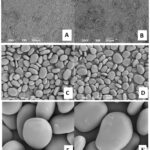 |
Figure 1: Microstructural Properties of HMT-Modified and Native Yam Starch at X60 (A-B), X500 (C-D), And X2000 (E-F) Magnifications, Respectively. |
Analysis of Techno-Functional Properties in Native and HMT-Modified Yam Starch
Figure 2 shows the swelling power (SP) and solubility index (SI) of native and HMT-modified yam starch at different temperatures.
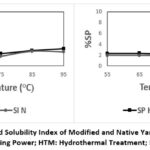 |
Figure 2: Swelling Power and Solubility Index of Modified and Native Yam Starch. SI: Solubility Index; SP: Swelling Power; HTM: Hydrothermal Treatment; N: Native. |
Water Retention Capacity Analysis
The water retention capacity (WRC) was evaluated. The results reveal significant differences between the samples, as the modified starch had a higher value (2.33% ± 0,02 a) than the native starch (1.94% ± 0,11 b), indicating a greater capacity to interact with water.
Analysis of The Beverage’s Rheological Properties
Figure 3 and the rheological parameters show the results of the rheological analysis of the oat beverage to which modified yam starch was added.
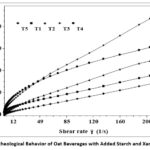 |
Figure 3: Rheological Behavior of Oat Beverages with Added Starch and Xanthan Gum |
Rheological Parameters
The results obtained for the rheological parameters showed that T1 had a yield threshold (Pa) of 0.41 ± 0.06, an index (n) of 0.99 ± 0.05, a viscosity (Pa*s) of 0.12 ± 0.04, and an R2 of 0.99. T2 showed a yield threshold (Pa) of 0.74 ± 0.07, an index (n) of 0.65 ± 0.02, a viscosity (Pa*s) of 0.39 ± 0.02, and an R2 of 0.99. T3 recorded the highest yield threshold (Pa) (1.14 ± 0.11), with an index (n) of 0.73 ± 0.03, a viscosity (Pa*s) The results show an R2 of 0.99, an R2 of 0.99, and an R2 of 0,99, respectively. The first result had a yield threshold (Pa) of 0.44 ± 0.07, the lowest index (n) of 0.46 ± 0.02, the highest viscosity (Pa*s) of 1.60 ± 0.08, and an R2 of 0.99. The second result had a yield threshold (Pa) of 0.57 ± 0.30, an index (n) of 0.97 ± 0.07, a viscosity (Pa*s) of 0.06 ± 0.02, and an R2 of 0.99. The third result had a yield threshold (Pa) of 0.59 ± 0.12, an R2 of 0.99, and an R2 of 0.99.
Analysis of The Physicochemical Properties of the Beverage
Table 3: Physicochemical Analysis of Different Oat-Based Milk Drink Formulations
| Test | T1 | T2 | T3 | T4 | T5 |
| Protein (%) | 2.67 ± 0.01 a | 2.58 ± 0.44 a | 2.55 ± 0.09 a | 2.56 ± 0.06 a | 2.59 ± 0.02 a |
| Lipids (%) | 0.55 ± 0.01 a | 0.55 ± 0.05 a | 0.55 ± 0.10 a | 0.55 ± 0.02 a | 0.55 ± 0.01 a |
| °Brix | 20.00 ± 1.00 a | 19.33 ± 0.58 a | 19.33 ± 1.52 a | 13.33 ± 0.58 b | 15.33 ± 1.53 b |
| pH | 6.40 ± 0.08 b | 6.57 ± 0.03 ab | 6.57 ± 0.05ab | 6.64 ± 0.04 a | 6.71 ± 0.14 a |
| Acidity | 1.62 ± 0.03 a | 1.62 ± 0.01 a | 1.60 ± 0.11 a | 0.88 ± 0.58 b | 0.91 ± 1.53 b |
T1: oat-based milk drink with 1.5% HMT starch; T2: 2.5% HMT; T3: 3.0% HMT; T4: Xanthan gum added; T5: Control. Values correspond to the mean ± standard deviation (n = 3). Different letters in the same row indicate significant differences between the formulations (T1–T5) for each analyzed property (p < 0.05).
Analysis of The Syneresis Properties Of Milk Drinks
Figure 4 shows the syneresis behavior in the different formulations of oat-type milk drinks during 21 days of storage.
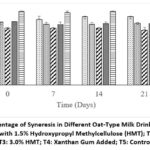 |
Figure 4: Percentage of Syneresis in Different Oat-Type Milk Drink Formulations T1: Oat Milk with 1.5% Hydroxypropyl Methylcellulose (HMT); T2: 2.5% HMT; T3: 3.0% HMT; T4: Xanthan Gum Added; T5: Control. |
Microbiological Properties Analysis
The results found that there was an absence of total coliforms, E. coli, and Salmonella (25 g) in all five treatments. T1 presented mesophilic microorganisms of 2.0 × 10² UFC/ml and psychrotrophic aerobes of 1.2 × 10² UFC/ml, with molds and yeasts <10 UFC/ml and Bacillus cereus <10 UFC/ml. T2 showed mesophilic microorganisms of 1.8 × 10² UFC/ml and psychrotrophic aerobes of 1.1 × 10² UFC/ml, with molds and yeasts <10 UFC/ml and Bacillus cereus <10 UFC/ml. T3 registered the lowest mesophilic count (1.5 × 10² UFC/ml) and psychrotrophic aerobes (1.0 × 10² UFC/ml), with molds and yeasts <10 UFC/ml and Bacillus cereus <10 UFC/ml. T4 presented mesophilic microorganisms of 1.7 × 10² UFC/ml and psychrotrophic aerobes of 1.3 × 10² UFC/ml, with molds and yeasts <10 UFC/ml and Bacillus cereus <10 UFC/ml. Finally, T5 showed the highest mesophilic microorganisms (2.5 × 10² UFC/ml) and psychrotrophic aerobes (1.8 × 10² UFC/ml), molds and yeasts of 2.0 × 10¹ UFC/ml, and Bacillus cereus <10 UFC/ml; all values complied with the limits established by NTC 5246 (2004).
Sensory Properties Analysis
Table 4: Sensory Analysis of Different Formulations of Oat-Based Milk Drinks
| Sample | T1 | T2 | T3 | T4 | T5 |
| Color | 3.66 ± 0.89 a | 3.42 ± 0.90 a | 3.72 ± 0.81 a | 3.60 ± 1.03 a | 3.48 ± 0.89 a |
| Smell | 3.52 ± 0.93b | 3.44 ± 0.70 b | 4.02 ± 0.77 a | 3.40 ± 0.76 b | 3.54 ± 0.70 b |
| Taste | 3.66 ± 0.92 b | 3.62 ± 1.05 ab | 3.96 ± 1.03 ab | 3.74 ± 1.01 ab | 4.20 ± 0.92 a |
| Overall appearance | 3.82 ± 0.94 a | 3.58 ± 0.95 a | 3.86 ± 0.80 a | 3.72 ± 0.88 a | 3.94 ± 0.93 a |
T1: oat-based milk drink with 1.5% HMT starch; T2: 2.5% HMT; T3: 3.0% HMT; T4: Xanthan gum added; T5: Control. Different letters in the same row indicate significant differences between the formulations (T1–T5) for each analyzed property (p < 0.05).
Discussion
Analysis of Amylose and Amylopectin in Native and HMT-Modified Yam Starch
These variations in the amylose-to-amylopectin ratio align with the findings of Nadir et al.,23 who demonstrated that potato starch treated with HMT experienced a reduction in amylose content accompanied by an increase in the amylopectin fraction. Similar results have been observed in starches from other botanical sources. Sun et al.24 noted a decrease in amylose after applying this treatment. It is essential to note that the observed differences in the proportion of amylose and amylopectin may be attributed to the intrinsic factors of the yam variety and the agronomic conditions of cultivation. Additionally, it has been documented that amylose content correlates directly with variability in starch’s functional properties, with improvements in swelling power and solubility observed upon a decrease in this property.25
On the other hand, Kumar et al.26 discovered that HMT treatment prompts the restructuring of amylose and amylopectin chains. This restructuring results in a crystalline structural fusion that is favored by hydration, granule swelling, and the reduction of amylose through the leaching of available chains. Amylose reorganizes itself in this process, and amylopectin undergoes thermal debranching to form linear chains. Thus, decreasing the number of chains in starch through heat treatment could improve its properties since lower amylose content results in greater swelling power, water solubility, and gel strength.27
This effect is further enhanced by the reduction in amylose content. Fewer linear fractions are available for retrogradation and syneresis. As a result, the stability of the matrix is improved.28 From a technological point of view, it is also widely used as a stabiliser and gelling agent due to its high solubility and water absorption capacity. It is also used to reduce agglomeration. This property improves the consistency and stability of food products.29
Physicochemical and Bromatological Analyses of Native and HMT-Modified Yam Starch
The results showed significant differences in the content of lipid, carbohydrate, moisture, and ash content were observed. Regarding lipid content, the modified starch showed a decrease (0.18%) compared to the native starch (0.26%). According to Salgado et al.,12 these values are considered adequate, as a content of less than 0.5% favors the improvement of starch’s functional properties, such as swelling power and solubility. Similarly, Pacheco and Techeira.30 suggest that this reduction may be due to denaturation processes or the release of lipids bound to the starch matrix.
Regarding carbohydrate content, the reduction in modified starch was greater than that in native starch 88.38% and 92.22%, respectively. This behavior contrasts with that reported by Okereke et al.,31 who observed a slight increase in carbohydrate content in modified white yam starch only, while the values decreased in bitter yam and sweet potato starches compared to native starches.
These differences may be explained by the botanical source of the starch, growing conditions, initial moisture content, and specific parameters applied during hydrothermal treatment. Other studies, however, agree with the results obtained in this study. For example, Putra et al.32 reported a significant decrease in cassava starch total content after HMT, resulting in a reduction in carbohydrate content. This behavior has also been observed in sago starch, where HMT decreased the carbohydrate content.33
In terms of moisture content, the value for native starch was 6.84%, which is similar to the result reported by Godfrey et al.34 for Dioscorea rotundata native starches (7.04%). Conversely, HMT-treated starch exhibited a notable increase, consistent with the treatment adjustment aimed at achieving levels approaching 10%. This increase affects the functional properties of starch, such as gelatinization and swelling capacity. Similar results were reported by Zhou et al.35 who observed an improvement in the moisture content of HMT-treated starches. Generally, HMT is classified as a physical modification performed under low humidity conditions, typically between 10% and 30%.36
Conversely, there were significant differences in ash content between samples, which was higher in native starch (0.17%) than in modified starch (0.07%). This reduction after heat treatment coincides with the findings reported by Pacheco and Techeira.30 who indicated that modifying yam starch leads to a decrease in ash content, possibly due to the loss of soluble minerals during the process.37 It is also worth mentioning that the protein and fiber percentages were unaffected by the process, consistent with the study by Dong et al.,38 where no significant changes in these properties were observed.
Regarding pH and acidity, the results showed no significant differences between the samples. The pH values ranged from 5.88 for native starch to 6.14 for modified starch. These results align with Salgado et al.12 research on yam starch and fall within the optimal range for starches. This parameter is relevant because values close to neutrality favor the chemical and microbiological stability of starch, reducing the risk of deterioration and maintaining its functional properties in industrial applications.39 Regarding titratable acidity, modified starch showed a slight increase (0.02), compared to native starch (0.01). However, both values remain low, suggesting the starch has good chemical stability. These results are similar to those reported by Horianski,40 for tuber starches.
Microstructural Analysis of Native and HMT-Modified Yam Starch
In the results of the micrograph of the granules, it was observed that in Figure 1A, corresponding to the HMT sample, shows a surface composed of more organized and aggregated granules compared to the native sample in Figure 1B, which has a less aggregated and more amorphous structure. These morphological changes may be due to exposure to moisture during hydrothermal treatment, which is consistent with Bora et al.,41 research on yam starches.
Figure 1C shows that HMT treatment at X500 magnification reveals the conversion of loose granules into compact ones of various sizes ranging from 20.83 to 28.77 µm. These particles are slightly flattened, with smooth surfaces and partial signs of agglomeration.42 Regarding the native starch sample (Figure 1D), under the same magnification conditions, the particle sizes are similar, ranging from 22.98 to 27.21 µm. While the values are similar, there is a slight tendency towards greater dispersion in the native sample. Similar results were reported by Bora et al.,41 who observed HMT granules with more aggregated structures when studying hydrothermally treated starch from D. alata and D. esculenta yams. The dimensions observed in both samples are within the 20-30 µm range described by Agudelo et al.43 for starch granules from other yam varieties. At X2000 magnification, as shown in Figures 1E and 1F for HMT and native starch, respectively, the granules’ similar oval and elongated shapes are more clearly visible, as is the greater agglomeration present in the modified sample. This treatment produces a smoother surface with no fractures or cracks.44
Analysis of Techno-Functional Properties in Native and HMT-Modified Yam Starch
These results indicate that both properties increased progressively with rising temperature in both types of starch, consistent with the expected behavior of starches during gelatinization processes.23 This trend was particularly pronounced at high temperatures (≥75 °C), where the HMT starch showed significant improvements in SP compared to the native starch. Specifically, Figure 2A shows that SI increased moderately with temperature in both samples; however, at 85 °C and 95 °C, HMT starch exhibited slightly higher SP values (2.82% and 3.14%, respectively), compared to native starch (2.70% and 2.98%, respectively). In Figure 2B, however, the SP of the modified starch clearly increased. At 85°C, the SP of HMT starch was 4.14%, which exceeded the SP of native starch (2.97%). This difference was accentuated at 95°C, where the SP were 9.13% and 6.80%, respectively. These results are consistent with those of Kumoro et al.45 who found that the swelling power and water solubility of Dioscorea hispida Dennst. starch increased when HMT was performed for 2–6 h. This confirms that the modified starch has a greater capacity to absorb water and expand at high temperatures.
This trend is consistent with that described by Umar et al.46 who noted that HMT partially breaks down the crystalline structure of amylopectin. This leads to greater water interaction through the exposed chains and facilitates granule swelling. Additionally, the solubility index increases significantly with temperature in this study. Xie et al.47 evaluated the effects of heat treatment on Chinese yam starches and showed that there was a significant increase in swelling power and solubility index, especially at high temperatures. They attributed this increase to the fusion of starch crystals, breaking of internal molecular bonds, release of amylose and amylopectin fragments, and exposure of hydroxyl groups, which promotes greater interaction with water. Furthermore, according to Sigala-Adame.48 swelling power is closely related to amylose content. The lower the amylose content, the higher the SP and IS. This is consistent with the aforementioned results.
Water Retention Capacity Analysis
The results indicate that this increase may be related to modifications in the internal structure of the granule and expansion of amorphous regions.10 Higher WRC is especially useful when avoiding moisture loss during storage, as demonstrated by Lee and Kang,49 who showed that using heat-treated starch significantly reduces whey separation, a direct indicator of water retention. This behaviour agrees with the study by Marta et al.50 They showed that starch subjected to HMT exhibits a higher water absorption capacity. This is due to molecular reorganisation and the exposure of hydroxyl groups, which increases the affinity for water.
Analysis of The Beverage’s Rheological Properties
These results showed that all formulations (T1–T5) exhibited pseudoplastic, non-Newtonian behavior with yield stress, which the Herschel-Bulkley model adequately described. The Herschel-Bulkley model is widely used in the food industry because it accurately represents the overall rheological profile without overestimating or underestimating shear stresses at low or high shear rates.21
The T3 treatment (3% modified yam starch) exhibited the highest apparent viscosity at low shear rates, as well as the highest consistency parameter (k) and the lowest flow index (n < 1). These results indicate a denser internal structure that is resistant to shear and suggest a more developed three-dimensional network.51 T3 also had a significantly higher yield stress value, suggesting greater initial resistance to flow. This is a desirable characteristic in beverages that require stability against sedimentation.52 Treatments T1 (1.5%) and T2 (2.5%) exhibited intermediate behavior, demonstrating a progressive increase in apparent viscosity and rheological parameters with increasing starch concentration.
On the other hand, treatment with 0.3% xanthan gum (T4) exhibited pseudoplastic behavior with yield stress, though its apparent viscosity was lower than that of T3. This result is consistent with reports in other food matrices because, despite being a hydrocolloid with high thickening power, xanthan gum generates networks that are more elastic than viscous, explaining its lower resistance to flow compared to starch-structured systems.21 In milk protein mixtures with oat and pea protein, xanthan gum modulated firmness and adhesiveness while maintaining a texture that was perceived as light and safe for swallowing.53 Treatment T5 (control), without the addition of structuring agents, exhibited behavior closer to that of a Newtonian fluid, with low k values reflecting a liquid matrix without significant rheological stabilization.
These findings are consistent with those reported by Pérez et al.7 who demonstrated that yam starch significantly improves the viscosity and stability of fermented dairy products even at low concentrations. They are also consistent with the studies by Sarmadi et al.54 who found similar behaviors when using high-methoxyl pectins in dairy beverages. The pseudoplastic behavior observed is also consistent with the typical properties of plant-based beverages, such as oat drinks21 and is beneficial from sensory and technological standpoints because it allows for easy pourability during consumption without compromising stability at rest.
Analysis of The Physicochemical Properties of the Beverage
The results showed that in all treatments the milk protein content complied with the minimum value established by NTC 5246 (1.4%) in all treatments, as did the fat content in whole oat milk drinks (1.5%). Regarding °Brix, treatments T1, T2, and T3 exhibited notably higher values (20.00, 19.33, and 19.33 °Brix, respectively) compared to T4 (13.33 °Brix) and T5 (15.33 °Brix). These results are consistent with Barreto’s research,55 which found that oat drinks with starch have °Brix values close to 20.00 due to starch’s ability to increase total soluble solids.
Similarly, significant differences in pH and titratable acidity were observed among the evaluated formulations. Samples T4 and T5 exhibited the highest pH values (6.64 and 6.71, respectively), while T1, T2, and T3 exhibited slightly lower values ranging from 6.40 to 6.57. These results are consistent with the acidity findings, in which T1, T2, and T3 exhibited higher acidity levels (1.60%-1.62%) than T4 (0.88%) and T5 (1.00%). This is consistent with the proportional relationship between pH and acidity.56 These results are similar to those of Pastrana et al.20 who reported similar values, showing that higher pH levels decrease acidity in Sinuan oats. The significant differences in T4 and T5 compared to the other formulations indicate higher pH and therefore lower acidity, which may be due to the absence of modified starch.
Analysis of The Syneresis Properties of Milk Drinks
Treatment T3 demonstrated the lowest syneresis on all days evaluated, reaching a value of 58.89% on the final day. This behavior was significantly more favorable compared to the control treatment T5, which showed the highest levels of syneresis up to 79.28% throughout storage. These findings demonstrate that the incorporation of HMT starch in the evaluated products led to a reduction in syneresis. Syneresis is an undesirable phenomenon in dairy beverages. It is associated with the expulsion of the liquid phase in food matrices. This phenomenon can affect the appearance and acceptability of the product.57 Arab et al.58 also note that this phenomenon occurs due to the contraction and reorganization of the polymer network. This helps release water retained in the matrix, reducing the stability of the system. This is critical for the sensory and technological quality of dairy products. The low syneresis of T3 can be attributed to the modification of the starch, since it has a more stable granular structure and therefore greater interaction with water.36
Similarly, T2 exhibited syneresis similar to T4 (xanthan gum) and lower than T1, suggesting a non-linear, starch-dose-dependent response. At low concentration (T1), the starch network is sparse, so water retention is limited and syneresis is high. As the concentration increases (T2), the matrix becomes more continuous, improving water retention to levels comparable to those of T4 (xanthan). These results align with those of Pérez et al.7 who discovered that adding yam starch to smoothie-type yogurts significantly reduces syneresis by 7-8% over 21 days of storage, compared to a commercial stabilizer. Similarly, Tolfo de Souza.59 Studies have shown that starches modified by HMT treatment can significantly reduce syneresis in dairy products and structured beverages, due to changes in the internal organisation of the granule that limit retrogradation and promote greater matrix stability. In the present study, when comparing treatment T3 with the control (T5), a reduction in syneresis of up to 20.23% was observed by day 21 of storage, whilst compared to the xanthan gum treatment (T4), reductions ranged from 3.7% to 7.2%. These results reinforce the technological value of HMT-modified starch as an effective natural stabiliser. This network limits the mobility of free water and reduces phase separation during storage, which explains the lower syneresis observed in treatments with a higher content of modified starch. It has also been demonstrated that starches modified by HMT treatment can significantly reduce syneresis in dairy products and structured beverages, due to changes in the internal organisation of the granule that limit retrogradation and promote greater matrix stability.⁷ In the present study, when comparing treatment T3 with the control (T5), a reduction in syneresis of up to 20.23% was observed by day 21 of storage, whilst compared to the xanthan gum treatment (T4), reductions ranged from 3.7 to 7.2%. These results reinforce the technological value of HMT-modified starch as an effective natural stabiliser. This network limits the mobility of free water and reduces phase separation during storage, which explains the lower syneresis observed in treatments with a higher content of modified starch.
Microbiological Properties Analysis
All treatments exhibited microbiological results that met or fell below the standards set by the standard, with no evidence of pathogenic microorganisms, thereby confirming the implementation of good manufacturing practices. Treatments containing HMT starch and xanthan gum exhibited reduced mold and yeast counts compared to the control. This finding aligns with the observations reported by Norhayati et al.,60 who noted a decrease in microbial growth in beverages containing xanthan gum due to the increased viscosity, which restricted the access of microorganisms to available sugars. Treatment T3 demonstrated slightly lower counts, indicating an inhibitory effect related to reduced water activity.
Sensory Properties Analysis
Samples T3 and T5 stood out, receiving the highest scores for most attributes, especially smell and taste, where significant differences were observed among the treatments. Sample T5 received the highest scores for taste (4.20 ± 0.926) and overall appearance (3.94 ± 0.935), while T3 performed well for color (3.72 ± 0.809) and smell (4.02 ± 0.769). Studies such as that of Amagua and Chancusig,61 confirm these favorable characteristics, showing that certain starches can enhance sensory perception by improving texture, smell, and taste.
Overall, the panelists accepted this favorably, as all scores were above 3. This aligns with the findings of Imbachí-Narváez et al.57 who indicated that milk drinks enriched with modified starches are stable and have good sensory quality when an adequate balance of structural components is maintained. Generally, no significant differences were perceived in color or overall appearance among the formulations. However, significant differences were observed in odor and taste attributes, with T3 and T1 standing out, respectively. This behavior may be related to the matrix modification caused by the modified starch, which could alter the release of volatile compounds or mask certain sensory notes. However, establishing a direct relationship between these properties is difficult and requires a specific methodology.62
Although the highest starch concentration evaluated (T3, 3.5%) showed the best performance in terms of stability and syneresis reduction, further increases in HMT starch concentration may not necessarily lead to proportional improvements. Higher starch levels can increase viscosity and network density, which may negatively affect flow behavior and sensory acceptability in beverage-type systems.
Conclusion
The results obtained in this study indicate that the incorporation of yam starch modified by humidity-modified treatment (HMT) influenced various technological properties of an oatmeal-type beverage. Significant differences were observed in the modified starch compared to native starch in terms of lipid, carbohydrate, moisture, and ash content, while protein and fiber content did not show significant changes. Microstructural analysis revealed more compact granules and a structural reorganization associated with the HMT treatment, which was reflected in an increase in swelling power, solubility index, and water-holding capacity. From a technological standpoint, the starch-containing formulations exhibited pseudoplastic behavior with yield stress, which may contribute to improving the stability of the system. The treatment with the highest concentration of modified starch (T3) showed the lowest syneresis during storage (58.89 ± 0.14% on day 21) compared to the control. Microbiological analyses indicated that all formulations complied with the limits established by NTC 5246. In the sensory evaluation, T3 exhibited adequate levels of acceptability in attributes such as odor and overall appearance, although the control treatment obtained higher scores in some attributes such as taste and overall acceptance. Overall, these results suggest that HMT-modified yam starch can help improve the stability of oatmeal-type beverages under the evaluated conditions, although further studies are needed to assess its application in other formulations and production scales.
Acknowledgement
The authors would like to thank the Agricultural and Agro-industrial Innovation and Development Research Group (IDAA) at the Universidad de Cartagena for their support in providing equipment and facilities, without which this research would not have been possible.
Funding Sources
This project was funded through the sistema general de regalías de Colombia (BPIN2020000100439).
Conflict of Interest
The authors do not have any conflict of interest.
Data Availability Statement
The manuscript incorporates all datasets produced or examined throughout this research study.
Ethics Statement
This research did not involve human participants, animal subjects, or any material that requires ethical approval.
Informed Consent Statement
This study did not involve human participants, and therefore, informed consent was not required.
Clinical Trial Registration
This research does not involve any clinical trials.
Permission to Reproduce Material from Other Sources
Not applicable.
Author Contributions
- Yurika Castro Mercado: Conceptualization, methodology, data collection, data analysis, writing – original draft, and final approval of the manuscript.
- Piedad Montero Castillo: Supervision, technical guidance, critical review, and final approval of the manuscript.
- Jhon Rodríguez Meza: Conceptualization, data analysis, supervision, critical review, review & editing, and final approval of the manuscript.
References
- Sukhikh SA, Astakhova LA, Golubcova YV, et al. Functional dairy products enriched with plant ingredients. Foods Raw Mater. 2019;7(2):428–438. https://doi.org/10.21603/2308-4057-2019-2-428-438
CrossRef - Rabbani A, Ayyash M, D’Costa CDC, Chen G, Xu Y, Kamal-Eldin A, et al. Effect of heat pasteurization and sterilization on milk safety, composition, sensory properties, and nutritional quality. Foods. 2025;14:1342. https://doi.org/10.3390/foods14081342.
CrossRef - Monteiro Rudke CR, Camelo Silva C, Rudke AR, et al. Trends in dairy products: new ingredients and ultrasound-based processing. Food Bioprocess Technol. 2024;17:811–827. https://doi.org/10.1007/s11947-023-03115
CrossRef - Angelov A, Yaneva Marinova T, Gotcheva V. Oats as a matrix of choice for developing fermented functional beverages. J Food Sci Technol. 2018;55(7):2351–2360. https://doi.org/10.1007/s13197-018-3186-y
CrossRef - Wani SA, Shah TR, Bindu B, et al. Oats as a functional food: a review. Univ J Pharm. 2014;3(1):14–20.
- Parra Huertas RA, Barrera Rojas LJ, Rojas Parada DC. Evaluation of the addition of oats, mango, and stevia to yogurt made from a mixture of semi-skimmed goat’s and cow’s milk. Corpoica Cienc Tecnol Agropecu. 2015;16(2):49–61.
CrossRef - Perez J, Margarita A, Ricardo A, et al. Effect of yam (Dioscorea spp.) starch on the physicochemical, rheological, and sensory properties of yogurt. Heliyon. 2021;7(1):e05987. https://doi.org/10.1016/j.heliyon.2021.e05987
CrossRef - León Tuirán A, Tapia Niño J. Caracterización del almidón de tres tipos de ñame: Dioscorea alata, Dioscorea rotundata y Diamante R22 con fines de agroindustrialización [Internet]. Sincelejo (CO): Corporación Universitaria del Caribe – CECAR; 2017. https://repositorio.cecar.edu.co/items/6035482a-808a-4c68-918d-dc598ac86756
- Pupo Argumedo MA. Enzymatic modification of flours and starches from yams (creole, espino, and diamond) grown in the department of Sucre [undergraduate thesis]. Montería (CO): Universidad de Córdoba; 2020. https://repositorio.unicordoba.edu.co/server/api/ core/ bitstreams/c5094c5e-fa4f-4cbd-8f36-4b851c39c393/content
- Mathobo VM, Silungwe H, Ramashia SE. Effects of heat-moisture treatment on the thermal, functional properties and composition of cereal, legume and tuber starches: a review. J Food Sci Technol. 2020;57(10):3665–3674. https://doi.org/10.1007/s13197-020-04520-4
CrossRef - Díaz Narváez LC, Polanco Ortega H, Carmona Wilches OE, et al. Micropropagation of Chinese yam (Dioscorea rotundata) Poir., cultivar Botón, in a two-phase cultivation system [Internet]. Sincelejo (CO): Corporación Universitaria del Caribe – CECAR; 2019. https://repositorio.cecar.edu.co/entities/publication/ab04950d-aa1b-42de-bde0-af1ae69b689d
- Salgado R, Paternina A, Cohen C, et al. Analysis of the gelatinization curves of native starches of three species of yam: criollo (Dioscorea alata), hawthorn (Dioscorea rotundata) and diamond 22. Inf Tecnol. 2019;30(4):93–102.
CrossRef - Shaheryar M, Afzaal M, Nosheen F, et al. Functional exploration of taro starch (Colocasia esculenta) supplemented yogurt. Food Sci Nutr. 2023;11(6):2697–2707. https://doi.org/10.1002/fsn3.3358
CrossRef - Yu B, Li J, Tao H, et al. Physicochemical properties and in vitro digestibility of hydrothermal treated Chinese yam (Dioscorea opposita Thunb.) starch and flour. Int J Biol Macromol. 2021;176:177–185. https://doi.org/10.1016/j.ijbiomac.2021.02.06
CrossRef - Galicia L, Miranda A, Gutiérrez MG, et al. Laboratorio de calidad nutricional de maíz y análisis de tejido vegetal: protocolos de laboratorio. CIMMYT; 2012. https://repository.cimmyt.org/server/api/core/bitstreams/60c3391f-61ba-45fe-95d1-f6a26252f189/content
- AOAC, Official methods of analysis, Association of official analytical chemist 21st ed. AOAC International, Gaithersburg, MD, USA, 2019.
- Ojo MO, Ariahu CC, Chinma CE. Proximate, functional and pasting properties of cassava starch and edible mushroom (Pleurotus pulmonarius) flour blends. J Food Meas Charact. 2017;11:1580–1588.
- Kayode RMO, Chia CN, Kayode BI, et al. Quality evaluation of chin-chin produced from aerial yam (Dioscorea bulbifera) and wheat flour blends. Food Prod Process Nutr. 2023;5(1):45.
CrossRef - Meaño Correa, N., Ciarfella Pérez, A. T., & Dorta Villegas, A. M., Evaluation of chemical and functional properties of native starch of Congo yam (Dioscorea bulbifera L.) to predict itd possible technological uses. Saber, 2014; 26(2), 182-188.
- Pastrana IY, Durango MA, De Paula DC, et al. Physicochemical, bromatological, and microbiological characterization of indigenous beverages from Córdoba, Colombia. Inf Tecnol. 2015;26(4):79–88.
CrossRef - Kwok E, Yang J, Taheri P, et al. Impact of ultrasound on nutritional recovery and physicochemical properties of oat beverage. LWT Food Sci Technol. 2024;198:116303. https://doi.org/10.1016/j.lwt.2024.116303
CrossRef - Vásquez Arteaga KK. Enrichment of a fermented milk drink (yogurt) with quinoa flour (Chenopodium quinoa) and banana (Musa paradisiaca) [doctoral dissertation]. Universidad Agraria del Ecuador; 2020. Available from: https://cia.uagraria.edu.ec/Archivos/ VASQUEZ%20ARTEAGA%20KEYLA%20KARINA.pdf
- Nadir AS, Helmy IMF, Abdelmaguid NM, et al. Modification of potato starch by some different physical methods and utilization in cookies production. Int J Curr Microbiol Appl Sci. 2015;4(10):556–569.
- Sun Q, Xu Y, Xiong L. Effect of microwave-assisted dry heating with xanthan on normal and waxy corn starches. Int J Biol Macromol. 2014;68:86–91. https://doi.org/10.1016/j.ijbiomac.2014.04.032
CrossRef - Acevedo-Viloria E, Figueroa-Flórez J, Salcedo-Mendoza J, et al. Effect of hydrothermal processing on the native starches of cassava (Manihot esculenta) and yam (Dioscorea alata). Rev Fac Nac Agron Medellin. 2025;78(1):10977–10987. https://doi.org/10.15446/rfnam.v78n1.112802
CrossRef - Kumar SR, Tangsrianugul N, Sriprablom J, et al. Effect of heat-moisture treatment on the physicochemical properties and digestibility of millet flour and starch. Carbohydr Polym. 2023;313:120630. https://doi.org/10.1016/j.carbpol.2023.120630
CrossRef - Torres A, Durán M, Montero P. Evaluation of the functional properties of starch obtained from taro (Colocasia esculenta). J Sci Eng Today. 2013;8(2):29–38.
- Villarroel P, Gómez C, Vera C, et al. Resistant starch: Technological characteristics and physiological benefits. Rev Chil Nutr. 2018;45(4):271–278. https://doi.org/10.4067/S0717-75182018000400271
CrossRef - Dobosz, A., Sikora, M., Krystyjan, M., Tomasik, P., Lach, R., Borczak, B., Berski, W., & Lukasiewicz, M. Short- and long-term retrogradation of potato starches with varying amylose content. Journal of the Science of Food and Agriculture, 2018;98(15), 5744–5751. https://doi.org/10.1002/jsfa.9446
CrossRef - Zhang G, Xuan Y, Lyu F, Ding Y, et al. Microstructural, physicochemical properties and starch digestibility of brown rice flour treated with extrusion and heat moisture. Int J Biol Macromol. 2023;242:124594. https://doi.org/10.1016/j.ijbiomac.2023.124594
CrossRef - Okereke GO, Doshima IB, Kwagh-Hal J. Potentials of yams’ utilizations in food, medicine and allied fields [Internet]. 2023.https://www.researchgate.net/publication/370466942_Potentials_Of_Yams’_Utilizations_In_Food_Medicine_And_Allied_Fields
- Putra LO, Suharti S, Sarwono KA, et al. The effects of heat-moisture treatment on resistant starch levels in cassava and on fermentation, methanogenesis, and microbial populations in ruminants. Vet World. 2023;16(4):811–819. https://doi.org/10.14202/vetworld.2023.811-819
CrossRef - Liestianty D, Rodianawati I, Patimah M. Chemical composition of modified and fortified sago starch (Metroxylon) from the northern Moluccas. Int J Appl Chem. 2016;12:243–249.
- Godfrey EO, Faith O, Esther II. Comparative assessment of the proximate composition, functional properties and amino acid profile of Dioscorea bulbifera, Dioscorea alata and Dioscorea rotundata found in Minna, Niger State. Biol Med Nat Prod Chem. 2023;12(1):177–185.
CrossRef - Zhou S, Hong Y, Gu Z et al. Effect of heat–moisture treatment on in vitro digestibility and physicochemical properties of starch–hydrocolloid complexes. Food Hydrocoll. 2020;108:105736.
CrossRef - Lee, D.-J., Kim, J.-M., & Lim, S.-T., Characterization of resistant waxy maize dextrins prepared by simultaneous debranching and crystallization. Food Hydrocolloids, (2021). 112, 106315. https://doi.org/10.1016/j.foodhyd.2020.106315
CrossRef - Yang L, Wang S, Li S, et al. Effect of heat-moisture treatment on the physicochemical properties and starch digestibility of mix powder (wheat flour–black soybean flour) and corresponding cookies. Gels (Basel). 2022;8(7):429.
CrossRef - Dong J, Huang L, Chen W, et al. Effect of heat-moisture treatments on digestibility and physicochemical property of whole quinoa flour. Foods (Basel). 2021;10(12):3042.
CrossRef - Bravo-Núñez Á, Garzón R, Rosell CM, et al. Evaluation of starch–protein interactions as a function of pH. Foods (Basel). 2019;8(5):155.
CrossRef - Horianski MA. In vitro digestibility and physicochemical properties of cassava starch modified by the combination of hydrothermal and chemical treatments [doctoral dissertation]. Misiones (AR): Universidad Nacional de Misiones; 2019.
- Bora J, Mahnot NK, Makroo HA, et al. Impact of hydrothermal treatments on the functional, thermal, pasting, morphological, and rheological properties of underutilized yam starches. Food Measure. 2023;17:2285-2300. doi:10.1007/s11694-022-01789-1
CrossRef - Liu C, Guo X, Li W, et al. Changes in physicochemical properties and in vitro digestibility of common buckwheat starch via heat–moisture treatment and annealing. Carbohydr Polym. 2015;134:237-244. doi:10.1016/j.carbpol.2015.06.071
CrossRef - Agudelo-Zamudio C, Argoty-Ortegón JE, Torres-Vargas OL, et al. Efecto de las modificaciones con ácido acético e hidróxido de calcio sobre las propiedades funcionales y reológicas del almidón de ñame (Dioscorea esculenta). TecnoLógicas. 2023;26(58):e204. Epub 2024 Mar 5. doi:10.22430/22565337.2802
CrossRef - Kim TJ, Seo KH, Chon JW, et al. Evaluation of the sensory profile of milk analogues containing clove oil: a preliminary study. J Dairy Sci Biotechnol. 2023;41:26-33. doi:10.22424/jdsb.2023.41.1.26
CrossRef - Kumoro AC, Retnowati DS, Ratnawati R, et al. Effect of temperature and reaction time on the swelling power and solubility of Gadung (Dioscorea hispida Dennst) tuber starch during heat moisture treatment process. J Phys Conf Ser. 2019;1295:012062. doi:10.1088/1742-6596/1295/1/012062
CrossRef - Umar M, Hassan M, Rungraeng N. In vitro digestibility and physicochemical analysis of heat-moisture treated finger millet flour and starch. Food Funct. 2025;16(3):456-468. doi:10.1039/d4fb00242c
CrossRef - Xie S, Lei Y, Chen H, et al. Physicochemical properties and structural study of starch–ferulic acid complexes from thermally treated Chinese yam (Dioscorea opposita Thunb.) starch. Foods. 2025;14(10):1761. doi:10.3390/foods14101761
CrossRef - Sigala Adame B. Obtaining pregelatinized potato starch (Solanum tuberosum) using ohmic heating. [Bachelor’s thesis]. Autonomous University of Querétaro; 2019. http://ri-ng.uaq.mx/handle/123456789/1497
- Lee, I. y Kang, T., Heat- and moisture-treated rice starches with different amylose and moisture contents as stabilizers for low-fat yogurt. Food Chemistry. 2024. https://sciencedirect.unicartagenaproxy.elogim.com/science/article/abs/pii/S0308814623023646
CrossRef - Marta H, Cahyana Y, Bintang S, et al. Physicochemical and pasting properties of corn starch as affected by hydrothermal modification by various methods. Int J Food Prop. 2022;25(5):792-812. doi:10.1080/10942912.2022.2064490
CrossRef - Otegbayo BO, Tanimola AR, Ricci J, et al. Thermal Properties and Dynamic Rheological Characterization of Dioscorea Starch Gels. Gels. 2024;10(1):51. doi:10.3390/gels10010051
CrossRef - Jingqi Z, Qin H, Lingxiang Q, et al. Physicochemical and Digestive Properties of Yam Starch/Oat β-Glucan Blends. Sci Technol Food Ind. 2022;43(18):114-121. doi:10.13386/j.issn1002-0306.2022040056
- Shay N, Bhandari B, Prakash S. Synergistic modulation of rheological and sensory properties in plant-dairy protein blends with xanthan gum: Toward dysphagia-targeted beverages. Food Hydrocoll. 2025;163:111087. doi:10.1016/j.foodhyd.2025.111087
CrossRef - Sarmadi B, Nikmaram P, Mortazavian AM, et al. High-methoxyl apple pectin improves rheological properties and storage stability of the flavored probiotic yogurt drinks, compared to pomegranate pectin. Appl Food Biotechnol. 2022;9(2):91-102. https://journals.sbmu.ac.ir/afb/article/view/37565/28522
- Barreto Vásquez E. Evaluation of the rheological, physicochemical, and sensory characteristics of a double-sterilized oat milk beverage. 2022. http://www.dspace.espol.edu.ec/handle/123456789/52452
- Moscol Calderón CA. Development of an embedded IoT system for measuring pH and temperature in dairy products [Bachelor’s thesis]. National University of Frontera; 2022. https://core.ac.uk/download/pdf/553017813.pdf
- Imbachí Narváez W. Effect of modified cassava starch on the physicochemical properties, stability, and acceptability of a fermented milk drink made from sweet whey. LWT. 2024;195:116303. doi:10.1016/j.lwt.2024.116303
CrossRef - Arab M, Yousefi M, Khanniri E, et al. Effect of partial replacement of milk protein concentrate with soy protein isolate on the physicochemical, textural, and sensory properties of probiotic yogurt. J Food Sci Technol. 2022;59(1):241-252. doi:10.1007/s13197-022-05403-6
CrossRef - Tolfo de Souza N, Lemos Lima G, Oliveira-Folador G, et al. Chemical and physical modification of corn starch and application in cupuassu and babassu dairy dessert. J Chem Environ Biol Eng. 2024;10(2):e18452. doi:10.18540/jcecvl10iss2pp18452
CrossRef - Norhayati H, Izzreen I, Tan Hooi P. Effects of pasteurization and different concentrations of xanthan gum on honey beverage. J Food Res. 2019;3(1):55-61. doi:10.26656/fr.2017.3(4).142
CrossRef - Amagua González GS, Chancusig Casa AP. Study of the behavior of an enzyme preparation (α-amylase, β-amylase, and amyloglucosidase) on semi-solid cassava mash (Manihot esculenta Crantz) for the production of a beverage. 2020. Available from: http://repositorio.utc.edu.ec/handle/27000/6693
- Chambers E IV, Koppel K. Application of Sensory and Instrumental Volatile Analyses to Dairy Products. 2023. doi:10.1146/annurev-food-022510-133653
CrossRef
 PlumX:
 Views: 1982
  PDF Downloads:
367
PDF Downloads:
367 
Accepted on: 19 Mar 2026
Second Review by: Irina Chernukha
Final Approval by: Dr. Vikas Kumar





Web of Science Coverage
Emerging Sources Citation Index (ESCI)
2024 Journal Impact Factor: 1.1
Scopus Journal Metrics
CiteScore 2025: 2.6
CiteScore Details
Sustainable Nutrition: Food Systems, Nutrient Retention, and Public Health Impact

This journal is a member of, and subscribes to the principles of, the Committee on Publication Ethics (COPE)