
Synergistic Influence of Thermal Expansion Regimes and Polysaccharide Binder Gradients on the Microstructural Cohesion, Oxidative Stability Indices, and Organoleptic Performance of Puffed Black Rice Nutraceutical Bars
 , Atheisa Riamroi2, Indu1, Punyakishore Maibam3, Thameridus Bolwari Marak4, Ningthoujam Manda Devi5and Palmei Gaibimei6
 1Department of Agricultural Engineering and Post-Harvest Technology, Central Agricultural University, Imphal, India
2Department of Food Technology, Central Agricultural University, Imphal, India
3Department of Community Science, Central Agricultural University Imphal, India
4Department of Agricultural Engineering, Assam University, Silchar, India
5Department of Agricultural Engineering and Technology, Nagaland University, Kohima, India.
6Indian Council of Agricultural Research, Indian Council of Agricultural Research, Gogamukh, India
*Corresponding Author Email: angamraleng@gmail.com
Download this article as:
ABSTRACT:This study aimed to investigate the physico-chemical characteristics, puffing time optimization, sensory quality, and storage stability of a puffed black rice cereal bar (PBRCB) formulated using puffed black rice (Poireiton), roasted sunflower seeds, cinnamon powder, and brown rice syrup (BRS) as a natural binding agent. The effects of puffing time (1.0, 1.5, and 2.0 min) and BRS levels (30, 40, and 50%) on key quality attributes were systematically evaluated. Physico-chemical properties, including hardness and color parameters (L*, a*, and b*), along with sensory attributes and overall acceptability, were analyzed to identify optimal processing conditions. Storage stability of the developed PBRCB was assessed over a period of four months at ambient conditions using aluminium coated laminate (ACL) packaging, comparing hand sealing and vacuum sealing techniques. Changes in moisture content, hardness, peroxide value, free fatty acids (FFA), and color parameters were monitored at regular intervals. Results indicated that puffing time and BRS level significantly influenced hardness and color L* and b* values, with an optimum combination observed at 1.5 min puffing time and 50% BRS level. Storage studies revealed that hardness and FFA content were significantly affected by packaging method and storage duration; however, all values remained within permissible limits throughout the study period. Vacuum-sealed ACL packaging demonstrated superior preservation of product quality compared to hand-sealed samples. Overall, the study establishes the feasibility of developing a nutritionally rich, shelf-stable puffed black rice cereal bar with desirable textural, sensory, and storage characteristics using optimized processing and packaging conditions
KEYWORDS:Black Rice (Poiteiton); Brown Rice Syrup; Hardness; Puffing Time; Storage Studies
Introduction
Cereal bars are multipurpose foods, which are made of cereal grains like oats, rice, wheat, legumes, millets, dehydrated fruits, nuts, seeds, sugar, vegetable oil and syrup. These contain high calories and protein, fibre, and micronutrients. There are different types of cereal bar, including high protein, high fiber, and high energy bars. Cereal bars are manufactured from a mixture of cereals, pulses, millets, and dried fruits and nuts that are compressed in different shapes and sizes.1 Bar can be standardized using different levels of cane sugar, honey, syrup and jaggery. Ready-to-eat snack bars were primarily used by office employees, sports, and students in order to maintain their levels of energy throughout the day. In addition, consumers seek out functional foods that can be quickly made, such as cereal bars, in addition to their nutritional advantages. Cereal bars are made because it is necessary to have a food that combines convenience and nutritional value for its many uses, including as a replacement for or improvement of between-meal snacks, a complement to meals, or simply a means to obtain energy in a healthy way.2 Aside from improving customers’ physical and emotional wellbeing, they are also consumed to avoid diseases linked to poor nutrition. Functional foods are those that fit this description. An excellent chance to raise product quality is provided by functional foods. Vitamins and minerals used to be added to functional food products. Young people now consume more cereal bars than previous generations. Current busy lifestyles have been associated with an increase demand for meals/snacks that are quick sources of nutrition.3 Ready-to-eat (RTE) cereals are prepared grains that can be eaten by people without further processing or cooking.
Black rice, also referred to as prohibited or purple rice, is a variety of the Oryza sativa L. indica plant with the scientific name Zizania aqatica. Other names for black rice include treasured rice, royal rice, heaven rice, and king’s rice. In Manipur, it is referred to as Chak-hao Ambi, where Chak-hao stands for “delicious” and ambi for “black,” referring to wonderful black rice. The majority of the grain is farmed in Southeast Asian nations like China, Indonesia, India, and Thailand.4 These days, it is also farmed in limited quantities in the Southern part of United States. Most often, chak-hao is eaten after being prepared as rice or kheer. Powder, syrup, chocolate, suji (flour), beer, wine, cake, flattened rice, bread, paratha, ladoo, a variety of sweetened foods, and cosmetic products are just a few examples of the value-added products that can be made. Black rice is used in a variety of items, including cakes, cookies, bread, and biscuits. It is also used to extruded foods like spaghetti and noodles.
Because it has a higher percentage of protein, vitamins, minerals, lipid, and anthocyanin, as well as essential amino acids like tryptophan and lysine, vitamins like vitamin B1, vitamin B2, and folic acid, and good sources of minerals like zinc, iron, calcium, selenium, and phosphorus, black rice has more nutritional benefits than regular rice. Black rice also has the highest content of antioxidants, protein, and dietary fiber of varieties of rice. Black rice had the greatest concentration of total anthocyanin of all the coloured grains examined. The pigment anthocyanin gives black rice its purple, red, and black colours. Due to its anti-inflammatory, antioxidant, hypoglycaemic properties and anti-cancer, anthocyanin aids in the prevention of chronic and degenerative illnesses. The most abundantly found anthocyanin is cyaniding-3-glycoside in black rice. Cyanidin-3-glycoside is the anthocyanin that is most prevalent in black rice. According to research, eating black rice helps prevent and control diseases like diabetes, atherosclerosis, Alzheimer’s disease, high cholesterol, hypertension, arthritis, allergies, aging symptoms, and even cancer.5
Global cereal and breakfast bars sales exceeded USD 13.4 billion in 2024, reflecting continued consumer demand for convenient, health-oriented snacks.6 Worldwide production and consumption of sunflower seeds, which are rich in protein, unsaturated fats, fiber, vitamins, selenium, zinc, iron, copper, and folate. These nutrients strengthen the immune system and shield the body’s cells from the harm caused by free radicals, which lowers the risk of acquiring chronic illnesses. Nuts are kernels of seeds that are often consumed as a snack or in meals. They are fatty and high in calories. Usually, these nuts need to have their hard, inedible outer shell cracked open non order to reveal the kernel inside. A few of the nuts employed in studies are cashews, almonds, and pistachios. Dried kiwis, dates, green cardamom, and black pepper make up the remaining ingredients. The primary goal of this study was to create cereal bars and analyse them using black rice and several dried nut varieties. In India, the puffed cereal bar product from combination of black rice, sunflower seeds, cardamom seeds, brown rice syrup (BRS) has not been studied. Studies on puffing time, texture, and sensory evaluation are scanty. Further, the usage of binding agent such as brown rice syrup has not been carried out. Limited information is available on the development of puffed cereal bar from black rice. Thus, this study has been undertaken to develop healthy and nutritious cereal bar from the goodness of black rice, sunflower seeds, brown rice syrup combination.
Materials and Methods
Sample preparation
The raw materials used in development of cereal bar viz., black rice, cashew nuts, almonds, pistachio, green cardamom seeds, dried kiwi, raisins, and sunflower seeds were purchased from the mini supermarket of Imphal, Manipur. The “Poireiton” variety of black rice was chosen for the experimental study owing to the superior quality and nutrition it possessed from the other variety of black rice. The other ingredient i.e., brown rice syrup (BRS) which is used as a binding agent in the development of the cereal bar was also purchased online. The black rice was cleaned properly for any foreign materials such as husk, stones dust etc., the shell of the sunflower seeds and the husk of the cardamom seeds were removed manually with hand, and the dried nuts were crushed coarsely with mortar and pestle gently.
Puffing
Firstly, the selected black rice was weighed to 150g in the digital weighing balance. Then the pan was heated along with the salt (common salt) on a gas stove in a medium flame (around 360°C). The ratio of the salt: puff rice used in the study was 10.1. When the salt was heated to the required temperature (around 250°C), the black rice was introduced into the pan and keep on stirring until the black rice starts puffing. The black rice was puffed in three different time intervals viz., 1 minutes, 1.5 minutes and 2.0 minutes. After puffing the black rice was separated from the salt by sieving with a metal sieve. The puff black rice is then left to cool.
Roasting
The sunflower seeds along with the other nuts viz., almonds, cashew nuts, pistachio were roasted in the pan on as gas stove in a low flame until it becomes crunchy. The nuts are much tastier and crunchier when it is roasted in the pan prior to consumption. It also reduces the moisture content of the nuts and adds flavour as well as the overall taste of the product.
Mixing
The puffed black rice along with the other roasted nuts and sunflower, cardamom seeds were mixed in a ceramic bowl. The pan is then heated on the gas stove in a low flame and the mixture is introduced into the heated pan. Then the brown rice syrup is poured into the mixture and mixed thoroughly until all the ingredients were mixed properly.
Puffed Black rice cereal bar
Finally, the mixtures of ingredients were poured out from the pan onto the stainless-steel tray. The mixtures were then spread uniformly into the tray nicely in a rectangular shape of half an inch thickness, pressed firmly with the back of the spoon, smoothened the top and the sides to give a smooth finish and left for an hour to cool and set. After setting the puff black rice cereal bar has become hard and was cut uniformly into 2×2 inch in square shape with the help of stainless-steel dough cutter. Thus, the black rice cereal bar was made with the uniform thickness and size which at the same time is nutritious, healthy, and very convenient to eat anywhere and anytime.
Formulation of the cereal bar
The black rice was roasted with heated salt for 1 min, 1.50 min and 2 minutes. Triplet samples of cereal bar were replicated in this experimental work (Table 1). The first cereal bar (sample 1) consisted of 150 g of black rice, 30 g of sunflower seed, 25 g of raisin,0.20 g of cardamom and 45 g of brown rice syrup. The second cereal bar (sample 2) consisted of 150 g of black rice, 30 g of sunflower seed, 25 g of raisin, 0.20 g of cardamom and 60 g of brown rice syrup. The third cereal bar (sample 3) consisted of 150 g black rice ,30g of sunflower seed,25 g of raisin, 0.20g of cardamom and 75g of brown rice syrup.
Table 1: Formulation chart of puffed black rice cereal bar
|
Ingredients |
Sample 1 | Sample 2 | Sample 3 |
| Puffed black rice | 150.0g | 150g |
150.0g |
|
Roasted sunflower seed |
30.0g | 30.0g | 30.0g |
| Raisin | 25.0g | 25.0g |
25.0g |
|
Cardamom powder |
0.20g | 0.20g | 0.20g |
| Brown rice syrup | 45.0g | 60.0g |
75.0g |
Colour parameters
The Colour Reader CR10 (Konica Minolta Sensing Inc., Japan) was used to evaluate the color characteristics of the black rice cereal bar samples. In order to analyze color, the puffed black rice cereal bar samples were ground into a fine powder using an electric grinder (Make: Sujata 750 W). During the testing periods, the powder was firmly packed inside the petri dish to prevent light from entering.
Sensory evaluation
The sensory qualities of black rice cereal bar were evaluated by a group of ten (10) expert tasters. A 9-point Hedonic scale, with 9 denoting extremes like and 1 denoting severe dislike, was used to estimate the sensory characteristics of colour, look, smell, taste, texture, flavour, and overall acceptability for all the samples of black rice cereal bar.7 Each panellist received fifteen grammes of each sample for sensory evaluation.
Estimation of storage life of Black rice cereal bar
Aluminium coated laminate (ACL) films were used to package and puffed black rice cereal bar for storage at room temperature (29.0°C and 67.5% RH). Samples were examined for moisture content, hardness, peroxide value, and free fatty acids, and color features at 0, 1, 2, 3, and 4 months.8 In each of the tests mentioned above for estimating the storage life of puffed black rice cereal bar, triplet samples were examined.
Quality estimation of puffed black rice cereal bar during storage
Moisture content, hardness, free fatty acids, peroxide value, and colour parameters physico-chemical properties such as moisture content, hardness, free fatty acids, peroxide value, and colour parameters of the cereal-based black rice protein bar were determined using standard methods at 30 days intervals till 4 months.9
Hardness
Using a 50 kg load cell and a TAXT2 texture analyzer (Stable Micro Systems Ltd., Godalming, UK), the hardness of the puffed black rice cereal bar (PBRCB) was determined. Using a probe SMSP/75—75 mm in diameter—and a crosshead speed of 5 mm/s, the 40 mm long PBRCB were reduced in size to 3 mm, or 90% of their original diameter. The pressure creates a curve across the distance in conjunction with the force. Since it indicated the first PBRCB rupture at a particular spot, the largest first peak value was recorded and used to calculate the material’s hardness.10
Free fatty acids and Peroxides value
Free fatty acid (FFA) is defined as the milligram of potassium hydroxide required to neutralize the FFA in one gram of oil. Oil’s peroxide value is used to predict how long rancidity reactions will last while being stored. The amounts of FFA and peroxide in the black rice cereal bar were assessed using the standard procedure recommended by the American Oil Chemist’s Society.11
Statistical analysis
A panel of ten (10) judges used a 9-point hedonic test to evaluate the samples’ texture, appearance, flavor, and overall acceptability. To investigate changes in the quality measures over time, a two-way analysis of variance (ANOVA) was performed on the data in a Microsoft Excel sheet version 365 at a 5% significant level.
Consent from the sensory evaluation panellist
In order to conduct the sensory evaluation of the puffed black rice cereal bar, the willingness to participate in the sensory evaluation was taken from each and every 10 panellist who were ready to evaluate the test sincerely and give the required time to conduct the sensory test. Also, the sensory evaluation test was conducted after fulfilling all the requirements and conditions which is to be made for conducting the test smoothly.
Results
In accordance with the formulation, the black rice was popped over the heated salt for 1.0 min, 1.5 min. and 2.0 mins. The effects of popping time and brown rice syrup (BRS) on the hardness, color attributes, and overall acceptability of popped black rice cereal bars (PBRCB) have been investigated.
Effect of popping time and BRS on the quality parameters of popped black rice cereal bar.
Effect of popping time and BRS on hardness of popped black rice cereal bar.
When evaluating the sensory qualities of food and food items objectively, one of the key texture factors is hardness. Texture is described as the perception of a food’s structure by the sensory organs of a person and its reaction to pressure, as defined in a study.12 In this investigation, increasing the popping duration and brown rice syrup (BRS) caused the hardness of the puffed black rice cereal bar (PBRCB) to decrease from 2182.51 to 1964.05 g.force (Table 2).
Table 2: Effect of popping time and BRS level on quality characteristics of black rice cereal bar
|
Parameter |
BRS level (%) | Popping time (mins.) | Statistical P values | ||
| 1.0 | 1.5 |
2.0 |
|||
|
Hardness (g.force) |
30 | 2003.63±0.05 | 1987.67±0.12 | 1985.19±0.08 | BRS level (p=0.055)
Popping time (p=0.006) |
|
40 |
2114.63±0.05 | 1971.67±0.09 | 1967.09±0.11 | ||
| 50 | 2182.51±0.02 | 1970.25±0.12 |
1964.05±0.21 |
||
| Colour ‘L’ value | 30 | 34.68±0.42 | 38.45±0.20 |
39.59±0.36 |
BRS level (p=0.043) Popping time (p=0.033) |
|
40 |
36.03±0.82 | 38.87±0.79 | 39.84±0.47 | ||
| 50 | 38.13±0.39 | 39.12±0.30 |
40.03±0.74 |
||
|
Colour ‘a’ value |
30 | 8.27±0.14 | 6.55±0.02 | 7.01 ±0.06 | BRS level (p=0.057)
Popping time (p=0.061) |
| 40 | 7.28±0.22 | 6.31±0.06 |
6.28 ±0.03 |
||
|
50 |
6.12±0.29 | 6.22±0.04 | 6.13 ±0.08 | ||
| Colour ‘b’ value | 30 | 26.07±0.02 | 27.17±0.02 |
28.43±0.10 |
BRS level (p=0.034) Popping time (p=0.017) |
|
40 |
27.27±0.08 | 27.55±0.08 | 28.49±0.23 | ||
| 50 | 27.33±0.11 | 28.46±0.02 |
28.54±0.12 |
||
|
Overall acceptability |
30 |
6.63±0.03 | 7.22±0.04 | 7.35±0.01 | BRS level (p=0.060)
Popping time (p=0.055) |
|
40 |
6.72±0.08 | 7.40±0.09 |
7.42±0.02 |
||
| 50 | 6.87±0.10 | 7.60±0.05 |
7.57±0.03 |
||
Effect of popping time and BRS on colour of popped black rice cereal bar
According to Table 2, the colour “L” and “b” values increased with higher popping times and BRS levels, ranging from 34.68 to 40.03 and 26.07 to 28.54, respectively, while the color value “a” decreased, going from 8.27 to 6.13.
Effect of popping time and BRS on Overall acceptability of popped black rice cereal bar
After evaluating the PBRCB’s appearance, texture, color, taste, and aroma in a sensory analysis test, the judges’ panel assigns the PBRCB an overall acceptance score. The PBRCB’s acceptability was found to vary from 6.63 to 7.60.
Effect of storage period on quality characteristics of the puffed black rice cereal bar
The following subheadings illustrate how the moisture content, hardness, color, peroxide value, & FFA of the puffed black rice cereal bar packed in laminate with an aluminum coating (ACL) and hand sealed & vacuum sealed respectively varied significantly during the course of four months of storage.
Moisture content as influenced by storage duration and packaging techniques
Regarding shelf life and storage life, every food product’s moisture content is by far the most important aspect. To preserve food products for an extended period of time without deterioration, the moisture content must be brought down to a minimum. During the four-month storage trials, it was discovered that the PBRCB packed in hand seal and vacuum seal absorbed moisture. As demonstrated in Fig. 1, the moisture content increased for PBRCB packaged in hand seal and vacuum seal, going from 5.48 to 6.71% wb and 5.48 to 6.38% wb, respectively.
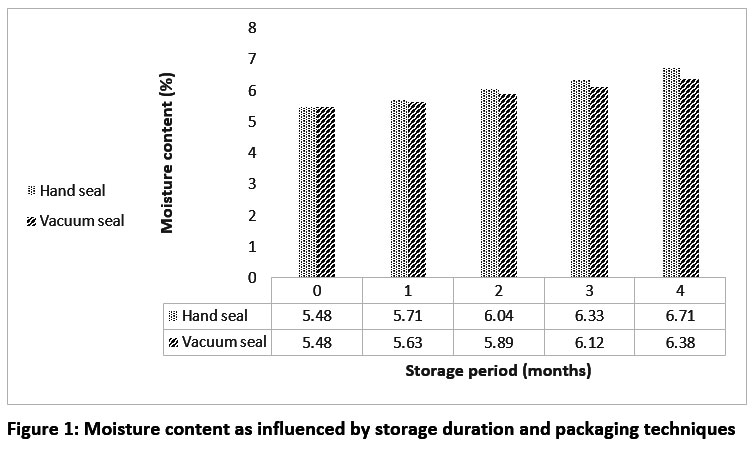 |
Figure 1: Moisture content as influenced by storage duration and packaging techniques |
Hardness as influenced by storage duration and packaging techniques
For cereal bars packed in hand seal and vacuum seal, respectively, the textural qualities, or hardness, of PBRCB rose from 1970.25 to 1986.86 g.force and 1970.25 to 1978.19 g.force (Fig.2).
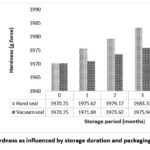 |
Figure 2: Hardness as influenced by storage duration and packaging techniques |
Peroxide value as influenced by storage duration and packaging techniques
The peroxide value of oil or fat can be used to evaluate the extent of rancidity that resulted through storage. The autoxidation of the fats and oil present in the food substance is what causes the off-flavours and off-odours in meals. Concentration of peroxide in oils or fats can be used to gauge the degree or scope of storage-related deterioration. The peroxide value of the PBRCB packed in hand seal and vacuum seal increased from 1.44 to 2.03 meq/kg and 1.44 to 1.96 meq/kg, respectively, as can be shown in the Fig.3.
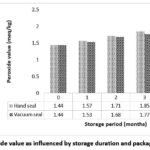 |
Figure 3: Peroxide value as influenced by storage duration and packaging techniques |
Free fatty acid as influenced by storage duration and packaging techniques
Fig. 4 shows that throughout the four-month storage period, the amounts of FFA in the PBRCB packed in hand seal and vacuum seal grew from 0.43 to 0.69% and 0.43 to 0.62%, respectively.
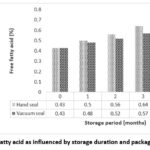 |
Figure 4: Free fatty acid as influenced by storage duration and packaging techniques |
Colour parameters as influenced by storage duration and packaging techniques
Fig. 5 shows that during the entire storage duration, the color L-value for PBRCB packed with hand seal and vacuum seal decreased from 59.4 to 54.2 and 59.4 to 55.8 respectively. Similar to this, the b-value for PBRCB packed with hand seal and vacuum seal decreased from 21.3 to 12.6 and 21.3 to 13.5, respectively, during the course of storage time, as shown in Fig. 6. For the PBRCB packed with hand seal and vacuum seal over the storage period, the color a-value increased from 5.6 to 7.8 and 5.6 to 7.2, respectively, as shown in Fig. 7.
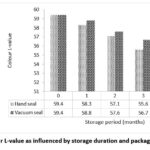 |
Figure 5: Colour L-value as influenced by storage duration and packaging techniques |
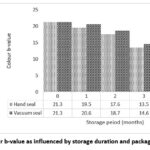 |
Figure 6: Colour b-value as influenced by storage duration and packaging techniques |
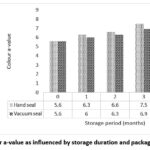 |
Figure 7: Colour a-value as influenced by storage duration and packaging techniques |
Discussion
Effect of popping time and BRS on the quality parameters of popped black rice cereal bar
Effect of popping time and BRS on hardness of popped black rice cereal bar
The amount of black rice popping that occurred during the course of the popping time may be responsible for the decrease in the PBRCB’s hardness. The amount of popped black rice was inversely linked to the reduction in PBRCB hardness. Similar findings were made by other study, who discovered that adding sweeteners made cereal bars softer and stickier because the polysaccharides’ hygroscopic nature caused them to absorb moisture.13 According to statistical examination of hardness, popping duration has a significant effect on hardness at the 5% level of significance (p<0.05), although the degree of BRS had no discernible impact on the hardness of the PBRCB.
Effect of popping time and BRS on colour of popped black rice cereal bar
According to statistical examination of color values, popping duration and BRS level significantly affect colour “L” and “b” values at the 5% level of significance (p<0.05), while color value “a” is unaffected. All of the treatments resulted in appreciable variations in the “L” and “b” values from PBRCB. The rise in the color “L” and “b” values is caused by an increase in the quantity of popped black rice kernels over time and the level of BRS. Similar findings were reported that the pigment in coloured fruits and rice caused the lightness to fluctuate, which led to a significant change in the color value “L”.14
Effect of popping time and BRS on Overall acceptability of popped black rice cereal bar
Table 2 also shows that the overall acceptance of the PBRCB increased as the popping time and BRS level increased, with the bar created at 1.5 minutes popping time and 40% BRS level being the most acceptable. However, statistical research reveals that the popping time (p>0.05) and BRS level (p>0.05) have no appreciable impact on the PBRCB’s general acceptability, as shown in Table 2. The product’s acceptance despite the PBRCB’s change in color may be attributed to its softness, decreased stickiness, and decreased sweetness. Additionally, the panellist’s perceptions indicated that the color fell inside the acceptable range.
Impact of storage duration on puffed black rice cereal bar qualitative attributes
Moisture content as influenced by storage duration and packaging techniques
Statistics reveals that for PBRCB packed using either method, the difference in moisture content was not statistically significant (p>0.05). Hydrolytic rancidity and sensory qualities including texture suffer as a result of moisture absorption during storage. Storage conditions and packing materials may contribute to moisture absorption. The product’s ability to retain moisture decreases as moisture provides a breeding ground for microorganisms and facilitates the development of rancidity owing to hydrolysis.
Hardness as influenced by storage duration and packaging techniques
The hardness of the PBRCB was considerably (p< 0.05) impacted by the packaging techniques over the entire storage duration. The popping period caused the PBRCB’s hardness to drop. When the storage period’s length grew, the hardness also did. The hardness can vary due to a variety of ingredients (such as grains and dry fruits), moisture content, and sweetness variations. Additionally, due to the higher moisture absorption and high hygroscopic qualities of PBRCB, high concentrations of brown rice syrup can increase the hardness of PBRCB. Similar outcomes have been noticed in the creation of granola and cereal bars made using sucrose substitutes.15,16
Peroxide value as influenced by storage duration and packaging techniques
Over the course of the storage period, however, at 5% level the change was not significant. Even after a 4-month storage period, the study’s peroxide value remained within the allowed limits (< 10 meq/kg, as per FAO guidelines). Similar finding was published that showed that after 9 months of storage, cereal bars made using De-fatted soy flour (DSF) had considerably higher peroxide values.17
Free fatty acid as influenced by storage duration and packaging techniques
In the instance of PBRCB sealed with a vacuum seal, the change during the 4 months of storage, however, was not appreciably different. The difference in the rancidity of the product in the case of PBRCB packed with hand seal has a substantial impact at the 5% level of significance, which may be related to the vacuum seal’s ability to block the transfer of light. Similar to this, a considerable rise in free fatty acid was found in a nutritional bar that had been stored for three months, but it was still within permissible bounds.18
Colour parameters as influenced by storage duration and packaging techniques
Color data revealed that throughout storage time, the ‘L’ and ‘b’ values declined, while the ‘a’ value greatly increased. Similar results were observed, who looked at nutrient-dense food bars made with the addition of legumes after a 120-day storage period.19
Conclusion
The study concludes that using Imphal, Manipur-sourced components (puffed black rice, roasted sunflower seeds, cardamom powder, and brown rice syrup), a composite cereal bar with adequate textural features and good consumer acceptability rating may be created. According to the optimization procedure, the ideal puffing duration for black rice and BRS level to make a respectable PBRCB are 1.5 minutes and 50%, respectively. The PBRCB produced using the optimal procedure offered sensory score (overall acceptability = 7.60±0.05) and textural qualities (hardness = 1970.25±0.12 g. force). Storage experiments showed that when packaged with vacuum sealing for 4 months of storage duration without any deterioration, the parameters of moisture content, peroxide value, free fatty acids, hardness, and color values were within the acceptable limit and fit for consumption. The future studies should focus on determining the glycemix index and glycemix load of cereal-based nutri bars to better understand their metabolic impact. In addition, large-scale consumer acceptance studies across different age and lifestyle groups would strengthen market relevance. Research on shelf-life extension strategies, including natural antioxidants, advanced packaging, and storage stability, is also warranted to enhance commercial viability.
Acknowledgement
The authors gratefully acknowledge College of Food Technology, Lamphelpat, Imphal, Manipur and Department of Processing and Food Engineering, College of Agricultural Engineering and Post Harvest Technology (Central Agricultural University Imphal), Ranipool, Sikkim, India for facilitating this study and the research team for their support.
Funding Sources
The author(s) received no financial support for the research, authorship, and/or publication of this article.
Conflict of Interest
The authors do not have any conflict of interest.
Data Availability Statement
This statement does not apply to this article
Ethics Statement
This research did not involve human participants, animal subjects, or any material that requires ethical approval.
Informed Consent Statement
This study did not involve human participants, and therefore, informed consent was not required.
Clinical Trial Registration
This research does not involve any clinical trials.
Permission to Reproduce Material from Other Sources
Not Applicable
Author Contributions
- Angam Raleng: Conceptualization, Methodology, Supervision, Data Analysis, Writing – Original Draft.
- Atheisa Riamroi: Investigation, Data Curation, Sample Preparation, Laboratory Analysis.
- Indu: Formal Analysis, Software (SPSS), Data Visualization, Writing – Review & Editing.
- Maibam Punyakishore: Data Visualization, Writing – Review & Editing.
- Thameridicus Bolwari Marak: Literature Review, Sensory Evaluation Coordination, Resources, and Documentation.
- Ningthoujam Manda Devi: Literature Review and Documentation.
- Palmei Gaibimei: Review, Editing and Documentation.
References
- Fast RB. Manufacturing technology of ready-to-eat cereals. In: Breakfast Cereals and How They Are Made. 2nd ed. AACC International Press; 2000:17-54.
CrossRef - Lobato L, Pereira A, Lazaretti M. Snack bars with high soy protein and isoflavone content for diets to control dyslipidaemia. Int J Food Sci Nutr. 2012; 63(1):49-58. doi:10.3109/09637486.2011.596148.
CrossRef - Magda S, Margarida VG, Claudia V, Marilia P. Nutritional profile and consumers’ perceptions of cereal bars. J. Food Prod. Mark. 2024. Doi:10.1080/10454446.2024.2340446.
CrossRef - Kushwaha U. Black Rice: Research, History and Development. Springer; 2016.
CrossRef - Angam R, Bhavesh D, Rebika S. Process standardization for development and quality evaluation of aromatic black rice–incorporated idli. Asian J Dairy Food Res. 2021;2(1):1-6. doi:10.18805/ajdfr. DR-1729.
- World Bakers Magazine. Cereal and breakfast bars market trends and health drivers. World Bakers. 2024;32(3):194-201.
- Vinutha NA, Navaneetha R. Development and evaluation of value -added nutri bar using popped rice and amaranth seeds for adolescents. Int. J. Health. Sci.Res. 2024; 14 (6): 133-141. Doi: https://doi.org/10.52403/ijhsr.20240620.
CrossRef - Angam R, Singh A, Chavan P, Attkan A, Singh B. Standardization of deep-frying process and its effects on storage stability of pineapple pomace powder–incorporated rice-based extruded product. J Food Process Preserv. 2019. doi:10.1111/jfpp.13950
CrossRef - Association of Official Analytical Chemists (AOAC). Official Methods of Analysis of the AOAC International. 16th ed. AOAC International; 1995.
- Stojceska V, Ainsworth P, Plunkett A, Ibanoglu E, Ibanoglu S. Cauliflower by-products as a new source of dietary fibre, antioxidants and proteins in cereal-based ready-to-eat expanded snacks. J Food Eng. 2008; 87:554-563. doi: 10.1016/j.jfoodeng.2008.01.009
CrossRef - Bansal G, Zhou W, Barlow PJ, Joshi PS, Lo HL, Chung YK. Review of rapid tests available for measuring quality changes in frying oils and comparison with standard methods. Crit Rev Food Sci Nutr. 2010; 50(6):503-514.
CrossRef - Meullenet J, Carpenter J, Lyon B, Lyon C. Bi-cyclical instrument for assessing texture profile parameters and its relationship to sensory evaluation of texture. J Texture Stud. 1996; 28(1):101-118.
CrossRef - Shourideh M, Taslimi A, Azizi M, Mohammadifar M. Effects of D-tagatose and inulin on physicochemical, rheological, and sensory properties of dark chocolate. Int J Biosci Biochem Bioinform. 2012; 2(5):314-319.
CrossRef - Comert ED, Mogol BA, Gokmen V. Relationship between color and antioxidant capacity of fruits and vegetables. Curr Res Food Sci. 2020; 2:1-10. doi: 10.1016/j.crfs.2019.11.001
CrossRef - Yadav L, Bhatnagar V. Optimization of ingredients in cereal bar. Food Sci Res J. 2015;6(2):273-278. doi:10.15740/HAS/FSRJ/6.2/273-278
CrossRef - Sethupathy P, Suriyamoorthy P, Moses JA, Chinnaswamy A. Physical, sensory, in-vitro starch digestibility and glycaemic index of granola bars prepared using sucrose alternatives. Int J Food Sci Technol. 2019; 55:348-356. doi:10.1111/ijfs.14312
CrossRef - Ananthan P, Padmashree A, Semwal AD. Development and evaluation of shelf stability of flaxoat nutty bar in different packaging materials. J Food Sci Technol. 2013; 50(6): 1162-1169.
- Monika S, Mridula D. Development and quality evaluation of maize-based fortified nutritious bar. Agric Res. 2015; 4(1):93-101. doi:10.1007/s40003-014-0140-8
CrossRef - Omer T. Development, Characterization and Shelf-Life Optimization of a Prototype Nutrient Dense Food Bar. 2009.University of Agriculture Faisalabad.
Abbreviations list
ACL – Aluminium Coated Laminate
ANOVA – Analysis of Variance
AOAC – Association of Official Analytical Chemists
BRS – Brown Rice Syrup
CR10 – Chroma Meter (Konica Minolta Colour Reader, model CR10)
DSF – Defatted Soy Flour
FFA – Free Fatty Acids
GI – Glycemic Index
PBRCB – Puffed Black Rice Cereal Bar
RTE – Ready-to-Eat
SPSS – Statistical Package for the Social Sciences
wb – Wet basis

Accepted on: 2 Feb 2026
Second Review by: Pathak Sumit Sudhir
Final Approval by: Dr. Teng Cong





Web of Science Coverage
Emerging Sources Citation Index (ESCI)
2024 Journal Impact Factor: 1.1
Scopus Journal Metrics
CiteScore 2024: 1.9
CiteScore Details
Sustainable Nutrition: Food Systems, Nutrient Retention, and Public Health Impact

This journal is a member of, and subscribes to the principles of, the Committee on Publication Ethics (COPE)