
Food-Waste-Derived Lutein as a Sustainable Bioactive for Preventive Nutrition

Department of Food Technology, Haldia Institute of Technology, Haldia, India
Corresponding author Email: rayswati279@gmail.com
Download this article as:
ABSTRACT:The growing emphasis on healthier diets has increased interest in natural bioactive compounds as alternatives to synthetic additives. Food waste valorization provides a sustainable source of such compounds while simultaneously addressing environmental concerns. Fruit peels, seeds, vegetable residues, and microalgae are rich in health-promoting molecules, including polyphenols, flavonoids, terpenoids, vitamins, pigments, and carotenoids, which exhibit antioxidant, antimicrobial, and anti-inflammatory activities. Among these, lutein, a xanthophyll carotenoid, has gained considerable attention for its role in reducing the risk of age-related macular degeneration. Although lutein is traditionally derived from plants, it can also be effectively extracted from microalgae and agro-industrial waste, offering an eco-friendly production route; however, detailed characterization and toxicological evaluation are required prior to commercialization. To enhance stability and bioavailability, advanced delivery systems such as nano- and micro-encapsulation and nano-emulsions are being developed, enabling controlled release and improved efficacy. Overall, food waste valorization offers a dual benefit of sustainable waste management and the development of functional ingredients that support long-term human health.
KEYWORDS:Additives; Functional Food; Lutein; Nutraceutical; Therapeutic
Introduction
Lutein, a yellow-to-orange xanthophyll carotenoid, is sourced from plants such as fresh leafy greens (cabbage, spinach, kale, broccoli, peas, corn), as well as egg yolks. Humans cannot synthesize lutein; therefore, dietary intake is essential. The recommended intake is approximately 10 mg/day, whereas typical adult consumption ranges from 1-2 mg/day. Proven to enhance eyesight, skin health, cardiac functions, and gut integrity, lutein scavenges free radicals to combat oxidative stress. It binds to StARD3 protein for macular accumulation in the retina, preventing eye diseases; and as secondary therapy, it reduces age-related macular degeneration and cataracts.1
Rising agricultural and food production to feed a growing global population generates extensive food waste, posing environmental threats to humans and wildlife. Valorizing these wastes into invaluable food additives like lutein aligns with circular economy principles for sustainability. These natural pigments offer therapeutic potential, enabling greener functional foods that outperform synthetic petroleum-based dyes.2
This narrative review synthesizes evidence from published studies on food-waste-derived lutein, focusing on sustainable extraction strategies, bioactivity, and preventive nutrition applications. It aims to consolidate current knowledge on food-waste-derived lutein by summarizing its core pigment characteristics, sustainable extraction from food waste streams and processing by-products, and its bioactivity in health management applications. It highlights the role of novel formulations and value-added applications in enhancing lutein’s functional potential, positioning waste-derived lutein as an eco-friendly ingredient for functional foods and in preventive nutrition. Unlike existing reviews that focus mainly on dietary or algal lutein, this communication uniquely emphasizes food waste sources and extraction strategies within a circular economy framework, while also underscoring their industrial scalability. Furthermore, the therapeutic use of lutein requires rigorous regulatory evaluation, including safety, bioavailability, and efficacy assessments, to meet approval standards set by authorities such as the FAO, FDA and ESFA, has also been discussed.
Attributes of the bio-pigment Lutein
The term lutein comes from the Latin word ‘Luteus,’ which means yellow and rightfully represents this dark yellowish xanthophyll pigment, which is among the 600 known naturally occurring carotenoids. This is mostly synthesized from natural green to yellow raw fruit or vegetable sources and some animal sources, and it can serve as a modulator in the non-photochemical quenching of triplet chlorophyll, which increases during the photosynthetic process.3 The water-insoluble lipophilic dicyclic molecule lutein contains long polyene chains of conjugated double bonds (Figure 1a) with light absorption capacity and is vulnerable to light, heat, and the presence of acids. The geometric cis and trans isomeric forms of lutein are shown in (Figure 1b), where the natural stereoisomer is (3R, 3′R, 6′R)-beta, epsilon–carotene-3, 3′-diol. The closest isomeric form of lutein is zeaxanthin, which can be interconverted by changing the placement of a double bond through the intermediate component, meso-zeaxanthin.4
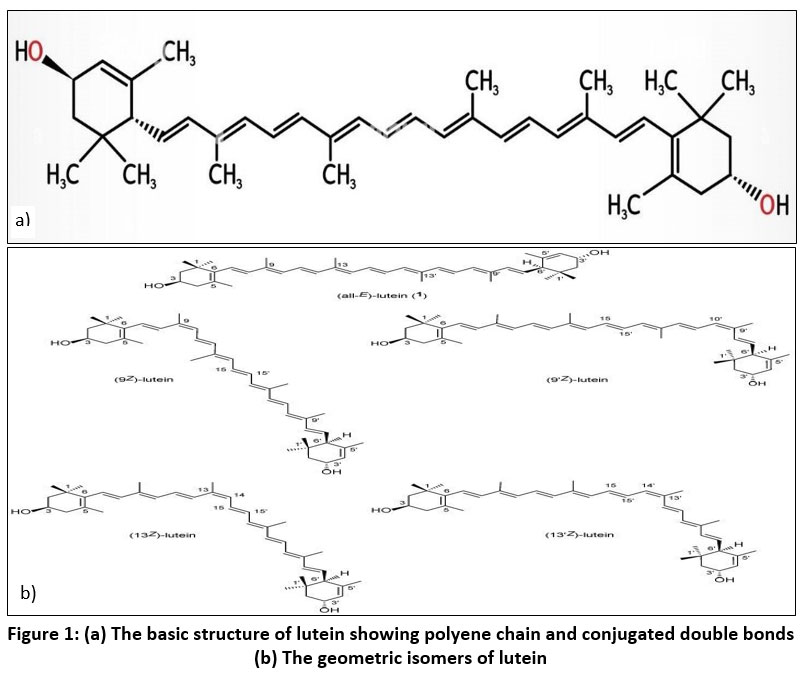 |
Figure 1: (a) The basic structure of lutein showing polyene chain and conjugated double bonds (b) The geometric isomers of lutein |
Lutein has antioxidant, anti-inflammatory, and other therapeutic and health benefits that can be introduced into the body from outside. Lutein is highly beneficial for general eye health or age-induced macular degradation, cardiac health, improving cognitive function, and reducing carcinogenic effects on the body.5
Further studies sheds light on the basic characteristics of lutein and its various sources, specifically of food waste origin. It also discusses the significance of lutein in the management of health issues in various forms.
Lutein from food waste: Sources and Extraction
Lutein can easily be sourced from various natural substances, as discussed previously. The recovery of lutein from food waste represents an important technological advancement. It enables waste reutilization while simultaneously reducing environmental pollution and supporting ecological sustainability. The process of lutein synthesis from food waste can occur mainly through fermentative production of biomass from different microorganisms followed by a solvent-based extraction process. In addition, supercritical fluid extraction using carbon dioxide, direct solvent extraction, solvent extraction using a Soxhlet apparatus, enzyme- or ultrasound-assisted extraction, or simple mechanical extraction can be performed using various food waste sources. The currently reported and available sources of lutein obtained by reusing food-processing wastes or by-products are listed in Table 1.
Table 1: Lutein valorization from different types of food processing wastes and by products
|
Name of the Food Waste |
Method of manufacture |
| Molasses6 |
Fermentative production of hydrolysed molasses for biomass generation of microalgae Chlorella sorokiniana MB-1-M12 from which lutein is extracted. |
|
Unconsumed and expired toast bread7 |
Mixotrophic fermentation by Chlorella using food waste enzymatic hydrolysate of expired toast bread
|
| Japanese Knotweed Waste8 |
Dried and pulverized Knotweed Waste generates lutein by supercritical CO2 (Sc-CO2) extraction for 24 h at 150 bar, 65 °C, and at a flow rate of 120 g CO2/min. |
|
Carrot peel and discarded9 carrots |
Supercritical CO2 (Sc-CO2) extraction of carrot peels using 14.3% ethanol as co-solvent at 58.5 °C and 306 bar. |
| Tomato peel10 |
Solvent extraction using methanol, ethanol, diethyl ether, acetone, chloroform, and hexane |
|
Spinach by-products11 |
Traditionally by using 93% aqueous ethanol for 4.3 h at 43 °C and a solvent to raw material ratio of 1/66.
Supercritical CO2 (Sc-CO2) extraction of spinach waste at 56 °C, for 3.6 h, 39 MPa pressure and 10% ethanol as co-solvent. |
| Paprika leaves12 |
Accelerated solvent extraction of paprika leaves using acetonitrile, acetone, methanol, and ethanol. |
|
Mixed waste of sweet potato, tomato, apricot, pumpkin, peach peels and pepper wastes13 |
Supercritical fluid extraction at 59 °C, 350 bar, 15 g/min CO2, 15.5% (v/v) ethanol as co-solvent and 30 min extraction time. |
| Orange peel14 |
Enzyme assisted mechanical extraction from orange peel |
|
Pistachio hull waste15 |
Extraction of pistachio hull powder in Soxhlet apparatus using ethyl acetate followed by saponification and ultrasonication |
| Banana peel16 |
Extraction of powdered banana peel using ethyl acetate at 27 °C. |
|
Quince peel17 |
Solvent extraction using hexane and ethyl acetate for optimal lutein recovery. |
| Food waste hydrolysate18 |
Fulvic acid supplemented food waste hydrolysate used for growing Dunaliella salina which is a source of lutein |
|
Mixed food Waste water19 |
Anaerobic digestion of waste using microalgal biomass |
| Corn starch wastewater20 |
Enzymatic hydrolysis of the wastewater to cultivate microalgae as source of lutein |
|
Carrot pomace21 |
Ultrasound assisted extraction using ethanol as extraction solvent |
| Liquefied food waste22 |
Anaerobically digested food waste mixed with synthetic brine used for preparation of biomass growth of Chlorella vulgaris as source of lutein |
|
Processing waste water23 |
Growing biomass of Chlorella pyrenoidosa in waste water and ultrasound assisted extraction of lutein. |
| Waste from peach24 |
Ethanolic extraction for 10 min using 38.5 mL of ethanol |
|
Pumpkin peel25 |
Methanolic extraction at 40 °C |
| Oil palm fronds26 |
Ultrasonic-assisted extraction optimized at 30 °C, 39.09 min giving 19.24 mL/g of lutein |
Although a wide range of extraction methods has been reported for recovering lutein from food waste, their suitability for industrial translation varies considerably. Conventional solvent extraction remains attractive due to its low capital cost and operational simplicity; however, it suffers from high solvent consumption, extended extraction times, and challenges in solvent recovery and regulatory compliance, particularly when toxic organic solvents are used. These limitations restrict scalability and increase downstream purification costs, reducing overall process sustainability.2,11
Green and assisted extraction technologies, including supercritical CO2, ultrasound-assisted, and enzyme-assisted extraction, offer distinct advantages in terms of scalability, reduced solvent residues, and environmental footprint. Supercritical CO2 extraction, especially when combined with ethanol as a co-solvent, enables high-purity lutein recovery with efficient solvent recycling and minimal thermal degradation, making it attractive for nutraceutical applications. However, its industrial adoption is constrained by high capital investment and energy requirements, which may limit cost-effectiveness for small and medium-scale processors.8,13 In contrast, ultrasound and enzyme-assisted techniques are more adaptable to decentralize waste valorization systems, offering moderate energy demand, improved mass transfer, and shorter extraction times, although enzyme costs and process optimization remain a challenge.15,21
A critical yet underexplored challenge across all extraction strategies is the variability in food waste composition, which directly influences extraction efficiency and reproducibility. Differences in raw material maturity, seasonal availability, processing history, and moisture content can result in fluctuating lutein yields and impurity profiles. Such heterogeneity complicates process standardization and scale-up, particularly for solvent-based methods that are sensitive to matrix effects. Integrated bioconversion approaches using microalgae grown on food waste hydrolysates partially mitigate this issue by converting heterogeneous substrates into more uniform biomass; however, they introduce additional operational complexity and time requirements.18,19
From an environmental perspective, solvent recovery, energy input, and waste generation are decisive factors in determining process sustainability. Supercritical CO2 systems offer near-complete solvent recyclability and minimal secondary waste, aligning well with circular economy principles, whereas conventional solvent extraction generates higher solvent loses and environmental burdens if recovery systems are inefficient. Life-cycle and techno-economic assessments consistently highlight that combining green extraction technologies with effective solvent recovery and waste minimization strategies is essential for achieving both environmental and economic viability in large-scale lutein production from food waste.2,6
Significance of lutein in health and bioavailability
The health effects of lutein can be broadly categorized into clinically supported benefits and emerging or preclinical evidence. While strong human data support lutein’s role in eye health and systemic antioxidant activity, several other reported benefits are primarily derived from in vitro experiments, animal models, or limited observational studies. These emerging findings should therefore be interpreted cautiously and not equated with established clinical outcomes.3,27
Lutein exhibits low bioavailability due to its poor water solubility and susceptibility towards oxidative degradation. Its intestinal absorption is limited by inefficient micelle formation and interaction with bile acids, digestive enzymes, and other physiological factors. Being heat and light sensitive, lutein content is often reduced during cooking or processing.28 As a fat-soluble compound, its absorption is enhanced in lipid-rich food matrices.29 Commercially lutein is available in diverse formulations-including pure tablets, capsules, syrup, concentrates, dehydrated powders with bioactives, vitamin blends, topical creams, intravenous solutions, nano-encapsulated carriers, and antioxidant sprays- for both nutraceutical and pharmaceutical applications. The key therapeutic domains in which lutein serves as a critical bioactive agent are outlined below:
Major domains
Clinically supported effects
Eye and cognitive health
Age-related macular degeneration (AMD) and other ocular defects stem from oxidative stress and chronic blue light exposure. Lutein supplementation counteracts these by quenching singlet oxygen, neutralizing zeaxanthin radicals, supressing pro-inflammatory cytokines, upregulating superoxide dismutase (SOD) activity, attenuating lipid peroxidation, and promoting retinal epithelial (RPE) cell repair and homeostasis.28 It also demonstrates efficacy in cataract prevention and symptom alleviation.
In maternal nutrition, lutein fosters fetal eye, brain, and neural development, enhances cognitive outcomes, and correlates with reduced preeclampsia risk via elevated plasma levels; higher cord blood carotenoids further bolster maternal-prenatal health and long term child neurodevelopement.30 Neuroprotectively, lutein safeguards docosahexaenoic acid (DHA) in key brain regions, augments memory consolidation and attentional processing, readily traverses the blood-brain barrier, and attenuates amyloid-β-induced memory deficits in Alzheimer’s disease models.31
Cardio-metabolic and oxidative stress
Lutein exerts cardio-protective effects by modulating Peroxisome Proliferator-activated receptor-α (PPAR-α) signalling, attenuating amyloid plaque deposition, supressing pro-inflammatory cytokines, such as Tumour Necrosis Factor-α (TNF-α), Interleukin 6 (IL-6), and acute-phase markers, such as C-Reactive proteins, and preventing cardiac arrhythmias, myocardial infarction, and acute coronary syndromes.5 It optimizes lipid homeostasis by enhancing cholesterol efflux, reducing LDL (Low-Density Lipoprotein) oxidation, and lowering triglyceride levels, yielding long term protection against lipid peroxidation, endothelial dysfunction and atherosclerosis.32 As a multifaceted agent, lutein functions as a potent antioxidant, anti-apoptotic modulator, and anti-inflammatory mediator, mitigating oxidative DNA damage and restoring homeostasis.33 By scavenging reactive oxygen species (ROS) and downregulating Nuclear Factor κB (NF-κB) pathways, it alleviates systemic oxidative stress-underpinning its therapeutic roles in tissue repair, vascular integrity and chronic disease amelioration.27
Robust clinical and epidemiological evidence supports lutein’s role in eye health, particularly in reducing the risk and progression of age-related macular degeneration and cataract, through antioxidant, anti-inflammatory, and blue-light filtering mechanisms.1,5,30
Emerging and preclinical evidence
Evidence for lutein’s role in cancer, liver, lung, and bone health is largely derived from cell culture studies, animal models, and observational analyses, with limited confirmation from controlled human trials. Preclinical studies suggest that lutein may modulate oxidative stress, inflammatory signalling, and cell proliferation pathways; however, these findings remain exploratory and require clinical validation.
Cancer
Inhibits vascular growth in endothelium, reduces risk of cancers, and decreases incidence of non-Hodgkin lymphoma.5 Preclinical studies indicate that lutein may inhibit angiogenesis and cancer cell proliferation through antioxidant and anti-inflammatory mechanisms; however, current evidence is largely limited to in-vitro and animal models, with insufficient clinical data to support therapeutic claims in humans.3,27
Skin condition
Enhances brightness, texture, elasticity and protects from UV damage.34
Liver disease
Enhances hepatic signalling via sirtuin-1 and PPAR-α, protects against hepatotoxicity, and reduces risk of non-alcoholic fatty liver disease.35
Lung disease
Improves lung capacity and expiratory volume; trials show limited benefit in asthma and bronchopulmonary dysplasia. Observational and experimental studies suggest a potential association between lutein intakes and improved respiratory outcomes, but clinical trials report inconsistent or modest effects, indicating that evidence for lung health benefits remains inconclusive.36
Bone associated problems
Lutein regulates the activity of NF-κB, thus helping with bone formation and inhibition of bone reabsorption, decreasing interleukin-1-dependent differentiation of osteoclasts.37 Studies have shown its effectiveness in increasing hip bone mineral density in men, contributing to overall bone health development.38 Experimental studies demonstrate that lutein may influence bone metabolism by regulating NF-κB signalling and osteoclast activity; however, human evidence is currently limited to cross-sectional associations, warranting further longitudinal and interventional studies.37,38
Regulatory status of lutein
Lutein is a well-characterized xanthophyll carotenoid with established approvals for use in foods, dietary supplements, and pharmaceuticals. Regulatory authorities such as the ESFA, JECFA and the FDA have evaluated its safety and defined acceptable intake levels for human consumption. However, when lutein is derived from food waste or processing by-products, additional regulatory considerations arise that extend beyond those applied to conventionally sourced lutein.
Regulatory classification of food-waste-derived lutein
Although lutein itself is an approved bioactive, its derivation from food waste introduces regulatory complexity. In many jurisdictions, waste-derived bioactives are not automatically covered under existing lutein authorizations and may instead be regulated as ‘novel foods’, ‘new dietary ingredients’, or ‘recycled food ingredients’, depending on the origin of the waste material and the processing pathway employed. Regulatory agencies such as ESFA and the FDA typically require clear evidence that waste-derived lutein is compositionally equivalent to lutein obtained from traditional sources, produced under food-grade conditions, and compliant enhanced documentation of traceability, source segregation, and process control to ensure regulatory acceptance and consumer safety.39,40
Safety, toxicological evaluation and contaminant risks
While lutein has a well-established safety profile, food-waste-derived lutein requires additional toxicological scrutiny due to the potential presence of contaminants. Food waste streams may carry pesticide residues, heavy metals, mycotoxins, process-related contaminants, or microbial hazards, depending on their origin and handling. As a result, regulatory approval commonly demands comprehensive safety assessment, including chemical characterization, impurity and contaminant profiling, stability testing, and toxicological evaluation using in-vitro and in-vivo models. Demonstration of batch-to-batch consistency and compliance with acceptable daily intakes values, established at 1 mg/kg body weight by ESFA and 2 mg/kg body weight by JECFA, is essential to support safety claims and regulatory approval.41,39
Regulatory approval and commercialization barriers
Despite strong scientific and sustainability rationales, several challenges hinder the commercialization of food-waste-derived lutein. Regulatory approval processes are often time-intensive and costly, particularly when novel food dossiers or new dietary ingredient notifications are required. Variability in waste composition across seasons and regions complicates standardization and large-scale production, while differences among International regulatory frameworks create barriers to global market entry. In addition, consumer perception of ‘waste-derived ‘ingredients may necessitate transparent labelling, Effective communication, and regulatory harmonization to build trust. Addressing these barriers through standardized processing protocols, robust safety datasets, and clearly defined regulatory pathways will be critical for the successful integration of food-waste-derived lutein into nutraceutical and functional food markets.42
Limitations and research gaps in food-waste-derived lutein valorization
Despite notable progress, several challenges limit the large-scale utilization of food-waste-derived lutein. Extraction yields vary due to heterogeneity in waste composition, seasonal availability, and prior processing, while lutein’s sensitivity to heat, light and oxygen leads to degradation during extraction, processing, and storage. Its poor aqueous solubility and limited intestinal absorption further restrict bioavailability, even when recovery yields are high. Although encapsulation and lipid-based delivery systems improve stability and uptake, their industrial scalability and cost-effectiveness remain insufficiently validated. In addition, waste-derived lutein faces increased regulatory scrutiny because food waste streams may contain pesticide residues, heavy metals, or microbial contaminants, requiring rigorous purification, toxicological evaluation, and batch-to-batch consistency testing. Such products are often regulated as novel foods or new dietary ingredients, increasing approval timelines and costs. Finally, the predominance of in-vitro and animal studies, coupled with limited human clinical trials, restricts robust assessment of bioavailability, dose-response relationships, and long-term safety, while the scarcity of life cycle and techno-economic analyses constrains evaluation of environmental and industrial feasibility compared with conventional lutein sources.2,27
Discussion
The primary goal of this review was to critically evaluate food-waste-derived lutein as a sustainable bioactive ingredient for preventive nutrition, integrating evidences on its sources, extraction strategies, biological functions, and formulation challenges within a circular economy framework. This current discussion highlights that valorization of food processing residues and agro-industrial waste is not merely an environmental remediation strategy but a scientifically and economically viable route for producing high-value nutraceuticals such as lutein.
Food Waste as a strategic lutein reservoir
A central insight emerging from this work is the diversity and abundance of lutein-rich food waste streams, including fruit and vegetable peels, pomace, processing wastewater, and expired food products. Unlike conventional lutein sources, which rely heavily on fresh marigold flowers or refined algal biomass, food waste offers a decentralized, low-cost, and renewable feedstock. The studies complied demonstrate that both plant-derived wastes (e.g., carrot, spinach, pumpkin, tomato peels) and secondary waste streams used to cultivate microalgae can yield appreciable lutein concentrations when appropriate extraction or bioconversion strategies are applied. Importantly, the feasibility of lutein recovery from waste depends not only on pigment content but also on process efficiency, solvent safety, energy consumption, and scalability. Advanced green technologies- such as supercritical CO2 extraction, ultrasound-assisted extraction, and enzyme-assisted processes-consistently outperform conventional solvent extraction in terms of yield, selectivity, and environmental compatibility. These approaches align well with sustainable processing goals and reduce reliance on toxic organic solvents, thereby improving regulatory acceptability for food and nutraceutical applications.
Functional relevance to preventive nutrition
The discussion of health benefits reinforces lutein’s position as a cornerstone carotenoid in preventive nutrition rather than a niche ophthalmic supplement. Beyond its established role in age-related macular degeneration, lutein demonstrates systemic antioxidant and anti-inflammatory activities that are relevant to cardiovascular health, neuroprotection, metabolic regulation, and chronic disease prevention. This broad physiological relevance strengthens the argument for incorporating lutein into functional foods and dietary supplements targeted at diverse population groups, including the elderly, pregnant women, and individuals at risk of oxidative stress-related disorders. From a preventive nutrition perspective, food-waste-derived lutein is particularly attractive because it supports the development of functional foods that address micronutrient insufficiency while simultaneously reducing environmental burden. This study highlights that habitual dietary intake of lutein remains substantially below recommended levels in many populations. Integrating lutein into commonly consumed food matrices such as bakery products, beverages, dairy alternatives, and edible oils could help bridge this gap without necessitating high-dose supplementation.
Bioavailability as a limiting factor
Despite its promising health profile, lutein’s low bioavailability remains a major bottleneck to its effective utilization. Poor aqueous solubility, sensitivity to heat, light, and oxygen, and limited intestinal absorption restricts its biological efficacy, particularly when delivered through conventional food matrices. Here it has been shown that extraction yield alone is not a sufficient indicator of functional success; bioaccessibility and stability must be addressed concurrently. Emerging delivery systems including nano- and microencapsulation, lipid-based carriers, nanoemulsions, and protein-polysaccharide complexes represent a critical translational bridge between food waste valorization and clinical efficacy. These systems not only protect lutein during processing and storage but also enhance micellarization and intestinal uptake. Future work should prioritize comparative studies that link waste-derived lutein formulations with in-vivo bioavailability and functional biomarkers, enabling evidence-based product development.
Regulatory and safety considerations
Another important dimension discussed is regulatory compliance. While lutein is widely regarded as safe and has established acceptable daily intake limits, waste-derived lutein introduces additional scrutiny related to source variability, contaminants, and batch-to-batch consistency. Comprehensive characterization, toxicological evaluation, and adherence to food-grade processing standards are essential for regulatory approval by agencies such as EFSA, JECFA, and the FDA. This discussion also highlighted that the regulatory pathway for waste-derived bioactives may be facilitated by transparent sourcing, traceability, and the adoption of standardized extraction protocols. Harmonization of safety assessment frameworks will be critical for global commercialization, particularly as food waste streams differ significantly across regions.
Future prospects and research directions
Looking forward, the integration of food-waste-derived lutein into preventive nutrition strategies presents several promising research and industrial avenues. First, techno-economic and life-cycle assessments should be conducted to quantify the environmental and economic benefits of waste-based lutein production relative to conventional sources. Such analyses are crucial for attracting industrial investment and policy support. Second, interdisciplinary research linking food science, nutrition, and clinical studies is needed to establish dose-response relationships and long-term health outcomes associated with waste-derived lutein consumption. This is particularly relevant for emerging applications in cognitive health, metabolic disorders, and maternal nutrition, where mechanistic evidence is still lacking as omega-3 fatty acids, polyphenols, or dietary fibres could amplify health benefits while improving market appeal. Food waste streams themselves may provide complementary bioactive compounds, enabling the creation of holistic, waste-derived nutraceutical blends. Finally, policy-driven incentives and industry-academia collaborations will be instrumental in scaling laboratory successes to commercial reality. Embedding lutein recovery within existing food processing infrastructures, such as juice, starch, or fermentation industries, could significantly lower production costs and enhance adoption.
Although this review draws upon a broad and diverse body of literature to minimize selection bias, certain limitations should be acknowledged. Potential sources of bias include publication bias favouring studies with positive outcomes, heterogeneity in extraction methods, waste matrices, and analytical protocols, as well as the predominance of preclinical and in-vitro evidence over human clinical data. Additionally, variations in regulatory frameworks and reporting standards across studies may influence data comparability. These factors may affect the generalizability of findings; therefore, conclusions should be interpreted within the context of these limitations. Explicit recognition of such biases strengthens transparency and supports balanced interpretation of food-waste-derived lutein’s functional and therapeutic potential.
To address the limitations more systematically in a nutshell, future research should focus on several key areas. First, standardization of extraction methodologies, analytical quantification, and reporting units is required to reduce heterogeneity across food-waste-derived lutein studies and enable meaningful cross-comparison. Second, the predominance of in-vitro and preclinical evidence highlights the need for well-designed human clinical trials evaluating bioavailability, dose-response relationships, and long-term safety of waste-derived lutein formulations. Third, variability in food waste composition and the potential presence of contaminants necessitate rigorous source characterization, toxicological evaluation, and batch-to-batch consistency testing to meet regulatory requirements. Finally, integrated techno-economic and life-cycle assessments are needed to determine industrial scalability and environmental advantages over conventional lutein sources. Collectively, addressing these aspects will strengthen the translational relevance of food-waste-derived lutein for preventive nutrition and functional food applications.
Conclusion
Lutein is a potent antioxidant and therapeutic carotenoid with well-established roles in preventive nutrition and human health. Its regular intake through a balanced diet is particularly important for vulnerable populations, including the elderly, pregnant women, and individuals with chronic health conditions. In cases of impaired absorption, dietary supplementation may be required; however, available evidence indicates lower incidences of reported acute or chronic toxicity. To ensure consumer safety, the acceptable daily intake of lutein has been established at 1 mg/kg body weight by the European Food Safety Authority (EFSA) and 2 mg/kg body weight by the Joint Expert Committee on Food Additives (JECFA).
Food waste, often regarded as an environmental burden, represents a valuable and sustainable reservoir of lutein that can be efficiently recovered through low-cost extraction processes. Valorization of such waste streams not only mitigates environmental pollution but also enables the development of value-added industries focused on nutraceutical and functional food production, thereby supporting circular economy principles.
Despite its promise, large scale recovery of lutein from food waste faces challenges related to extraction efficiency, stability, bioavailability, regulatory approval, and cost effectiveness. Addressing these limitations through process optimization, advanced formulation strategies, and regulatory alignment will be essential for successful industrial translation of laboratory-scale valorization into commercially viable nutraceutical applications.
Acknowledgement
The author thanks Department of Food Technology, Haldia Institute of Technology for providing the infrastructural support
Funding Sources
The author(s) received no financial support for the research, authorship, and/or publication of this article.
Conflict of Interest
The authors do not have any conflict of interest.
Data Availability Statement
This statement does not apply to this article.
Ethics Statement
This research did not involve human participants, animal subjects, or any material that requires ethical approval
Informed Consent Statement
This study did not involve human participants, and therefore, informed consent was not required.
Clinical Trial Registration
This research does not involve any clinical trials
Permission to Reproduce Materials from Other Sources.
Not Applicable
Author Contributions
The sole author was responsible for the conceptualization, methodology, data collection, analysis, writing, and final approval of the manuscript
References
- Mrowicka M., Mrowicki J., Kucharska E. et al. Lutein and zeaxanthin and their roles in Age-Related Macular Degeneration—Neurodegenerative disease. Nutrients. 2022; 14(4): 827. DOI: https://doi.org/10.3390/nu14040827
CrossRef - Sharma M., Sridhar K., Gupta V.K. et al. Greener technologies in agri-food wastes valorization for plant pigments: Step towards circular economy. Res. Green Sustain. Chem. 2022; 5: 100340. DOI: https://doi.org/10.1016/j.crgsc.2022.100340
CrossRef - Terao J. Revisiting carotenoids as dietary antioxidants for human health and disease prevention. Food Funct. 2023; 14(17):7799-824.DOI: 10.1039/D3FO02330C.
CrossRef - Nagy V., Agócs A., Balázs V.L. et al. Lutein isomers: preparation, separation, structure elucidation, and occurrence in 20 medicinal plants. Molecules. 2023; 28(3): 1187. DOI: https://doi.org/10.3390/molecules28031187.
CrossRef - Buscemi S., Corleo D., Di Pace F. et al. The effect of Lutein on Eye and Extra-Eye health. Nutrients. 2018; 10(9): 1321. DOI: https://doi.org/10.3390/ nu10091321
CrossRef - Chen J., Huang J., Nagarajan D. et al. Reutilization of food industrial waste for lutein production with heterotrophic microalgae Chlorella sorokiniana MB-1-M12. Taiwan Inst. Chem. Eng. 2023; 160: 105243. DOI: https://doi.org/10.1016/j.jtice.2023.105243
CrossRef - Wang X., Zhang M., Sun Z. et al. Sustainable lipid and lutein production from Chlorella mixotrophic fermentation by food waste hydrolysate. Hazard. Mater. 2020; 400: 123258. DOI: https://doi.org/10.1016/j.jhazmat.2020.123258.
CrossRef - Metličar V., Albreht A. Esterification of Lutein from Japanese Knotweed Waste Gives a Range of Lutein Diester Products with Unique Chemical Stability. ACS Sustain. Chem. Eng. 2022; 10(18): 6072–6081. DOI: https://doi.org/10.1021/acssuschemeng.2c01241
CrossRef - Encalada A.M.I., Pérez C.D., Flores S.K. et al. Antioxidant pectin enriched fractions obtained from discarded carrots (Daucus carota L.) by ultrasound-enzyme assisted extraction. Food Chem. 2019; 289: 453–460.DOI: https://doi.org/10.1016/j.foodchem.2019.03.078
CrossRef - Palozza P., Colangelo M., Simone R. et al. Lycopene induces cell growth inhibition by altering mevalonate pathway and Ras signaling in cancer cell lines. Carcinogenesis. 2010; 31(10): 1813–1821. DOI: https://doi.org/10.1093/carcin/bgq157
CrossRef - Derrien M., Aghabararnejad M., Gosselin A. et al. Optimization of supercritical carbon dioxide extraction of lutein and chlorophyll from spinach by-products using response surface methodology. LWT. 2018; 93: 79–87. DOI: https://doi.org/10.1016/j.lwt.2018.03.016
CrossRef - Kang J., Kim S., Moon B. Optimization by response surface methodology of lutein recovery from paprika leaves using accelerated solvent extraction. Food Chem. 2016; 205: 140–145. DOI: https://doi.org/10.1016/j.foodchem.2016.03.013
CrossRef - De Andrade Lima M., Charalampopoulos D., Chatzifragkou A. Optimisation and modelling of supercritical CO2 extraction process of carotenoids from carrot peels. Supercrit. Fluids. 2017; 133: 94–102. DOI: https://doi.org/10.1016/j.supflu.2017.09.028.
CrossRef - Kumar S., Sharma P., Ratrey P. et al. Reusable nanobiocatalysts for the efficient extraction of pigments from orange peel. Food Sci. Technol. 2016; 53(7): 3013–3019. DOI: https://doi.org/10.1007/s13197-016-2272-2
CrossRef - Ahmadi R., Honarvar M., Ghavami M. et al. Optimization of Lutein Extraction from Pistachio Waste Using Experimental Design and Ultrasonic Method. Waste Biomass Valorization. 2023; 15(5): 3077–3091. DOI: https://doi.org/10.1007/s12649-023-02363-6
CrossRef - Sheikhzadeh M., Hakimzadeh V., Abedi M.R. Carotenoids Extraction Optimization of Lutein-Based Banana Peel. J. Appl. Environ. Biol. Sci. 2015; 4 (11S): 213–217.
- Farideh M., Vahid H., Hasan R. Optimizing of Quince Peel Extraction by Using Solvent Based on Antioxidant Power and Lutein Content. J. Food Sci. Technol. 2018; 10 (2): 146.
- Wang X., Zhang M., Liu S. et al. Synergistic bioconversion of lipids and carotenoids from food waste by Dunaliella salina with fulvic acid via a two-stage cultivation strategy. Energy Convers. Manag. 2021; 234: 113908. DOI: https://doi.org/10.1016/j.enconman.2021.113908
CrossRef - Kumar V., Jaiswal K.K., Tomar M.S. et al. Production of high value-added biomolecules by microalgae cultivation in wastewater from anaerobic digestates of food waste: a review. Biomass Convers. Biorefin. 2021; 13(11): 9625–9642. DOI: https://doi.org/10.1007/s13399-021-01906-y
CrossRef - Zheng H., Wang Y., Li S. et al. Lutein production by microalgae using corn starch wastewater pre-treated with rapid enzymatic hydrolysis. Technol. 2022; 352: 126940. DOI: https://doi.org/10.1016/j.biortech.2022.126940
CrossRef - Umair M., Jabbar S., Nasiru M.M. et al. Ultrasound-Assisted Extraction of Carotenoids from Carrot Pomace and Their Optimization through Response Surface Methodology. Molecules. 2021; 26(22): 6763. DOI: https://doi.org/10.3390/molecules26226763
CrossRef - Giwa A., Chalermthai B., Moheimani N. et al. Effective nutrient removal and metabolite accumulation by C. vulgaris cultivated using digested food waste and brine. Technol. Innov. 2021; 24: 101935. DOI: https://doi.org/10.1016/j.eti.2021.101935
CrossRef - Arun J., Avinash U., Arun K.B. et al. Ultrasound Assisted Enhanced Extraction of Lutein (β, ε-Carotene-3,3′-diol) from Microalga (Chlorella pyrenoidosa) Grown in Wastewater: Optimization through Response Surface Methodology. Nest J. 2017; 19 (4): 574–583.
CrossRef - De Vargas E.F., Jablonski A., Flôres S.H. et al. Waste from peach (Prunus persica) processing used for optimisation of carotenoids ethanolic extraction. J. Food Sci. Technol. 2016; 52(3): 757–762. DOI: https://doi.org/10.1111/ijfs.13332
CrossRef - Khoshnevis N., Hakimzadeh V., Abedi M.R. Study of the Best Temperature and Solvent in Extraction of Carotenoids Based on Lutein from Pumpkin Peel. Innovation Food Sci. Technol. 2017; 5 (4): 337–346. DOI: 10.22101/JRIFST.2017.02.26.002.
- Ofori‐Boateng C., Lee K.T. Response surface optimization of ultrasonic‐assisted extraction of carotenoids from oil palm (Elaeis guineensisJacq.) fronds. Food Sci. Nutr. 2013; 1(3): 209–221. DOI: https://doi.org/10.1002/fsn3.22
CrossRef - Mitra S., Rauf A., Tareq A.M. et al. Potential health benefits of carotenoid lutein: An updated review. Food Chem. Toxicol. 2021; 154: 112328. DOI: https://doi.org/10.1016/j.fct.2021.112328
CrossRef - Bhat I., Yathisha U.G., Karunasagar I. et al. Nutraceutical approach to enhance lutein bioavailability via nanodelivery systems. Rev. 2019; 78(9): 709–724. DOI: https://doi.org/10.1093/nutrit/nuz096
CrossRef - Read A., Wright A., Abdel-Aal E.M. In vitro bioaccessibility and monolayer uptake of lutein from wholegrain baked foods. Food Chem. 2014; 174: 263–269.DOI: https://doi.org/10.1016/j.foodchem.2014.11.074
CrossRef - Addo E.K., Allman S.J., Arunkumar R. et al. Systemic Effects of Prenatal Carotenoid Supplementation in the Mother and Her Child: The Lutein and Zeaxanthin in Pregnancy (L-ZIP) Randomized Trial—Report Number 1. J Nutr. 2023; 153 (8): 2205–2215. DOI: 10.1016/j.tjnut.2023.05.02.
CrossRef - Nazari L., Komaki S., Salehi I. et al. Investigation of the protective effects of lutein on memory and learning using behavioral methods in a male rat model of Alzheimer’s disease. Funct. Foods. 2022; 99: 105319. DOI: https://doi.org/10.1016/j.jff.2022.105319
CrossRef - Kishimoto Y., Taguchi C., Saita E. et al. Additional consumption of one egg per day increases serum lutein plus zeaxanthin concentration and lowers oxidized low-density lipoprotein in moderately hypercholesterolemic males. Food Res. Int. 2017; 99: 944–949. DOI: https://doi.org/10.1016/j.foodres.2017.03.003.
CrossRef - Oyovwi O.M., Ben-Azu B., Tesi E.P. et al. Possible mechanisms involved in the protective effect of lutein against cyclosporine-induced testicular damage in rats. Heliyon. 2024; 10(3): e24989. DOI: https://doi.org/10.1016/j.heliyon.2024.e24989
CrossRef - Grether-Beck S., Marini A., Jaenicke T. et al. Molecular evidence that oral supplementation with lycopene or lutein protects human skin against ultraviolet radiation: results from a double-blinded, placebo-controlled, crossover study. J. Dermatol. 2016; 176(5): 1231–1240. DOI: https://doi.org/10.1111/bjd.15080
CrossRef - Cao Y., Wang C., Liu J. et al. Greater serum carotenoid levels associated with lower prevalence of non-alcoholic fatty liver disease in Chinese adults. Rep. 2015; 5(1): 12951. DOI: https://doi.org/10.1038/srep12951
CrossRef - Van Lent D.M., Leermakers E.T., Darweesh S.K. et al. The effects of lutein on respiratory health across the life course: A systematic review. Clin Nutr ESPEN. 2016; 13: e1–e7. DOI: https://doi.org/10.1016/j.clnesp.2016.02.096
CrossRef - Takeda H., Tominari T., Hirata M. et al. Lutein enhances bone mass by stimulating bone formation and suppressing bone resorption in growing mice. Pharm. Bull. 2017; 40(5): 716–721. DOI: https://doi.org/10.1248/bpb.b16-00897
CrossRef - Regu G., Kim H., Kim Y. et al. Association between Dietary Carotenoid Intake and Bone Mineral Density in Korean Adults Aged 30–75 Years Using Data from the Fourth and Fifth Korean National Health and Nutrition Examination Surveys (2008–2011). Nutrients, 2017; 9(9): 1025. DOI: https://doi.org/10.3390/nu9091025
CrossRef - EFSA NDA Panel. Scientific opinion on the re-evaluation of lutein (E 161b) as a food additive. EFSA Journal. 2012; 10(7):2789.
CrossRef - S. Food and Drug Administration (FDA). Generally recognized as safe (GRAS) notices and new dietary ingredient guidance for carotenoids. 2023.
- Lutein. In: Evaluation of certain food additives and contaminants. WHO Food Additives Series. 2004.
- FAO/WHO. Safety evaluation of food additives and nutraceuticals. 2019.
Abbreviations List:
FAO: Food and Agriculture Organization
FDA: Food and Drug Administration
StARD3: StAR-related lipid transfers domain-3
Sc-CO2: Supercritical CO2
AMD: Age-related macular degeneration
SOD: Superoxide Dismutase
RPE: Retinal Epithelial
DHA: Docosahexaenoic Acid
TNF-α: Tumour Necrosis Factor α
IL-6: Interleukin 6
LDL: Low-Density Lipoprotein
ROS: Reactive oxygen species
NF-κB: Nuclear Factor κB
UV: Ultraviolet
PPAR-α: Peroxisome proliferator-activated receptor alpha
EFSA: European Food Safety Authority
JECFA: Joint Expert Committee on Food Additives

Accepted on: 11 Feb 2026
Second Review by: Nimmi Santhanam
Final Approval by: Dr. Yogesh Gat





Web of Science Coverage
Emerging Sources Citation Index (ESCI)
2024 Journal Impact Factor: 1.1
Scopus Journal Metrics
CiteScore 2024: 1.9
CiteScore Details
Sustainable Nutrition: Food Systems, Nutrient Retention, and Public Health Impact

This journal is a member of, and subscribes to the principles of, the Committee on Publication Ethics (COPE)