
Antioxidant, Antihyperlipidemic, and Anti-inflammatory Effects of Saudi Date (Phoenix dactylifera L.) Pulp, Pits, and Juice Phenolic Extracts and Fiber in Hypercholesteromic Rats
 , Dalia Al‐Tamimi, Magdi Osman, , Mohamed Alqarni, Ghalia Shamlan* and Isam Ali Mohamed Ahmed
 Department Food Science and Nutrition, College of Food and Agriculture Science, King Saud University, Riyadh, Saudi Arabia.
Corresponding Author E-mail: Shamlana@ksu.edu.sa
DOI : http://dx.doi.org/10.12944/CRNFSJ.13.Special-Issue-July.12
Download this article as:

The bioactive properties and effects of the pulp, seeds, and juice polyphenol extracts and dietary fibers of two date cultivars namely Khalas and Sukkari on the lipid profile, antioxidant enzymes, and inflammatory markers of rats fed cholesterol-rich diets were assessed. The seeds contain higher (P<0.05) amounts of dietary fiber of 88.9 g/100 g (Khalas) and 71.5 g/100 g (Sukkari) and total phenolic contents (TPC) of 12128.8 mg GAE/100 g (Sukkari) and 6632.9 mg GAE /100 g (Khalas) than fruit pulp and juice. All extracts exhibited sufficient DPPH and ABTS radicals scavenging activity. Feeding rats with cholesterol-rich diet promoted hypercholesteremia, inflammation, and oxidative stresses by elevating the body weight and increasing the levels of total cholesterol (TC), triacylglycerides (TAG), low‐density lipoprotein cholesterol (LDL‐C), very‐low density lipoprotein cholesterol (VLDL‐C), arteriosclerosis index (AI), oxidized low‐density lipoprotein (OxLDL), C-reactive protein (CRP) and reducing the levels of high‐density lipoprotein cholesterol (HDL‐C) and antioxidant enzymes activity in rat serum compared to those of rats fed a standard diet. Oral administration of hypercholesteremic rats with polyphenol extracts of Khalas and Sukkari date pulp and seeds plus feeding pulp and seed fibers reduced body weight and the levels of TC, TAG, LDL-C, vLDL-C, OxLDL, AI and CRP and increased the level of HDL-C and the activity of catalase, superoxide dismutase and glutathione peroxidase in the serum of hypercholesteremic rats. In conclusion, Khalas and Sukkari fruit and seed polyphenols and fiber extracts exhibited hypocholesteremia, antioxidant, and anti-inflammatory potentials and could be used for developing functional supplements for disease curing or prevention.
KEYWORDS:Anti-inflammatory; Antioxidant; Hypocholesteremia; Khalas dates; Sukkari dates
Introduction
Dyslipidemia or hypercholesteremia is a metabolic disorder that characterized by high level of serum total cholesterol, low-density lipoprotein cholesterol and triglycerides (TAG), and low level of high-density lipoprotein cholesterol. 1 It is a major cause of hypertension, diabetes mellitus, atherosclerosis, nonalcoholic fatty liver, and coronary heart disease2 and it caused a high population disability and about 2.6 million death every year worldwide. 1,3 Cardiovascular diseases (CVDs) are predominantly caused by hypercholesterolemia and considered the leading cause of death in the world. 4 Obesity, less physical activity, and consumption of high fat diets are the main causes of hypercholesterolemia.5,6 Hypercholesterolemia exhibited negative impacts on the lipoprotein metabolisms causing elevation of TAG, LDL-C and TC, in the blood and liver and leading to oxidative stress thereby promote peroxidation of lipids, breakdown of DNA molecules, and damage of protein structure and function by free radicals. 7 Lipid peroxidation results in the formation of oxidized LDL interact with Toll-like receptors and activate the innate immune system and subsequently encourage the expression of various pro-inflammatory molecules such as ROS, reactive nitrogen species, cytokines, chemokines, and stimulatory molecules and thereby contribute to inflammation processes.6,8 Controlling dyslipidemia is the main strategy to overcome the CVDs risks that could be by modulating the physical activity, weight loss, and dietary choice.4,9 Lipid-lowering synthetic drugs atorvastatin, niacin, fibrates, and cholestyramine are effective in the treatment of dyslipidemia related diseases; however, they have numerous adverse side effects and limitations.10 Therefore, utilization of natural phytochemicals and functional foods in the preventing and treating dyslipidemia received great attention in recent decades.11 In this context, foods rich in plant antioxidants have been extensively used and found to reduce the incidence of CVDs.10 In addition, the search for new and less utilized sources of functional ingredients for developing functional foods to control dyslipidemia is still progressing worldwide.
Date palm (Phoenix dactylifera L.) is considered an eco-efficient tree due to its minimal requirements for cultivation and growth and therefore its cultivation is expanded worldwide in recent decades and its fruits is highly appreciated as nutritious and staple food for date palm producing countries 12. Increased date fruit production worldwide and the development of date fruit-based products has led to increase in by- products such as date seed and pomace and despites their high nutritional and pharmaceutical values they are less utilized and considered as a waste.13 Date fruit pulp and seeds are an excellent source bioactive substance and fiber that possess antioxidant, anticancer, antimicrobial, anti-inflammation, hypolipidemia properties.13,14 Saudi Arabia is the leading producer of date palm in world the in 202215 and has around 400 date varieties.16 Khalas and Sukkari dates varieties are among the five top varieties in terms of production in Saudi Arabia are highly appreciated for consumption and production of a wide range of date-based products.17 Studies have shown that date fruits and by-products are valuable sources of phytochemicals for controlling and preventing hypercholesterolemia and other chronic diseases 12,14,18 and the research in this field is still progressing.
In this regard, the current study was aimed to assess the impact of the polyphenols and fiber extracts of Sukkari and Khalas date fruit pulp, seeds, and juice on lipid profile, antioxidant enzymes activity, inflammatory markers of rat fed cholesterol-rich diet.
Although previous research has examined the general health benefits of date fruit, few studies have systematically evaluated the distinct polyphenolic and fiber extracts from both Sukkari and Khalas varieties—specifically from the pulp, seeds, and juice—in the context of dyslipidemia and inflammation in a cholesterol-rich dietary model. The current study addresses this gap by investigating their differential impacts on lipid profile, antioxidant enzyme activity, and inflammatory biomarkers in vivo.
Materials and Methods
Materials
The Sukari and Khalas date fruit samples were obtained at a local market. All of the date fruits were at the rutab stage of maturity and had no physical damage, such as insects or fungal infection. When they arrived at the laboratory, the pits were manually removed. The fruit and pits were properly cleaned, air-dried, and packaged in plastic containers. A food mixer was used to grind the date fruit pulp until it formed powder. The seeds were cleaned to remove any clinging date flesh before being pulverized using a wood grinder and kept at -20 °C.
Sigma Aldrich (St. Louis, MO, USA) provided the Folin-Ciocalteu phenol reagent, A.B.T.S. (2,2-azinobis(3-ethylbenzthiazoline-6-sulfonic acid)), D.P.P.H. (1,1-diphenyl-2-picrylhydrazyl), and methanol, while Scharlau (Gato Prez, Barcelona, Spain) provided the gallic acid monohydrate.
Preparation of phenolic extracts
Biglari et al.’s 200819 technique was carried out to extract phenolic compounds from date pulp, juice, and pits. Each 100g of date pulp or pit was soaked in 300mL of methanol: water (4:1, v/v) and mixed gently for 5 hrs at room temperature. The resultant mixtures were filtered using Whatman filter paper no. 4 and centrifuged at 4000 g for 10 minutes on a Hettich centrifuge (Andreas Hettich, GmbH, Tuttlingen, Germany). A rotary evaporator (Ika Werke RV 06 ML, Staufen, Germany) under vacuum pressure at 40°C was used to evaporate methanol and concentrate. Finally, all concentrations were freeze-dried with a freeze dryer (ilShin Biobase, Netherlands).
Determination of total phenolic content
Folin-Ciocalteu (FC) colorimetric reaction method was used to determine the total phenolic content 20. A standard curve of gallic acid was prepared using concentration ranging from 0.0005 to 0.02 g/mL Mixture of sample extract (0.5 ml), water (10 ml) and the FC reagent (0.5 ml) were incubated for 5 min at room temperature. Then 7.5% sodium bicarbonate (8 ml) was to the mixture, vortexed and kept in the dark for 2hrs and the mixture absorbance was read at 756 nm. Using a BioTek 765 nm spectrophotometer (USA).
Determination of free radical scavenging activity
ABTS+ antioxidant activity of methanolic extracts was conducted as described by 21. The working solution was made by mixing 2mM ABTS+(50 ml) and 70 mM potassium persulfate 0.2l). The mixture was kept in the dark for 16 hrs at room temperature. For free radical scavenging activity determination 0.1ml of extract was mixed with 1.8 working solution the decrease in absorption was measured using spectrophotometer at 734 nm.
The DPPH scavenging activity was of the extracts was measured as described by,21 Briefly, a mixture of 100 ul of 0.1 M DPPH, 900ul of Tris-Hcl biffere and 100 ul of the sample extract was incubated for 30 min at room temperature. The mixture absorbance was read at 517nm Using a BioTek 765 nm spectrophotometer (USA).
Preparation of date dietary fiber
The method utilized to extract date pulp fiber concentrations was carried out according,22 by soaking the date pulp in distilled water at 70°C for 15 minutes at a 1:6 ratio (date flesh to water). The resultant mixture was filtered through a fine cloth to eliminate any insoluble residue. This filtration procedure was repeated five times to produce a fiber free of simple sugar. The same technique was then used to extract date pit fiber concentrate at a 1:20 ratio (date pit to water). All of the filtrates were lyophilized using a freeze drier.
Preparation of the Date juice
The juice was made by mixing date pulp with distilled water in 1:3 ratio for 15 mi, then filtered to eliminate any solid residue. The filtrate was then stored at -80°C.
Experimental animals
72 male Wister Albino rats weighing 200 ± 20 g used in this study were obtained from the Experimental Animal Care Center, the Faculty of Pharmacy, King Saud University. The experimental procedure was approved by Research Ethics Committee (KSU-SE-12-01). After one-week of acclimatization period, the rats were divided into 12 groups randomly (6 rats/group) and fed the assigned diet. The animals were kept individually in stainless steel cages under regulated condition (22 ± 2°C temperature, 50 % relative humidity with a 12/12hour light/dark cycle), throughout the four-week, the experimental period the rats had unlimited access to food and water
Diets preparation
The diet was supplied from Dyets (Bethlehem, Pennsylvania, USA). Diets were formulated in accordance with the American Institute for Nutrition (AIN) guidelines, as described by.23
The experimental diets consist of:
Control diet: A standard diet
Hypercholesteremic diet: The standard diet + 1.0% cholesterol
Hypercholesteremic diet + 5% date pulp or seed Fiber instead of cellulose in standard diet;
Date seed and pulp Fiber 5 % is used to replace cellulose in standard diet. Phenolic extracts were diluted in normal saline (0.9% sodium chloride) at 50 mg/kg daily, and the juice were orally s administered. It was calculated based on the body weight of each rat, as commonly practiced in preclinical models.
Experimental rat study design
Following a one-week 72 adult male rats (aged eight weeks) were randomly allocated to the following 12 groups:
Group 1: The negative control (NC) group fed just a standard diet.
Group 2: The positive control (PC) group fed Hypercholesteremic diet
Group 3: Fed Hypercholesteremic diet + oral dose of Sukari pulp polyphenol (SPP) extract.
Group 4: Fed Hypercholesteremic diet + oral dose of Sukari pulp polyphenol (SPP) extract + %5 fiber
Group 5: Fed Hypercholesteremic diet + an oral dose of Sukari juice (SJ).
Group 6: Fed Hypercholesteremic diet + oral dose of Khalas pulp polyphenol (KPP) extract.
Group 7: Fed Hypercholesteremic diet + Khalas pulp polyphenol extract + 5% fiber (KPPF).
Group 8: Fed Hypercholesteremic diet + an oral dose of Khalas juice (KJ).
Group 9: Fed Hypercholesteremic diet + an oral dose of Sukari seed polyphenol (SSP) extract.
Group 10: Fed Hypercholesteremic diet + Sukari seed polyphenols extract +5% fiber (SSPF)
seed fiber, as well as
Group 11: Fed Hypercholesteremic diet + an oral dose of Khalas seed polyphenol extract (KSP).
Group 12: Fed Hypercholesteremic diet + oral administration of Khalas seed polyphenol extract + 5% seed fiber (KSPF)
Collection of blood samples
Following a 28-day feeding, the rats were rendered unconscious by breathing diethyl ether after fasting overnight. Blood sample were collected by cardiac puncture. The serum was collected in especial tube while plasma was collected in tube contains the anticoagulant EDT, both plasma and serum were separated by centrifugation for 10 minutes at 4°C at 1000 g with a Heraeus Labofuge 400 centrifuge (Waltham, MA, USA). The serum and plasma samples were kept at -80°C in 500-µL Eppendorf tubes until chemical analysis.
Determination of lipid profile
Serum total cholesterol (TC), triglycerides (TAG), and High-Density Lipoprotein (HDL-C) were assessed spectrophotometrically at 505 nm using rat enzymatic reagent kit (UDI No. REF 024), rat triglyceride enzymatic reagent kit (UDI No. REF 059L), and rats high density lipoprotein enzymatic reagent kit (UDI No. REF 041) (United Diagnostic Industry, Dammam, Saudi Arabia), respectively as described in the instruction manuals. The equations described by 24 were applied to calculate the levels of low-density lipoprotein cholesterol (LDL-C) and very low-density lipoprotein cholesterol (vLDL-C). The atherogenic index (AI) was calculated using the bellow equation:

Determination of antioxidant enzyme activity
All antioxidant enzyme activity were evaluated using BioTek enzymatic assay kits and spectrophotometric analysis. The following test kits were used for the quantitative measurement of serum glutathione peroxidase (GPx), superoxide dismutase (SOD), and catalase (CAT). – Glutathione peroxidase test kit (ab102530, Abcam) at 340 nm – Superoxide dismutase assay kit (EnzyChrom, ESOD-100, Bioassay systems) at 440 nm – Nystrom Catalase Assay Kit (ECAT-100, Bioassay Systems) at 570 nm These measurements were carried out according to the manufacturer’s specifications.
Statistical analysis
Data analysis was blinded to the group assignments throughout the study in order to minimize observer bias. All tests were analyzed in triplicate and mean standard deviation were calculated using SPSS software for Windows (version 21.0; SPSS Inc., Chicago, Illinois, USA).. One- way ANOVA was performed to figure out significance differences among the groups (p < 0.05). A post-hoc analysis was conducted using Duncan’s multiple range test (P < 0.05) to discover significant variations between means and data as mean ± SD.
Results
In vitro bioactive properties of date fruits and seeds polyphenols extract and dietary fiber
The results on the bioactive properties polyphenol extract and dietary fiber of the fruits and seeds of two Saudi date varieties (Khalas and Sukkari) are shown in Table 1.
Table 1: Dietary fiber (g/100g), total phenol content (mg GAE/ 100 g FW), and antioxidant activities (%) of pulps, seeds and juices of Khalas and Sukkari dates
|
Date variety |
Samples | Dietary fiber (g/100g) | Total phenol
(mg GAE/ 100 g FW) |
Antioxidant activity (%) | |
| ABTS |
DPPH |
||||
|
|
Pulp | 5.1 ± 0.3b | 359.5±1.6e | 56.0 ± 1.40d | 47.1 ± 1.20d |
| Khalas | Seeds | 88.9 ± 3.2a | 6632.9 ± 3.7b | 60.4 ± 0.52b |
56.5 ± 1.80a |
|
|
Juice | ND | 207.7 ±1.6f | 62.0 ± 0.92a | 34.2 ± 1.60e |
| Pulp | 7.3 ± 0.6c | 503.2 ± 2.1c | 59.2 ± 0.52c |
58.1 ± 0.97a |
|
|
Sukkari |
Seeds | 71.5 ± 5.6b | 12128.8 ± 1.5a | 61.0 ± 0.49a | 52.2 ± 1.30b |
| Juice | ND | 398.4 ± 3.3d | 56.4 ± 1.20d |
49.0 ± 0.30c |
|
The mean difference is significant at P<0.05 level. Same small case letters of each variety mean no significant differences in same column.
The seeds contain high levels of dietary fiber of 88.9 g/100 g (Khalas date seeds) and 71.5 g/100 g (Sukkari date seeds) and significant (P<0.05) differences were observed in seed dietary fiber content between the two cultivars with the highest being seen in Khalas date seeds. The dietary fiber of the date fruit pulp was 7.3 g/100 g (Sukkari dates) and 5.1 g/100 g (Khalas dates) (P<0.05) whereas it was not detected in the juice of both varieties. The findings demonstrated that date seeds and fruit pulp contain sufficient amounts of dietary fiber and could be considered as suitable source of dietary fiber food application and human consumption.
Effect of date polyphenol and fiber extract on weight gain and food intake of rat fed high cholesterol diet
The effects of polyphenol extract and dietary fiber of the pulp, juice and seeds of Khalas and Sukkari date varieties on the weight gain, food intake, and food efficiency ratio of rats are shown in Figure 1A-E.
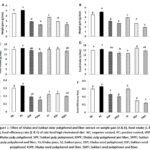 |
Figure 1: Effect of Khalas and Sukkari date polyphenol and fiber extract on weight gain (A & B), food intake (C & D), food efficiency rate (E & F) of rats feed high cholesterol diet. |
The results showed that the highest (P<0.05) weight gain (Fig. 1A & B) was recorded in rat fed standard diet containing 1% cholesterol (positive control, PC) followed by that fed standard diet only (negative control, NC). Interestingly, rat fed a standard diet containing 1% cholesterol and date fiber and administered with polyphenol extract of pulp, seeds, and juice of both date varieties exhibited significantly lower weight gain compared to both positive (PC) and negative (NC) control groups suggesting the weight reduction potential of Khalas and Sukkari date fiber extract of the fruit pulp and seeds and polyphenol extracts. Among the rat groups fed 1% cholesterol diet plus fiber and polyphenol and extract, the maximum reduction of weight gain was evident in SSPF group followed by that of KPPF group, KSPF group, and SPPF group indicating weight reducing effect when both polyphenol and dietary fiber were used combinedly in the diet. The food intake was insignificantly different between all groups with slight reduction of food intake was seen in the KPPF group, SPPF and SJ compared to the other groups (Fig. 1c &d), which could be due to the slight impact of polyphenol and fiber of both varieties on the rat appetite. The food efficiency rate was high in PC group followed by NC group and then SJ group (Fig. 1 e & f). Compared to PC and NC groups, low food efficiency rates were found in all groups fed with polyphenol and/or fiber extract of the pulp, seeds, and juice of both cultivars with the lowest ratio being seen in SSPF followed by SSP and KPPF.
Effect of date polyphenol and fiber extract on serum lipids of rat fed high cholesterol diet.
The results on the Effect of Khalas and Sukkari date polyphenol and fiber extract on serum total cholesterol, TC , High density lipoprotein-cholesterol, HDL-C (C & D), and triglyceride, TAG of rats feed high cholesterol diet are depicted in Figure 2 and effect of Khalas and Sukkari date polyphenol and fiber extract on serum low density lipoprotein-cholesterol, LDL-C , very low-density lipoprotein-cholesterol, vLDL-C , and arteriosclerosis index, AI of rats feed high cholesterol diet are depicted in Figure 3.
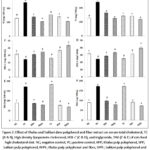 |
Figure 2: Effect of Khalas and Sukkari date polyphenol and fiber extract on serum total cholesterol, TC (A & B), High density lipoprotein-cholesterol, HDL-C (C & D), and triglyceride, TAG (E & F) of rats feed high cholesterol diet. |
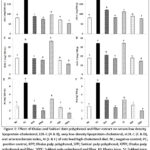 |
Figure 3: Effect of Khalas and Sukkari date polyphenol and fiber extract on serum low density lipoprotein-cholesterol, LDL-C (A & B), very low-density lipoprotein-cholesterol, vLDL-C (C & D), and arteriosclerosis index, AI (E & F) of rats feed high cholesterol diet. |
The overall results showed significant (P<0.05) effects of date polyphenol extract and dietary fiber on the lipid profile of hypercholesterolemic rats. Feeding rats with hypercholesterolemic diet significantly (P<0.05) augmented of total cholesterol (TC), triacyl glyceride (TAG), low density lipoprotein-cholesterol, (LDL-C), very low-density lipoprotein-cholesterol, (vLDL-C), and arteriosclerosis index (AI) and reduced the high-density lipoprotein-cholesterol (HDL-C) in cholesterol control (PC) group compared with those of non-cholesterol control (NC) group. Interestingly, feeding hypercholesterolemic rats with date polyphenol extract and/or dietary fiber of both Khalas and Sukkari date varieties significantly (P<0.05) reduced TC of hypercholesterolemic rats and the maximum reduction was achieved with KPPF and KSPF of both varieties suggesting pulp and seed polyphenols and fiber are reasonable for reducing TC of rats (Fig. 2 A & B). In addition, Khalas and Sukkari date polyphenol extract and/or dietary fiber extracts significantly (P<0.05) reduced the TAG to the lowest level in KSPF and SSPF groups, except KJ and SJ groups that showed increased TAG compared to PC and NC groups (Fig. 2 E & F). Khalas and Sukkari date polyphenol extract and/or dietary fiber significantly (P<0.05) increased the blood HDL-C to the maximum level in KSPF and SSPF groups (Fig. 2 C & D) indicating the seed polyphenol extract and fiber are effective in improving the HDL-C of rats. Feeding hypercholesterolemic rats with all forms of Khalas and Sukkari date polyphenol extract and/or dietary fiber significantly (P<0.05) reduced LDL-C (Fig 3. A & B), vLDL-C (Fig. 3 C & D), and AI (Fig. 3 E & F), except the group feed with KJ and SJ, which possessed increased levels of vLDL-C compared to that of PC. Hypercholesterolemic rat groups fed with KSPF and SSPF exhibited the least values of LDL-C, vLDL-C, and IA among all groups suggesting the greater positive impact of seed polyphenol extract and fiber on these attributes in rats. The augmented reduction of TC, TAG, LDL-C, vLDL-C, and AI and the increase of HDL-C in the serum of rat groups treated with the seed polyphenol and dietary fiber is likely due to high total phenolic and fiber content in the seeds of both varieties.
Effect of date polyphenol extract and dietary fiber on serum antioxidant enzymes of rat fed high cholesterol diet.
The results on the antioxidant enzymes in the serum of hypercholesterolemic and non-hypercholesterolemic rats fed with Khalas and Sukkari date polyphenol and fiber extracts are shown in Figure 4A-E.
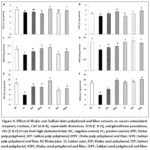 |
Figure 4: Effect of Khalas and Sukkari date polyphenol and fiber extracts on serum antioxidant enzymes; catalase, CAT (A & B), superoxide dismutase, SOD (C & D), and glutathione peroxidase, GPx (E & F) of rats feed high cholesterol diet. |
The highest catalase (CAT) activity was observed in the serum of NC, KJ, KSPF, and SSPF groups (Fig. 4A & B) whereas the lowest value was observed in hypercholesterolemic (PC) rats’ group. Feeding hypercholesterolemic rats with diets containing Khalas and Sukkari date polyphenols and dietary fiber significantly (P<0.05) enhanced the CAT activity to the highest levels in KJ, FSPF and SSPF groups compared to PC rats’ group demonstrating the positive impacts of the polyphenols and dietary fiber of the seeds of both cultivars and the juice polyphenols of Khalas on the CAT activity. The superoxide dismutase (SOD) activity of hypercholesterolemic rats was the lowest and feeding these rats with date polyphenols and fiber greatly (P<0.05) enhanced SOD activity to the highest levels in KPPF, KJ, SJ, SSP, and SSPF (Fig. 4 C& D). The glutathione peroxidase (GPx) was significantly low in hypercholesterolemic rats (PC) group and feeding these rats with date polyphenols and dietary fiber significantly (P<0.05) augmented the activity to the highest values in KJ, SPPF and SSPF rats (Fig. 4 E & F) indicating the positive effect of Khalas date juice and Sukkari date pulp and seeds polyphenol extract and dietary fiber on the GPx activity. Overall, it is clear that the activity of CAT, SOD, and GPx was lowest in hypercholesterolemic rats (PC) group and Khalas and Sukkari date polyphenols and dietary fiber enhanced the activity of these enzymes demonstrating the potentials of these polyphenols and fibers in improving and stabilizing antioxidants activity of rat serum.
Cholesterol diet.
The results on the inflammatory markers in hypercholesterolemic and non-hypercholesterolemic rats fed with Khalas and Sukkari date polyphenol extract and dietary fiber are shown in Figure 5a-d.
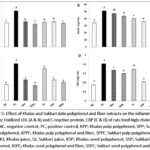 |
Figure 5: Effect of Khalas and Sukkari date polyphenol and fiber extracts on the inflammatory factors; Oxidized LDL (A & B) and C-reactive protein, CRP (C & D) of rats feed high cholesterol diet. |
The highest levels of oxidized low-density lipoprotein (OxLDL) and C-reactive protein (CRP) were seen in hypercholesterolemic rats (PC) group compared to non-hypercholesterolemic rats (NC) indicating that feeding rats on high cholesterol diet increased the levels of these inflammatory markers and induced inflammation in rats. Feeding hypercholesterolemic rats with Khalas and Sukkari date pulp, seeds, and juice polyphenols and fibers significantly (P<0.05) reduced the levels of OxLDL and CRP. The highest reduction of OxLDL was observed in the serum of KPPF, KSPF, and SSPF rat groups and that of CRP was seen in serum of KPPF and SPPF rat groups. These findings indicated that feeding hypercholesterolemic rats with date pulp and seed polyphenols plus fibers lowered the OxLDL and CRP levels and decreased the negative impacts of these inflammatory inducing markers on health.
Discussion
The results of the dietary fiber of date fruit pulp of Khalas and Sukkari are within the wide range (1.9 – 20.25 g/100 g) of dietary fiber in date fruit pulp reported for different date varieties 12. The dietary fiber content of the seeds of Khalas and Sukkari date cultivars was partially comparable with the previous findings, which demonstrated that date seed contains 60 – 80 g/100 g fiber 13. The dietary fiber content of date seeds in the current study is higher than that of a commercial fiber known as fibrex (65.74 g/100g), which obtained from the sugar beet as a byproduct of sugar extraction process 25. These findings revealed that date seeds could be utilized as the source of dietary fiber for food application and nutrition intervention. Significant variations (P<0.05) were seen in the total phenolic content (TPC) between date varieties and fruit parts. Date seeds also contain high quantities of TPC compared to pulp (359.5 mg GAE/100 g Khalas and 503.2 mg GAE/100 g Sukkari) and juice (398.4 2 mg GAE/100 g Sukkari and 207.7 2 mg GAE/100 g Khalas) with the highest value being observed in Sukkari date seeds (12128.8 mg GAE/100 g) followed by Khalas date seeds (6632.9 mg GAE /100 g). The results of TPC of date fruit pulp and juice are within the very wide range of TPC (2.89-3541 mg GAE/100 g DW) in different date fruits from different countries 14. revious studies have shown that Khalas date fruit contains TPC of 134-339 mg GAE/100 g 26, whereas that of Sukkari date fruits was 248 mg GAE/100 g 27. In agreement with our findings, the TPCs for both Sukari and Khalas date pits extracted with 80% acetone plus 1% formic acid were reported to be 5,046.30 mg GAE/ l00 g, and 13,393.73 mg GAE/ l00 g, respectively 28. In another study, the TPC of three Omani date seeds were ranged from 3,102 to 4,430 mg GAE/100 g 29. The antioxidant activity of date fruit pulp, seeds, and juice extracts showed some variations as assessed by the ABTS and DPPH radical scavenging activity. The highest ABTS scavenging activity was seen in Khalas juice (62.0%) and Sukkari seed extract (61.0%), whereas the least values were observed in Khalas pulp extracts (56.0%) and Sukkari juice (56.4%). The highest DPPH inhibition was observed in Sukkari pulp (58.1%) and Khalas seed (56.5%) extracts whereas the least value was seen in Khalas juice (34.2%). The results of antioxidant activity of Sukkari and Khalas date fruit pulp, seeds, and juice are comparable to previous reports on date types and parts from different countries 18. The antioxidant activity of the fruits of nine Saudi date varieties was 22-44% 16, of Libyan date flesh was 87.66 % 30, and date juice of Deglet Nour was 47.64% 31. The variations in TPC and antioxidant activity of date fruits among these studies are probably due to the differences in the maturity stage, geographical location, harvesting time, soil type, irrigation, and extraction solvents, conditions, and analytical methods 32. It is worth to note that high dietary fiber content and TPC of the seeds of Sukkari and Khalas date varieties pave the way for potential utilization of these valuable waste in food, nutritional, and pharmaceutical applications.
Similarly, the highest body weight was observed in hypercholesteremic control rat group compared to non-hypercholesteremic control group and oral administration of Ajwa date powder extract greatly reduced the body weight of hypercholesteremic rats 33. In addition, marked weight gain was reported in hyperlipidemic rats group compared to control group and administration of 200 and 400 mg/kg body weight/day of Jihel and Majhoul date seeds extracts significantly reduced the body weight of hyperlipidemic rats 34. Moreover, high fat diet rats showed increased weight gain compared to normal diet rats and feeding hyperlipidemic rats with Bousrdoun and Majhoul date fruit extracts resulted in more than 2-folds reduction of the body weight compared to hyperlipidemic rats’ group 11. Furthermore, higher food intake and body weight gain was reported in rats fed high fat diet compared to those received standard diet and feeding these rats with Barhi and Ruthana date seed extracts induced drastic weight reduction in high fat diet receiving groups 6. The reduction of body weight of hypercholesteremic rats with Khalas and Sukkari polyphenols and fiber extracts is probably due to the inhibition of enzymes involved in lipid metabolisms by the bioactive compounds in date fruit and seed extracts 33,34
Dietary fiber and polyphenol are known to minimize the absorption and reabsorption of the cholesterol in the bile sap and the intestine, prevent the hepatic biosynthesis of cholesterol through the generation of short chain fatty acids, reduce the atherogenicity of the LDL, and reduction of insulin secretion and synthesis and thereby demonstrated hypocholesteremia in rat and human models 18. The aforementioned mechanisms can explain the improvement of lipid profile of rat treated with date seed polyphenol extract and dietary fiber. In agreement with our findings numerous previous studies demonstrated that date pulp and/or seed extracts improved the plasma lipids of hypercholesterolemic rat models. 33 stated that oral administration of hypercholesterolemic rats with different concentrations (25, 50, and 100 mg/kg body weight/day) of Ajwa date powder extract significantly reduced TC, TAG, LDL-C, vLDL-C, and AI and increased the HDL-C in rat plasma and attributed that to the direct and indirect inhibition of cholesterol synthesis. 35 reported that Aseel date fruit solution at 300 mg/kg body weight/day reduced the TC, TAG, LDL-C, and vLDL-C of rat fed high sugar-high saturated fat diet. In addition, 36 demonstrated that incorporation of dates into diet of high cholesterol-induced hamsters resulted in the reduction of serum TC, TAG, and LDL-C and increase of the serum HDL-C. Moreover, 11,9 reported that the fruit extracts of two Moroccan date fruit varieties namely Majhoul and Bousrdoun reduced the TC, TAG, LDL-C and increased the HDL-C of high-fat diet hyperlipidemic rats. Date seed extract improved the lipid profile of hypercholesterolemic rats by lowering TC and LDL-C and increasing the HDL-C in rat plasma 7. In addition, date seed extracts at different doses improved plasma lipid profile of diabetic-induced rats 30,37,38. Furthermore, date seeds extract of different date varieties reduced the TC, TAG, and LDL-C and increased HDL-C in high fat diet induced hyperlipidemia in rats 4,34. Overall the finding of this study revealed that date seeds polyphenols and fiber can improve the serum lipid profile and thereby prevent and control the coronary heart diseases because the serum lipid profile is the major predictor of heart diseases.
The body defense systems depend on CAT, SOD and GPx enzymes to overcome the oxidative stress risks through the reaction of CAT with hydrogen peroxides and conversion of hydro829peroxides into nontoxic metabolites, prevention of peroxide formation by SOD, and decomposition of lipid peroxides by GPx 39,40. Feeding rats with high cholesterol diet decreased the CAT, SOD, and GPx activity and thus demonstrated negative impact on the antioxidant defense system. Lowering the activity of these enzymes might lead to the formation of reactive oxygen species (ROS) in hypercholesterolemic rats, which could promote the development of numerous chronic diseases namely atherosclerosis, cancers, aging, diabetes, cardiovascular diseases 41. Interestingly, Khalas and Sukkari date polyphenols and dietary fiber increased and restored the activity of CAT, SOD, and GPx and consequently improves the antioxidant defense system in hypercholesterolemic rats and thereby prevent the development of hypercholesterolemic-related cardiovascular diseases. In agreement with our findings, previous reports have shown that feeding rats with high fat and/or cholesterol-rich diets decreases the activity of CAT, SOD, and GPx, which was restored by incorporation of date fruits and seed extracts in the diet 6,33,42,43
OxLDL interact with Toll-like receptors and activate the innate immune system thereby induce the expression of various pro-inflammatory molecules such as ROS, RNS, cytokines, chemokines, and stimulatory molecules 44. CRP acts as a marker and a mediator of atherosclerosis and coronary heart disease by its contribution in the macrophage lipid uptake, cytokines release, monocytes tissue factors expression induction, complement pathway activation and nitric oxide production inhibition 44. Reduction of oxLDL and CRP is of critical significance and interestingly date pulp and seed polyphenol extracts and dietary fibers in this study greatly reduced these inflammatory markers in hypercholesterolemic rats. Similar observations on the reduction of CRP and OxLDL are reported in studies using olives 45, Crataegus Aronia extract 46, and date seed extract 6,47 +and the effects were attributed to the bioactive compounds in the extracts. In this study, date pulp and seeds contain substantial amounts of polyphenols and dietary fibers that can inhibit the oxidative stress processes, prevent oxidation of LDL, and reduce the level of CRP and thus inhibit the inflammation pathways.
Conclusion
Khalas and Sukkari date fruit pulp and seeds are rich of polyphenols and fiber and could be considered as an excellent source of these vital nutrients for food and nutritional applications. The seeds extract of both date varieties outscore fruit pulp extract and juice in the bioactive composition and its beneficial hypocholesterolemic, antioxidant, and anti-inflammatory properties. Addition of Khalas and Sukkari date fruit pulp and seeds are rich of polyphenols and fiber to the diet of hypercholesterolemic rats improves the lipid profile by lowering TC, TAG, LDL-C, vLDL-C, and AI and increasing HDL-C, enhance the antioxidant defense system by increasing the activity of SOD, CAT, and GPx, and prevent inflammation by inhibiting the LDL oxidation and CRP synthesis. Thus, date seeds of Khalas and Sukkari varieties could be utilized in the production of functional foods and pharmaceutical supplements with the propose of prevention of hypercholesterolemia-related cardiovascular diseases. Further studies shall specifically focus on the in-depth characterization of the bioactive compounds and dietary fiber types of the date seeds contribute in the hypocholesterolemia, antioxidant, and anti-inflammatory properties of these seeds to understand the mechanisms of the beneficial impacts of these seeds on human health.
Despite the well-documented nutritional value of date fruits, there remains a lack of comprehensive in vivo investigations into the distinct roles of polyphenol- and fiber-rich extracts derived from different anatomical parts—namely pulp, seeds, and juice—of specific cultivars such as Sukkari and Khalas. This study addresses this gap by systematically evaluating and comparing their hypocholesterolemic, antioxidant, and anti-inflammatory effects in a cholesterol-induced rat model. The findings offer novel insights into the therapeutic potential of date seed extracts, supporting their future use in functional foods or nutraceutical applications aimed at cardiovascular health.
Acknowledgement
The authors gratefully acknowledge the support of the ongoing research funding program (ORF-2025-805), King Saud University, Riyadh, Saudi Arabia.
Funding Sources
The research supported by the ongoing research funding program (ORF-2025-805), King Saud University, Riyadh, Saudi Arabia.
Conflict of Interest
The authors do not have any conflict of interest.
Data Availability Statement
The data that support the findings of this study are available from the corresponding author upon reasonable request.
Ethics Statement
This study was conducted in accordance with the ethical standards of (KSU-SE-12-01) and with the 1964 Helsinki Declaration and its later amendments.
Informed Consent Statement
Informed consent was obtained from all individual participants included in the study.
Permission to Reproduce Material from Other Sources
Permission to reproduce copyrighted materials (e.g., figures, tables, questionnaires) was obtained from the original copyright holders, and proper attribution is provided.
Clinical Trial Registration
This research does not involve any clinical trials
Author Contributions
- Doha Mustafa.Al-Nouri.; methodology and investigation,
- Abdulrahman Al-Khalifa; supervision and validation,
- Magdi Osman; supervision, funding acquisition, writing-review and editing,
- Isam Ali Mohamed Ahmed; formal analysis, validation, writing-review and editing,
- Mohamed Alqarni.; methodology, validation,
- Dalia Al‐Tamimi.; software and data curation.
- Ghalia Shamlan: reviewing, editing, software and data curation.
References
- Nie C, Zhang F, Ma X, et al. Determination of quality markers of Xuezhiling tablet for hyperlipidemia treatment. Phytomedicine. 2018;44:231-238.
CrossRef - Bahmani M, Mirhoseini M, Shirzad H, Sedighi M, Shahinfard N, Rafieian-Kopaei M. A review on promising natural agents effective on hyperlipidemia. Journal of evidence-based complementary & alternative medicine. 2015;20(3):228-238.
CrossRef - Singh H, Bharti J. Non-Communicable Diseases and Their Risk Factors. EAS J Parasitol Infect Dis. 2021;3(6):83-86.
- Khan TJ, Kuerban A, Razvi SS, et al. In vivo evaluation of hypolipidemic and antioxidative effect of ‘Ajwa’(Phoenix dactylifera L.) date seed-extract in high-fat diet-induced hyperlipidemic rat model. Biomedicine & Pharmacotherapy. 2018;107:675-680.
CrossRef - Wajpeyi SM. Analysis of etiological factors of dyslipidemia-A case control study. International Journal of Ayurvedic Medicine. 2020;11(1):92-97.
CrossRef - Zarie AA, Osman MA, Alshammari GM, Hassan AB, Yagoub AEA, Yahya MA. Saudi date cultivars’ seed extracts inhibit developing hepatic steatosis in rats fed a high-fat diet. Saudi Journal of Biological Sciences. 2023;30(9):103732.
CrossRef - Saryono S, Eliyan J, Herdiati D, Khikmatullah A, Silvana C, Adi H. Anti-atherogenic properties of Deglet Noor date seeds (Phoenix dactylifera) methanol extract on diet-induced hypercholesterolemic rats. IOP Publishing; 2017:012046.
CrossRef - López-Contreras AK, Martínez-Ruiz MG, Olvera-Montaño C, et al. Importance of the use of oxidative stress biomarkers and inflammatory profile in aqueous and vitreous humor in diabetic retinopathy. Antioxidants. 2020;9(9):891.
CrossRef - Cabral CE, Klein MRST. Phytosterols in the treatment of hypercholesterolemia and prevention of cardiovascular diseases. Arquivos brasileiros de cardiologia. 2017;109:475-482.
CrossRef - Duraipandiyan V, Al-Dhabi NA, Irudayaraj SS, Sunil C. Hypolipidemic activity of friedelin isolated from Azima tetracantha in hyperlipidemic rats. Revista Brasileira de Farmacognosia. 2016;26:89-93.
CrossRef - Bouhlali EDT, Hmidani A, Bourkhis B, Moussafir Z, Filali-Zegzouti Y, Alem C. Date (Phoenix dactylifera L.) Fruits as a Potential Lipid-Lowering Therapy: Effect on High-Fat Diet and Triton-WR-1339-Induced Hyperlipidemic Rats. Drugs and Drug Candidates. 2023;2(2):422-432.
CrossRef - Fernández-López J, Viuda-Martos M, Sayas-Barberá E, Navarro-Rodríguez de Vera C, Pérez-Álvarez JÁ. Biological, nutritive, functional and healthy potential of date palm fruit (Phoenix dactylifera L.): Current research and future prospects. Agronomy. 2022;12(4):876.
CrossRef - Al-Khalili M, Al-Habsi N, Rahman MS. Applications of date pits in foods to enhance their functionality and quality: A review. Frontiers in Sustainable Food Systems. 2023;6:1101043.
CrossRef - Echegaray N, Gullón B, Pateiro M, Amarowicz R, Misihairabgwi JM, Lorenzo JM. Date fruit and its by-products as promising source of bioactive components: A review. Food Reviews International. 2023;39(3):1411-1432.
CrossRef - Fao F. Food and agriculture organization of the United Nations. Rome, URL: http://faostat fao org. 2018;403.
- Abdul-Hamid NA, Mustaffer NH, Maulidiani M, et al. Quality evaluation of the physical properties, phytochemicals, biological activities and proximate analysis of nine Saudi date palm fruit varieties. Journal of the Saudi Society of Agricultural Sciences. 2020;19(2):151-160.
CrossRef - Aleid SM, Al-Khayri JM, Al-Bahrany AM. Date palm status and perspective in Saudi Arabia. Date Palm Genetic Resources and Utilization: Volume 2: Asia and Europe. 2015:49-95.
CrossRef - Echegaray N, Pateiro M, Gullon B, Amarowicz R, Misihairabgwi JM, Lorenzo JM. Phoenix dactylifera products in human health–A review. Trends in Food Science & Technology. 2020;105:238-250.
CrossRef - Biglari F, AlKarkhi AF, Easa AM. Antioxidant activity and phenolic content of various date palm (Phoenix dactylifera) fruits from Iran. Food chemistry. 2008;107(4):1636-1641.
CrossRef - Nawaz H, Shi J, Mittal GS, Kakuda Y. Extraction of polyphenols from grape seeds and concentration by ultrafiltration. Separation and Purification Technology. 2006;48(2):176-181.
CrossRef - Thaipong K, Boonprakob U, Crosby K, Cisneros-Zevallos L, Byrne DH. Comparison of ABTS, DPPH, FRAP, and ORAC assays for estimating antioxidant activity from guava fruit extracts. Journal of food composition and analysis. 2006;19(6-7):669-675.
CrossRef - Borchani C, Besbes S, Masmoudi M, Blecker C, Paquot M, Attia H. Effect of drying methods on physico-chemical and antioxidant properties of date fibre concentrates. Food Chemistry. 2011;125(4):1194-1201.
CrossRef - Reeves PG, Nielsen FH, Fahey Jr GC. AIN-93 purified diets for laboratory rodents: final report of the American Institute of Nutrition ad hoc writing committee on the reformulation of the AIN-76A rodent diet. The Journal of nutrition. 1993;123(11):1939-1951.
CrossRef - Van Horn L, Emidy LA, Liu K, et al. Serum lipid response to a fat-modified, oatmeal-enhanced diet. Preventive medicine. 1988;17(3):377-386.
CrossRef - Idowu AT, Igiehon OO, Adekoya AE, Idowu S. Dates palm fruits: A review of their nutritional components, bioactivities and functional food applications. AIMS Agriculture and Food. 2020;5(4):734-755.
CrossRef - Al-Farsi M, Alasalvar C, Morris A, Baron M, Shahidi F. Comparison of antioxidant activity, anthocyanins, carotenoids, and phenolics of three native fresh and sun-dried date (Phoenix dactylifera L.) varieties grown in Oman. Journal of agricultural and food chemistry. 2005;53(19):7592-7599.
CrossRef - El-Mergawi RA, AlGeffari MA, Al-Humaid A. Sugar types, phenolic contents, and antioxidant activities for 17 Saudi Arabian date cultivars and their relations with glycemic indices. International Journal of Fruit Science. 2019;19(3):315-325.
CrossRef - Al-Turki SM. Antioxidant properties of date palm (Phoenix dactylifera L.) cultivars. Colorado State University; 2008.
- Al-Farsi M, Alasalvar C, Al-Abid M, Al-Shoaily K, Al-Amry M, Al-Rawahy F. Compositional and functional characteristics of dates, syrups, and their by-products. Food chemistry. 2007;104(3):943-947.
CrossRef - Hasan M, Mohieldein A. In vivo evaluation of anti diabetic, hypolipidemic, antioxidative activities of Saudi date seed extract on streptozotocin induced diabetic rats. Journal of clinical and diagnostic research: JCDR. 2016;10(3):FF06.
CrossRef - Ben Thabet I, Besbes S, Attia H, et al. Physicochemical characteristics of date sap “lagmi” from deglet nour palm (Phoenix dactylifera L.). International Journal of Food Properties. 2009;12(3):659-670.
CrossRef - AlFaris NA, AlTamimi JZ, AlGhamdi FA, et al. Total phenolic content in ripe date fruits (Phoenix dactylifera L.): A systematic review and meta-analysis. Saudi Journal of Biological Sciences. 2021;28(6):3566-3577.
CrossRef - Alqarni MM, Osman MA, Al‐Tamimi DS, et al. Antioxidant and antihyperlipidemic effects of Ajwa date (Phoenix dactylifera L.) extracts in rats fed a cholesterol‐rich diet. Journal of food biochemistry. 2019;43(8):e12933.
CrossRef - Hmidani A, Bourkhis B, Khouya T, Harnafi H, Filali-Zegzouti Y, Alem C. Effect of Phoenix dactylifera seeds (dates) extract in triton WR-1339 and high fat diet induced hyperlipidaemia in rats: A comparison with simvastatin. Journal of Ethnopharmacology. 2020;259:112961.
CrossRef - Ahmed S, Alam Khan R, Jamil S. Anti hyperlipidemic and hepatoprotective effects of native date fruit variety” Aseel”(Phoenix dactylifera). Pakistan journal of pharmaceutical sciences. 2016;29(6).
- Alsaif MA, Khan LK, Alhamdan AA, et al. Effect of dates and gahwa (Arabian coffee) supplementation on lipids in hypercholesterolemic hamsters. International Journal of Pharmacology. 2007;3(2):123-129.
CrossRef - Abiola T. Assessment of the Antidiabetic Potential of the Ethanolic Extract of Date Palm (Phoenix Dactylifera) Seed in Alloxan-Induced Diabetic Rats. 2018;
- Melek F, Saleh D, Medhat A, Farrag A, Ghaly N, Baraka S. ANTIDIABETIC and ANTIOXIDANT ACTIVITIES of Phoenix dactylifera L. Seed extract in streptozotocin-induced diabetic rats. Malaysian. J Biochem Mol Biol. 2019;22(1):53-59.
- Fki I, Bouaziz M, Sahnoun Z, Sayadi S. Hypocholesterolemic effects of phenolic-rich extracts of Chemlali olive cultivar in rats fed a cholesterol-rich diet. Bioorganic & medicinal chemistry. 2005;13(18):5362-5370.
CrossRef - Chenni A, Ait Yahia D, Boukortt F, Prost J, Lacaille-Dubois M, Bouchenak M. Effect of aqueous extract of Ajuga iva supplementation on plasma lipid profile and tissue antioxidant status in rats fed a high-cholesterol diet. Journal of ethnopharmacology. 2007;109(2):207-213.
CrossRef - Alfadda AA, Sallam RM. Reactive oxygen species in health and disease. BioMed research international. 2012;2012(1):936486.
CrossRef - Al-Yahya M, Raish M, AlSaid MS, et al. ‘Ajwa’dates (Phoenix dactylifera L.) extract ameliorates isoproterenol-induced cardiomyopathy through downregulation of oxidative, inflammatory and apoptotic molecules in rodent model. Phytomedicine. 2016;23(11):1240-1248.
CrossRef - Bikri S, Aboussaleh Y, Abuelezz N, et al. Phenolic fraction concentrate of Phoenix dactylifera L. seeds: a promising antioxidant and glucose regulator. J Pharm Pharmacogn Res. 2021;9(6):921-36.
CrossRef - Meqbaali AA, Saif FT. The Potential Antioxidant and anti-inflammatory effects of date seed powder in rats. 2016;
- Conterno L, Martinelli F, Tamburini M, et al. Measuring the impact of olive pomace enriched biscuits on the gut microbiota and its metabolic activity in mildly hypercholesterolaemic subjects. European journal of nutrition. 2019;58:63-81.
CrossRef - Shatoor AS, Al Humayed S, Alkhateeb MA, et al. Crataegus Aronia protects and reverses vascular inflammation in a high fat diet rat model by an antioxidant mechanism and modulating serum levels of oxidized low-density lipoprotein. Pharmaceutical biology. 2019;57(1):37-47.
CrossRef - Karimi E, Dehghan P, Azizi-Soleiman F, Mohamadizadeh M. Date seed (Phoenix dactylifera) supplementation modulates oxidative DNA damage, lipid peroxidation, and cardiometabolic risk factors in type 2 diabetes: A triple-blinded randomized placebo-controlled trial. Journal of Functional Foods. 2024;117:106226.
CrossRef
Abbreviations List
Total Phenolic Contents (TPC)
Total Cholesterol (TC)
Triacyllycerides (TAG)
Low‐Density Lipoprotein Cholesterol (LDL‐C)
Very‐Low Density Lipoprotein Cholesterol (VLDL‐C)
Arteriosclerosis Index (AI)
Oxidized Low‐Density Lipoprotein (OxLDL)
C-reactive protein (CRP)
High‐Density Lipoprotein Cholesterol (HDL‐C).
Cardiovascular diseases (CVDs)
Folin-Ciocalteu (FC),
Negative Control (NC),
Positive Control (PC)
Sukari Pulp Polyphenol (SPP)
Sukari Pulp Polyphenol (SPP)
Sukari Juice (SJ)
Khalas Pulp Polyphenol (KPP)
Khalas Pulp Polyphenol extract + 5% Fiber (KPPF)
Khalas Juice (KJ)
Sukari Seed Polyphenol (SSP)
Sukari Seed Polyphenols extract +5% fiber (SSPF)
Khalas Seed Polyphenol extract (KSP)
Khalas seed polyphenol extract + 5% seed fiber (KSPF),
low-density lipoprotein cholesterol (vLDL-C).
Atherogenic Index (AI),
Glutathione Peroxidase (GPx),
Superoxide Dismutase (SOD),
Catalase (CAT)
 PlumX:
 Views: 322
  PDF Downloads:
386
PDF Downloads:
386 
Accepted on: 30 Jun 2025
Second Review by: Jana Klopchevska
Final Approval by: Dr. Haroon Khan





Web of Science Coverage
Emerging Sources Citation Index (ESCI)
2024 Journal Impact Factor: 1.1
Scopus Journal Metrics
CiteScore 2024: 1.9
CiteScore Details
Sustainable Nutrition: Food Systems, Nutrient Retention, and Public Health Impact

This journal is a member of, and subscribes to the principles of, the Committee on Publication Ethics (COPE)