
Yam Flour (Dioscorea alata): An Alternative for Use in the Baking Industry
Dayana Cervantes-Maza1 , Piedad Montero-Castillo2 and Katherine Paternina-Sierra3*
1Department of Engineering, Food Engineering Program, University of Cartagena, Cartagena, Colombia.
2Department of Engineering, Food Engineering, Agricultural and Agro-Industrial Innovation and Development Research Group (IDAA), University of Cartagena, Cartagena, Colombia.
3Department of Economic Sciences, University of Cartagena, Cartagena, Colombia.
Corresponding Author Email: kpaterninas@unicartagena.edu.co
DOI : http://dx.doi.org/10.12944/CRNFSJ.13.3.32
Download this article as:

Yam (Dioscorea spp.), a member of the Dioscoreaceae family, is a tuber crop of high nutritional and agro-industrial value. The variety Dioscorea alata is widely cultivated in the Colombian Caribbean but faces challenges such as post-harvest losses and limited industrial application. This study aimed to evaluate the quality attributes of biscuits formulated with partial substitution of wheat flour by Dioscorea alata flour. Biscuits are widely consumed baked goods with long shelf life and are suitable vehicles for nutritional enhancement through flour substitution. Four formulations were developed with 0%, 20%, 30%, and 40% yam flour substitution levels. Physicochemical parameters, bromatological composition, microbiological quality, sensory attributes, and instrumental texture profile analysis (TPA) were assessed. The incorporation of yam flour increased fiber and carbohydrate content while reducing protein and ash levels, with carbohydrate content reaching 81.52% in the 40% formulation. Moisture content decreased from 12.82% (control) to 10.21% (T3), whereas fat content increased from 1.41% to 1.95%. Microbiological analysis confirmed compliance with NTC 1241 standards, ensuring product safety. Sensory evaluation showed no significant differences (p > 0.05) among treatments, with acceptability scores between 5.41 and 5.74, indicating good consumer acceptance up to 40% substitution. The 30% substitution level showed the highest sensory preference. Texture analysis revealed the lowest hardness at 30% substitution (4862.07 N) and the highest at 40% (7589.12 N), suggesting that moderate substitution improves softness while higher levels increase compactness. Overall, yam flour substitution up to 40% maintained desirable quality attributes without compromising texture, flavor, or safety; these findings support the use of Dioscorea alata flour as a functional ingredient in biscuit production, promoting the utilization of local crops and innovation in traditional bakery products.
KEYWORDS:Dioscorea alata; Filled cookie; Flour; Physicochemical properties; Quality; Substitution; Texture
Introduction
Yam (Dioscorea spp.), a member of the Dioscoreaceae family, is a prominent tuber crop with over 600 cultivated species globally, primarily in regions such as Africa, Asia, and South America.1 In Eastern countries, yam has traditionally been utilized not only as a dietary staple but also as an herbal remedy to promote health and well-being.2 Nutritionally, yam represents a significant source of carbohydrates and, to a lesser extent, contributes proteins, vitamins, and minerals,3,4 making it particularly valuable in regions where it is a primary crop. As of 2021, global yam production reached 75,142,630.14 metric tons, with Africa particularly Nigeria accounting for 97.8% of total output. The Americas contributed 1.4%, with Colombia being the leading producer in the region at 409,423.31 tons.5
Although numerous yam species flourish in the humid tropics, only approximately ten are typically consumed for food. The most economically important species are Dioscorea rotundata, Dioscorea alata, and Dioscorea cayenensis.6 This study focuses on Dioscorea alata, a species valued for its high carbohydrate content and presence of vital elements like starch, fiber, and vitamins.7,8 Furthermore, it is regarded as the most frequently cultivated yam species worldwide.9
Yam includes a wide range of nutritional and functional bioactive components and has significant potential for translation into value-added food products.10 However, various postharvest constraints continue to make Dioscorea alata’s use difficult. Notably, losses during storage and transportation, which are frequently caused by insufficient traditional handling methods, have been associated to considerable decreases in both tuber quality and yield.11,12
Furthermore, the crop’s agro-industrial potential is not being fully realized. Despite its beneficial characteristics, yam is underutilized as a raw material for food innovation and product diversity.13 In this perspective, yam flour appears to be a promising alternative for the food business. Its use not only extends the shelf life and commercial value of yam, but also enables its use as a functional ingredient in a variety of food formulations.7,14 The manufacturing of yam flour takes advantage of the tuber’s functional characteristics, helping to ensure food security and economic stability.10 Additionally, yam flour is rapidly being investigated as a partial alternative for wheat flour in the creation of baked goods such as bread, biscuits, and muffins,15-21 with encouraging findings in terms of product quality and consumer acceptance.
In this regard, studies such as “Evaluation of Yam Flour as a Partial Substitute for Wheat Flour in Bread Making”22 found that yam flour improves certain functional properties (such as water absorption and solubility), although it may reduce loaf volume and cause surface cracking at high substitution levels. From a sensory perspective, its use was acceptable up to 30%, and nutritionally, it contributes minerals but is relatively low in protein content. Similarly, the study “Assessment of sensory properties of optimized wheat- white yam composite cookies using response surface methodology”23 examined how dough thickness and baking temperature influence biscuits made from a blend of wheat (90%) and white yam (10%) flours, enriched with moringa and uziza. Using a CCRD design and sensory evaluation with 30 panelists, the optimal formulation was identified as 4 mm thickness and 165 °C baking temperature, achieving high scores for appearance, flavor, aroma, and texture. Together, these studies emphasize the potential of yam flour as a functional and sustainable alternative to wheat flour in bakery products, while also highlighting the need for further research on different substitution levels, nutritional composition, and product shelf life.
Among bakery products, biscuits are particularly popular due to their affordability, ease of preparation, and longer shelf life compared to other baked items.10 In addition to their convenience as snacks to combat short-term fatigue, biscuits can serve as carriers for functional ingredients. Functional biscuits may offer added health benefits, contributing to recommended nutrient intake, enhancing general wellness, and potentially reducing dependence on nutritional supplements.24 Though different types of biscuits have gained popularity in recent years such as those made with legume flours among others, 25-27 their traditional formulation typically involves combining butter, sugar, eggs, and flour.28 Variations in ingredient proportions, as well as differences in processing technologies, significantly influence the texture, structure, and rheological properties of the final product.28 These characteristics play a crucial role in consumer perception and acceptance, as texture and mouthfeel are key determinants of biscuit quality.29 Due to their high consumption and low production cost, biscuits represent a strategic vehicle for delivering nutritionally enhanced foods to a wide population. Given this context, the objective of this study is to evaluate the quality attributes of filled biscuits formulated with partial substitution of wheat flour by yam flour (Dioscorea alata). The physicochemical, microbiological, sensory, and textural properties are characterized to determine the effects of substitution on composition, consumer acceptance, and structural integrity. Additionally, the study aims to assess to supporting the feasibility of using yam flour in bakery products.
Materials and Methods
Experimental design
A completely randomized experimental design was followed, in which the independent variable corresponded to the percentage of wheat flour substituted with Dioscorea alata flour used in the preparation of the biscuits. Based on the methodology reported by Zucco et al.30 with slight modifications, four treatments were obtained with the following wheat flour to yam flour (WF:YF) ratios: control (100:0), T1 (80:20), T2 (70:30), and T3 (60:40).
Table 1: Composite flour formulations prepared from the mixture of wheat flour (WF) and Dioscorea alata (yam) flour (YF).
|
|
Control | T1 | T2 | T3 |
|
WF(%) |
100 | 80 | 70 |
60 |
| YF(%) | – | 20 | 30 |
40 |
Obtaining yam flour
To prepare the Dioscorea alata flour, the modified methodology established by Setyawan et al.31 was followed. Undamaged yams were selected, washed with water, peeled, and cut into 2 mm thick slices. The slices were then immersed in 1% citric acid for 10 minutes, followed by blanching at 50°C for 3 minutes, and then immersed in water for 4 hours. Finally, they were dried in a forced convection oven (Tornado, Colombia) at 70°C for 2 hours; once dehydrated, they were ground and sieved. Finally, the flour was packaged in airtight metallized bags.
Formulation and preparation of biscuits
The ingredients used in the biscuit formulation included wheat flour, flour Dioscorea alata, sugar, butter, water, fresh yeast, baking powder, vanilla essence, and salt. Four types of biscuits were prepared, each corresponding to a different level of wheat flour substitution with yam flour: Control (100% wheat flour), T1 (20% substitution), T2 (30% substitution), and T3 (40% substitution). The specific formulation for each treatment is presented in Table 2.
Table 2: Formulation of biscuit dough
|
Ingredients |
Samples | |||
| Control | T1 | T2 |
T3 |
|
|
Wheat flour |
500g | 400g | 350g | 300g |
| Yam flour | 0 | 100g | 150g |
200g |
|
Butter |
70g | 70g | 70g | 70g |
| Sugar | 250g | 250g | 250g |
250g |
|
Water |
200ml | 200ml | 200ml | 200ml |
| Fresh yeast | 10g | 10g | 10g |
10g |
|
Baking powder |
10g | 10g | 10g | 10g |
| Vanilla essence | 2.5ml | 2.5ml | 2.5ml |
2.5ml |
|
Salt |
2.5g | 2.5g | 2.5g |
2.5g |
The process began with the reception, inspection, and weighing of the raw materials. The dough was prepared in two stages: first, sugar, fresh yeast, and vanilla essence were dissolved in water, and then the sifted dry ingredients were added. After kneading until a uniform consistency was achieved, the dough was rolled out to a thickness of 2 cm, cut into circles, and fermented for 60 minutes. The biscuits were then baked at 160°C for 16-20 minutes, cooled to room temperature, filled with dulce de leche, and glazed with meringue made from egg whites, sugar, lemon, and vanilla. Finally, they were left to rest until the coating hardened, then packaged and stored under appropriate conditions.
Physicochemical properties
The pH measurement was performed following the method described by Haase et al.32 with some modifications. 0.5 grams of ground biscuits were suspended in 20 milliliters of distilled water, mixed for 3 minutes and rested for 1 hour. Subsequently, the pH of the supernatant was measured using a Hanna Instruments pH meter. The acidity was determined by titration with a 0.1N solution of NaOH and 1% phenolphthalein as indicator. The color parameters (CIE L* a* b*) of the biscuits were determined using a colorimeter (Konica Minolta, EE.UU.) L* defines lightness and values range from 0 (black) to 100 (white), while a* and b* denote green (-a) to red (+a) and blue (-b) to yellow (+b) respectively. The whiteness (W) was calculated according to the following equation 1.

Proximate analysis
For proximate analysis of the biscuits, AOAC standard analytical methods33 were followed for moisture content (925.09), total ash (923.03), crude protein (960.52), crude fat (920.85), crude fiber (993.21). Carbohydrates were calculated by difference according to equation 2.

Microbiological characterization
The microbiological analysis was carried out in accordance with NTC 1241,34 which establishes the requirements that biscuits for human consumption must meet. In this way, the mesophilic aerobic bacteria count CFU/g, coliform plate count and Escherichia coli count, CFU/g, were determined, coagulase-positive Staphylococcus aureus count CFU/g, mold and yeast count, Bacillus cereus count, CFU/g and Salmonella.
Sensory Analysis
A sensory analysis was conducted with a panel of 70 untrained cookie consumers. Freshly baked biscuits were used for the evaluation of sensory attributes. Samples were served on white plates, each labeled with randomly assigned three-digit codes to eliminate bias. The order of presentation was randomized, and panelists were provided with drinking water to rinse their mouths between samples to minimize carryover effects. The evaluation was performed using a 7-point hedonic scale, where 1 = “Dislike extremely”, 2 = “Dislike very much”, 3 = “Dislike slightly”, 4 = “Neither like nor dislike”, 5 = “Like slightly”, 6 = “Like moderately”, and 7 = “Like very much”.35 The assessed attributes included appearance, color, aroma, taste, flavor, texture, and overall acceptability. Overall acceptability was calculated as the average of all the individual sensory parameters.36
Texture Profile Analysis (TPA)
According to the results of the sensory analysis, TPA was performed for the 4 treatments. According to Bourne37 and Correa38 to perform TPA, the samples were subjected to two successive compressions with a rest interval between them. Taking into account the methodology reported by Kaur et al.39 The hardness of the prepared biscuits was measured using P/75 aluminum probe; pretest speed 3 mm/s, test speed 3 mm/s, posttest speed 3 mm/s; 25% deformation, load cell 50 kg-f. TATX plus Stable Microsystem texturometer equipment Approximate shape of specimens cylindrical: diameter range 58-64 mm and height range 18-29 mm. The value reported for each test parameter (hardness, adhesiveness, cohesiveness, gumminess, elasticity, resilience, chewiness) corresponds to measurements on four specimens belonging to the same class of samples (replicates).
Statistical Analysis
All experiments were carried out in triplicate, except for the texture profile analysis (TPA), which was conducted in quadruplicate. Data are presented as the mean ± standard deviation (SD). Statistical analysis was performed using IBM SPSS Statistics software (version 23 for Windows 11). An analysis of variance (ANOVA) followed by Tukey’s HSD test was applied to compare means, with the level of significance set at p < 0.05.
Results
Physicochemical properties
The pH analysis showed a progressive and statistically significant decrease as the substitution level with diamond yam flour increased. Nevertheless, all treatments remained within values close to neutrality (pH 6.2–6.6), which are characteristic of baked products such as biscuits.
Table 3: pH, Acidity and color measurement in biscuits.
|
Parameters |
Treatments | |||
| Control | T1 | T2 |
T3 |
|
|
pH |
7.0367±0.015a | 6.9100±0.020b | 6.5100±0.020c |
6.4467±0.015d |
|
Acidity |
0.0427±0.018b | 0.0427±0.018b | 0.1280±0.000a | 0.1493±0.037a |
| L* | 67.6733±3.423a | 67.3067±1.44a | 65.8033±3.508a |
65.7400±1.681a |
|
a* |
3.0200±1.671a | 4.2567±1.641a | 5.6767±2.685a | 6.1900±2.476a |
|
b* |
29.5033±2.499a | 28.1267±2.192a | 28.400±2.966a | 27.4633±3.561a |
| %W | 56.0900±3.940a | 56.6467±2.669a | 55.1200±3.850a |
55.5500±2.758a |
Values represent the averages of three replicates (mean ± SD). Means that are denoted by different letters between treatments indicate a significant difference at (P <0.05).
Proximate Analysis
The results indicate that the moisture content decreased progressively with the increase in the substitution level of yam flour. The control sample presented a moisture content of 12.82%, while T1 and T2 showed values of 12.12% and 12.27%, respectively, with no significant differences. Similarly, the T3 sample experienced a significant reduction to 10.21%.
Ash content decreased progressively from 1.17% in the control to 0.61% in T3.
Table 4: Proximate composition of the biscuits.
|
Components (%) |
Treatments | |||
| Control | T1 | T2 |
T3 |
|
|
Moisture |
12.8191±0.191a | 12.1163±0.067b | 12.2733±0.237b | 10.2133±0.232c |
| Total ash | 1.1667±0.055a | 0.6867±0.006b | 0.6767±0.012bc |
0.6100±0.010c |
|
Fat |
1.4089±0.040c | 2.1193±0.081a | 1.1611±0.068d | 1.9533±0.008b |
| Protein | 7.145±0.040a | 6.3340±0.128b | 6.0013±0.046c |
5.3892±0.160d |
|
Fiber |
0.290±0.05a | 0.418±0.22a | 0.453±0.19a | 0.314±0.27a |
| Carbohydrates | 77.1697±0.210d | 78.3258±0.229c | 79.4346±0.286b |
81.5201±0.387a |
Values represent the averages of three replicates (mean ± SD). Means that are denoted by different letters between treatments indicate a significant difference at (P <0.05).
The results of the fat analysis in the biscuits showed significant variations among treatments (p < 0.05), with values ranging from 1.40% in the control sample to 1.95% in T3.
The protein content of the biscuits decreased considerably as the substitution percentage of wheat flour with yam flour increased, with values ranging from 7.14% in the control to 5.38% in T3.
The fiber content, as shown in Table 4, did not present statistically significant variations. However, treatment T2 recorded the highest value (0.45%).
Carbohydrate content increased progressively with higher levels of yam flour substitution, ranging from 77.16% in the control sample to 81.52% in treatment T3. This increase corresponds to the high starch content of yam flour.
Microbiological characterization
Table 5 presents the microbiological analysis of the control, T1, T2, and T3 samples. All treatments complied with the requirements set forth by the NTC 1246 standard, thus ensuring the microbial safety and hygienic quality of the biscuits. Notably, replacing wheat flour with varying levels of diamond yam flour did not result in a statistically significant increase in microbial load.
Table 5: Microbiological analysis of the biscuits according to NTC 1241.
|
Analysis |
Treatments | ||||
| Control | T1 | T2 | T3 |
NTC 1241 |
|
|
Mesophilic Aerobic Count (CFU/g) |
290 | 260 | 220 | 200 | 5000 |
| Total Coliform Count (CFU/g) | <10 | <10 | <10 | <10 |
<10 |
|
Coagulase (+) Staphylococcus aureus count (CFU/g) |
<100 | <100 | <100 | <100 | <100 |
| Mold Count (CFU/g) | <30 | <20 | <100 | <20 |
<1000 |
|
Yeast count (CFU/g) |
<70 | <30 | <30 | <10 | <1000 |
| Detection of Salmonella spp (/25 g) | Absence | Absence | Absence | Absence |
Absence |
|
Escherichia coli Count (CFU/g) |
<10 | <10 | <10 | <10 | < 10 |
| Bacillus cereus Count (CFU/g) | <100 | <100 | <100 | <100 U |
< 100 |
Control: 100% wheat flour biscuit, T1: biscuit with 20% substitution, T2: biscuit with 30% substitution, and T3: biscuit with 40% substitution.
Sensory evaluation
According to the results obtained, the color parameter showed no significant variation among the samples. This behavior suggests that partial substitution does not significantly affect color perception at the evaluated levels. Similarly, no significant differences were observed in the odor attribute between treatments, indicating that substitution with yam flour up to 40% does not negatively affect this parameter, allowing the biscuits to retain their characteristic aroma.
Likewise, flavor appeared to remain constant regardless of the substitution level, which is positive in terms of consumer acceptance. In terms of texture, no statistically significant differences were observed either, suggesting textural stability in the treatments evaluated with yam flour substitution. Finally, no significant differences were demonstrated in appearance and overall acceptability among the treatments, evidencing that the progressive substitution of wheat flour with yam flour did not substantially alter the sensory perception of the filled biscuits.
Table 6: Sensory analysis of the biscuits
|
Parameters |
Treatments (Formulations of biscuits with yam flour) | |||
| Control | T1 | T2 |
T3 |
|
|
Color |
5.586±1.245a | 5.429±1.223a | 5.586±1.070a | 5.314±1.246a |
|
Aroma |
5.229±1.066a | 5.300±1.220a | 5.271±1.284a | 5.300±1.232a |
| Flavor | 5.414±1.222a | 5.414±1.324a | 5.514±1.126a |
5.514±1.380a |
|
Texture |
5.386±1.289a | 5.586±1.161a | 5.471±1.188a | 5.229±1.395a |
| Overall appearance | 5.600±1.109a | 5.571±1.111a | 5.743±0.988a |
5.514±1.248a |
|
Overall acceptability |
5.529±1.073a | 5.529±1.100a | 5.600±0.923a |
5.414±1.123a |
Control: 100% wheat flour biscuit, T1: biscuit with 20% substitution, T2: biscuit with 30% substitution, and T3: biscuit with 40% substitution.
According to Figure 1, the sensory analysis showed no significant differences (p > 0.05) among the treatments for the attributes of color, aroma, flavor, texture, and overall acceptability. Hedonic scores ranged from 5.41 to 5.74 on a 7-point scale, indicating broad consumer acceptance even at substitution levels of up to 40%. The formulation with 40% yam flour substitution (T3) obtained slightly higher scores for appearance and flavor, supporting its sensory viability.
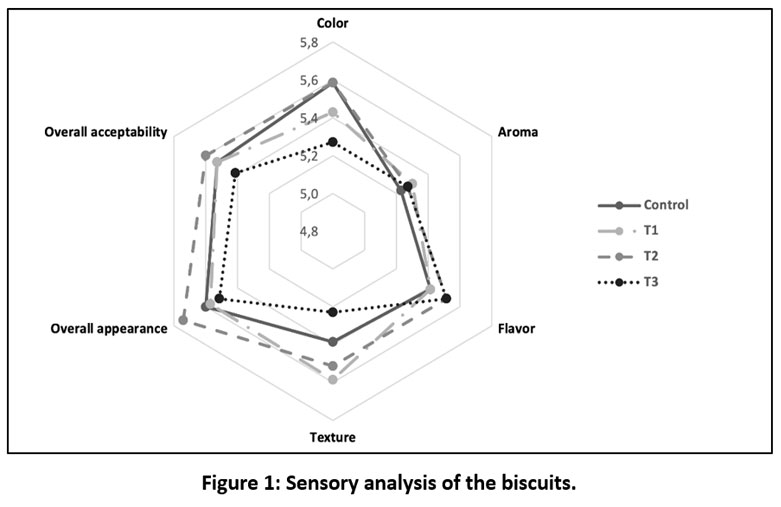 |
Figure 1: Sensory analysis of the biscuits. |
Texture Profile Analysis (TPA)
Table 7 summarizes the texture profile analysis of the four biscuit treatments with partial substitution of wheat flour by yam flour. With respect to hardness, it was observed that treatment T2 exhibited the lowest value (4862.07 N), indicating a lower force required to compress the biscuit and, consequently, a softer texture. In contrast, T3 recorded the highest value (7589.12 N), evidencing a more compact structure with greater resistance to deformation.
Table 7: Texture Profile Analysis (TPA) of the biscuits
|
Parameters |
Treatments | |||
| Control | T1 | T2 |
T3 |
|
|
Hardness (N) |
6618.52±958.65ab | 6134.90±1023.71ab | 4862.07±1181.79b | 7589.12±1614.99a |
| Adhesiveness (g/s) | -0.38±0.19a | -2.32±1.25a | -12.88±11.29a |
-5.94±10.50a |
|
Cohesiveness |
0.52±0.02a | 0.52±0.03a | 0.57±0.04a | 0.57±0.01a |
| Gumminess (N) | 3483.58±604.51ab | 3201.38±599.16ab | 2760.24±626.09b |
4340.82±810.76a |
|
Elasticity |
0.67±0.07a | 0.63±0.06a | 0.73±0.05a | 0.71±0.02a |
| Resilience | 0.20±0.01b | 0.20±0.01b |
0.23±0.01ab |
0.24±0.01a |
|
Chewiness (N) |
2331.42±472.49ab | 2026.78±478.81ab | 2006.56±487.97b | 3115.58±639.95a |
Values represent the averages of four replicates (mean ± SD). Means that are denoted by different letters between treatments indicate a significant difference at (P <0.05).
Overall, the TPA showed that partial substitution of wheat flour with yam flour up to 40% does not significantly affect the hardness, adhesiveness, resilience, or chewiness of the biscuits, maintaining textural characteristics comparable to the control formulation.
Discussion
Physicochemical properties
These results are consistent with findings reported by Afolabi et al. Mingle et al. and Adedeji.40-42 who documented pH values for yam flours ranging from 6.20 to 7.03, indicating low acidity. This pH range does not generate perceivable acidic flavors, which is favorable from a sensory and consumer acceptability standpoint.
In contrast, treatments T2 and T3 exhibited significantly higher titratable acidity compared to the control sample. However, the values remained low (<0.2%), well below the threshold generally associated with noticeable sourness. For context, fermented products such as bread, yogurt, or fermented beverages often exhibit titratable acidity levels ranging from 0.3% to 1.0% or higher, which are associated with clear sensory impacts.43,44 This outcome is encouraging, as it suggests that Dioscorea alata flour can be effectively used as a functional ingredient in biscuits without negatively affecting their nutritional or sensory characteristics.45
No significant changes were observed in the color parameters with the progressive substitution of wheat flour by yam flour. The L* value showed a slight decreasing trend as the substitution level increased, ranging from 67.67 in the control sample to 65.74 in treatment T3; however, these differences were not statistically significant. These findings are consistent with those reported by Tamaroh and Sudrajat,46 who evaluated bread made with wheat flour partially substituted by purple yam flour (Dioscorea alata L.) at different baking temperatures and found no significant differences in color between treatments. Similarly, Dada et al.47 reported no significant differences in L* values when assessing biscuits made from blends of wheat flour, African yam bean (AYB), and tiger nut flours, with L* values of 57.23 (100% wheat flour), 59.52 (70% wheat flour + 25% AYB + 5% tiger nut flour), 58.93 (70% wheat flour + 20% AYB + 10% tiger nut flour), and 56.90 (70% wheat flour + 15% AYB + 15% tiger nut flour). The a value showed a progressive increase among treatments, ranging from 3.02 in the control sample to 6.19 in T3, though these variations were not statistically significant—a trend also reported by Dada et al.47 Regarding the b value, a slight decrease was observed in T1 and T2 compared to the control (29.50), indicating a minor reduction in yellow hue; however, these differences were not statistically significant. Similarly, the whiteness index (%W) showed no significant variations with increasing yam flour substitution, with values ranging from 56.09 in the control to 55.55 in T3. Overall, these results indicate that the incorporation of yam flour did not perceptibly affect the color of the final product, maintaining an appearance comparable to the control formulation.
The behavior of the protein component is consistent with the findings of Amandikwa et al.54 who reported a similar trend when replacing wheat flour with flours from three different yam varieties (Dioscorea rotundata, Dioscorea alata, and Dioscorea bulbifera) in bread making, at substitution levels of 25%, 50%, and 75%. A progressive decrease in bread protein content was observed as the proportion of yam flour increased; in the case of formulations with Dioscorea alata flour, the protein content was 9.25%, 8.70%, 8.40%, and 7.70% for 100% wheat flour and substitution levels of 25%, 50%, and 75%, respectively. Studies such as those by Bensod et al. and Induar et al.55,56 also reported a decrease in protein content in biscuits and cakes made with Dioscorea bulbifera L. and Dioscorea bulbifera flour, respectively. In both cases, increasing substitution levels of wheat flour with yam flour led to progressive reductions in protein content, confirming the inverse relationship between substitution proportion and the protein contribution of the final product.
Proximate Analysis
This decrease in moisture may be explained by the lower water-holding capacity of yam flour compared to wheat flour, which has been reported in previous studies;45,48 that explored the use of yam flour as a functional ingredient in bakery applications. Similar trends were observed in studies,49,50 that evaluated the moisture content of biscuits produced from composite flours incorporating wheat, acha, and African yam flours; and wheat, African yam, and fermented cocoyam flours, with substitution levels ranging between 20% and 60%. The reduced moisture content observed in the T3 treatment may provide an advantage in terms of product stability and shelf life, since lower moisture levels tend to inhibit microbial growth and contribute to prolonged freshness.49
The ash content, which represents the mineral composition,51 decreased in the formulations with higher percentages of yam flour. The ash content in the control sample was 1.17%, while values of 0.69%, 0.68%, and 0.61% were obtained for T1, T2, and T3, respectively. Similar findings were reported by Kundam et al.52 who evaluated the use of flour from five yam types for biscuit production, corresponding to two varieties: four belonging to white yam (Dioscorea rotundata) and one to water yam (Dioscorea alata). In two treatments with D. rotundata, a reduction in ash content was observed, with values of 1.29% for the Ogoja variety and 1.10% for Faketsa. In comparison, the treatment with wheat flour presented a value of 1.77%.
The observed increase in fat content at higher substitution levels could be associated with the intrinsic composition of yam flour, which contains lipids in variable proportions depending on the variety and the type of processing applied.
Comparable findings were reported by Nwosu.53 who evaluated biscuits prepared with wheat flour partially substituted with aerial yam (Dioscorea bulbifera) flour at substitution levels ranging from 10% to 100%. In their study, fat content increased from 24.33% at 10% substitution to 33.92% at 30%, subsequently showing fluctuations at higher levels (28.20% at 40%, 31.20% at 80%, 26.52% at 90%, and 27.62% at 100%). These results reinforce the notion that yam flour can alter the lipid profile of bakery products depending on its proportion in the formulation. In contrast, other studies have indicated that fat content tends to decrease as the proportion of root and tuber flours increases in bakery formulations. For instance, Banti et al.22 reported that replacing wheat flour with taro flour at levels between 7.5% and 30% resulted in significantly higher fat content in the 7.5% substitution treatment (4.25%), followed by the 30% substitution (3.53%), while the lowest value was recorded in the 100% wheat flour formulation (1.91%). The authors attributed these findings to the higher oil absorption capacity of taro flour compared to wheat flour.
The fiber content is consistent with the findings of Armando et al.57 who evaluated the effect of substituting wheat flour with purple yam tuber (Dioscorea alata L.) of a local variety flour in stick-type biscuits, with substitution levels of 0%, 12.5%, 25%, 37.5%, 50%, and 62.5%. In their study, the addition of purple yam flour increased the fiber content compared to the control sample (0.48%), with values of 0.57%, 0.76%, 0.92%, 0.67%, and 0.84% for the different substitution levels, respectively. On the other hand, Amandikwa et al.54 studied the partial substitution of wheat flour with yam flour from three different varieties (Dioscorea alata, Dioscorea rotundata, and Dioscorea bulbifera) in bread, where the fiber content increased as the substitution level rose. The substitution levels were 0%, 25%, 50%, 75%, and 100%. In the case of Dioscorea alata, the results were as follows: 0.12, 0.12, 0.13, 0.15, and 0.15. Despite the increase, no significant differences were observed between the evaluated treatments and the control sample.
The increase in carbohydrate content observed in the present study with higher levels of yam flour substitution is consistent with previously reported trends in composite flour systems. As the proportion of yam flour increased, the carbohydrate content of the biscuits also rose, reflecting the naturally high carbohydrate composition of Dioscorea species. Comparable findings have been documented by Tsegay et al.,⁵⁸ who reported carbohydrate contents ranging from 70.65% to 71.99% in composite flours formulated from yam and wheat. Similarly, Nwosu⁵³ observed that the carbohydrate content of baked products increased with higher levels of yam flour (Dioscorea abyssinica) substitution, reaching values between 75.57% and 77.07%. These consistencies reinforce the expectation that yam-based formulations tend to exhibit elevated carbohydrate levels relative to wheat-only products, thereby supporting the nutritional behavior observed in the present study.
Microbiological characterization
All treatments complied with the microbiological limits established by the NTC 1241 standard. The absence of Salmonella spp., Escherichia coli, and Bacillus cereus confirmed that the partial substitution with yam flour did not compromise the product’s safety or hygiene during processing. These results align with those reported by Altamar et al.59 who prepared composite flours of wheat, yam, and cassava for cake production. Their study, conducted under NTC 1241 standards, determined that the resulting product was microbiologically acceptable for human consumption.
Sensory evaluation
These results indicate that substitution of up to 40% wheat flour with yam flour is adequate and generally well perceived by consumers. These findings are consistent with previous studies such as that of Tamaroh and Sudrajat.46 where the addition of purple yam flour did not affect the preference level for the produced bread. In this way, the authors stated that purple yam flour (up to 30%) can be included in bread formulations made with wheat flour. Research such as that of Banti et al. and Orafa et al.22,60 also demonstrated the feasibility of producing acceptable biscuits using flours from five selected yam varieties, as well as biscuits with up to 25% substitution with yam and carrot flours, respectively.
According to the sensory evaluation graph, treatment T2 obtained the highest scores in several attributes, particularly in color, odor, overall appearance, and overall acceptability. Although the differences were not statistically significant, these results suggest that the 30% substitution of wheat flour with yam flour maintains and even enhances certain sensory aspects compared to the control sample and the other treatments. This is consistent with the findings reported by China et al.61 who indicated that bakery products made with blends of wheat flour and tuber or root flours can retain high sensory acceptance up to moderate substitution levels.
Texture Profile Analysis (TPA)
The texture analysis revealed variations in hardness among the treatments. The lowest value was recorded for T2 (4862.07 N), indicating a softer texture, whereas T3 (7589.12 N) exhibited greater firmness and compactness. The cohesiveness, springiness, and adhesiveness parameters showed no significant differences among samples. These results suggest that moderate substitution levels may enhance textural properties, while higher levels tend to increase product density. These results may be partially associated with the reduction in moisture observed in the treatments containing yam flour, which is attributed to its lower water-holding capacity compared to wheat flour, as previously reported by Salazar and Marcano. and Cruz Chinguel et al.45,48 The decrease in hardness in partially substituted formulations could be related to the reduction in gluten content, resulting in a more fragile and less compact matrix. However, at higher substitution levels (T3), the excess starch content may promote greater compaction of the dough, significantly increasing hardness compared to T2. This behavior is consistent with the findings of Xie et al. and Adebowale et al.62,63 who indicate that the proportion of starches and proteins in flour blends directly influences the firmness of baked products.
In relation to adhesiveness, no statistically significant differences were observed; however, Table 6 shows that T2 presented a value of −12.88, suggesting that these biscuits were stickier. This behavior could be related to the starch present in yam flour, which, upon gelatinization during baking, may produce dough with higher moisture and stickiness.64 This, in turn, could also explain the lower hardness observed in this treatment.
On the other hand, cohesiveness and springiness did not show significant differences. Cohesiveness measures the resistance of the internal structure to breaking down in this case; the biscuit,65 and the results indicate that the internal structure of the biscuits was not compromised by the partial substitution of yam flour. Similarly, for springiness, which represents the degree of structural breakdown of the biscuit,66 the absence of significant differences suggests that yam flour did not influence this parameter.
Regarding resilience and chewiness parameters, significant differences were observed. Resilience showed a statistically significant variation; however, the values obtained (0.20–0.24) indicate that the difference between treatments is not markedly relevant in practical terms, suggesting that the substitution levels for this parameter are suitable and do not negatively affect the texture of the biscuit. Finally, T3 recorded the highest chewiness value (3115.58 N), indicating that greater force is required for mastication. Nevertheless, it is worth noting that the statistical analysis did not show significant differences between the control and the treatments, making it possible to state that substitutions of up to 40% do not generate perceptible changes in this parameter.
the results confirm the potential of Dioscorea alata flour as a functional and sustainable ingredient for the bakery industry, capable of being incorporated without compromising the sensory or technological quality of the product.
Future research should focus on optimizing technological parameters such as dough rheology, as well as baking time and temperature, in order to improve textural uniformity. It would also be relevant to examine the impact of different yam varieties or pre-treatments on the physicochemical characteristics and shelf life of the final product.
Conclusion
This study evaluated the quality attributes of filled biscuits prepared with partial substitution of wheat flour by Dioscorea alata flour at levels of 0%, 20%, 30%, and 40%. The incorporation of yam flour increased the carbohydrate content from 79.02% to 81.52% and fat content from 1.41% to 1.95%, while reducing protein and ash levels, without affecting sensory acceptability (scores between 5.41 and 5.74). The 30% substitution treatment showed the lowest hardness value (4862.07 N), indicating better softness; moreover, all treatments maintained quality and safety parameters consistent with the NTC 1241 standard. These findings provide new scientific evidence supporting the technological feasibility of incorporating Dioscorea alata flour in bakery formulations without negatively impacting texture or consumer perception, while promoting the valorization of local crops.
However, the variations observed in texture at higher substitution levels suggest the need for further research aimed at optimizing processing parameters and evaluating the influence of different yam varieties or pretreatments on dough rheology and final product quality. Future studies could also assess the functionality, nutritional profile, and storage stability of bakery products formulated with yam flour, to strengthen their industrial applicability and market acceptance.
Acknowledgement
The authors would like to express their sincere gratitude to the University of Cartagena for supporting this research through the Research Group on Agricultural and Agro-industrial Innovation and Development (IDAA), whose facilities and equipment were fundamental for the successful completion of this work. The authors also wish to acknowledge the framework of the project “Implementation of technologies for the agro-industrial development of yam in Bolívar” (BPIN2020000100439), supported by the General Royalties System, which provided the environment necessary to carry out this study.
Funding Sources
This Project was financed through the General Royalties System Project, entitled “Implementation of technologies for the agro-industrial development of yams grown in the department of Bolívar” (BPIN2020000100439).
Conflict of Interest
The authors do not have any conflict of interest.
Data Availability Statement
The manuscript incorporates all datasets produced or examined throughout this research study.
Ethics Statement
This research did not involve human participants, animal subjects, or any material that requires ethical approval.
Informed Consent Statement
This study did not involve human participants, and therefore, informed consent was not required.
Clinical Trial Registration
This research does not involve any clinical trials.
Permission to Reproduce Material from Other Sources
Not Applicable
Author Contributions
- Dayana Cervantes Maza: Study design, data collection and analysis, writing.
- Katherine Paternina Sierra: Study design, data analysis, critical review, supervision.
- Piedad Montero Castillo: Critical review, supervision, technical contributions.
References
- Nie HN, Dong H, Chen YL, et al. Effects of spray drying and freeze drying on the structure and emulsifying properties of yam soluble protein: A study by experiment and molecular dynamics simulation. Food Chem. 2022;409:135238. doi:10.1016/j.foodchem.2022.135238
CrossRef - Gao Q, Chen JN, Zhang JC, et al. Comparison of explosion puffing drying with other methods on the physicochemical properties and volatiles of yam (Dioscorea oppositathunb.) chips through multivariate analysis. Dry Techno. 2021; 40(7):1405-1420. doi:10.1080/07373937.2020.1870488
CrossRef - Li Z, Xiao W, Xie J, et al. Isolation, characterization and antioxidant activity of yam polysaccharides. Foods. 2022; 11(6):800. doi:10.3390/foods11060800
CrossRef - Sánchez-López DB, Luna-Castellanos LL, Tapia-Coronado JJ, Diaz-Cabadiaz AT, Del Valle Rodríguez-Pinto M, Cadena-Torres J. Inducción de la producción de minitubérculos mediante inoculación con rizobacterias en plantas de ñame (Dioscorea rotundata Poir). Terra Latinoam. 2022; 40. doi:10.28940/terra.v40i0.
CrossRef - Food and Agriculture Organization of the United Nations. https://www.fao.org/faostat/en/#data/QCL/visualize
- Wahab BA, Adebowale AA, Sanni SA, et al. Effect of species, pretreatments, and drying methods on the functional and pasting properties of high‐quality yam flour. Food Sci Nutr. 2015; 4(1):50-58. doi:10.1002/fsn3.260
CrossRef - Posada MC, Toledo E. Montaje de una empresa procesadora y comercializadora de harina de ñame diamante (Dioscórea Alata) Estudio de Prefactibilidad. https://bibliotecadigital.udea.edu.co/handle/10495/14799. Published 2019.
CrossRef - Shan N, Wang PT, Zhu QL, et al. Comprehensive characterization of yam tuber nutrition and medicinal quality of Dioscorea opposita and D. alata from different geographic groups in China. J Integr Agric. 2020;19(11):2839-2848. doi:10.1016/s2095-3119(20)63270-1
CrossRef - Lebot V, Lawac F, Legendre L. The greater yam (Dioscorea alata L.): A review of its phytochemical content and potential for processed products and biofortification. J Food Compos Anal. 2022; 115:104987. doi:10.1016/j.jfca.2022.104987
CrossRef - Li Y, Ji S, Xu T, et al. Chinese yam (Dioscorea): Nutritional value, beneficial effects, and food and pharmaceutical applications. Trends Food Sci Technol . 2023; 134:29-40. doi:10.1016/j.tifs.2023.01.021
CrossRef - Hernández BR, Olivero DS, Pineda P. Alternativa agroindustrial de comercialización para el ñame (Dioscorea alata L.) producido en el departamento de Sucre. Publicado en 2019 https://revistas.sena.edu.co/index.php/ gipama/article/download/3194/3675
- Merlano-Porto RH, Alvarado-Rodriguez JA, Barroso-Críales DM, Cohen-Manrique C. Evaluación computacional de la calidad y rendimiento del ñame (Dioscórea rotundata) debido a factores ambientales de empaque y almacenamiento. Inf Tecnol. 2023;34(5):21-36. doi:10.4067/s0718-07642023000500021
CrossRef - Li L, Chen J, Bai D, et al. Physicochemical, pasting properties and in vitro starch digestion of Chinese yam flours as affected by microwave Freeze-Drying. Foods. 2022; 11(15):2324. doi:10.3390/foods11152324
CrossRef - Oyeyinka SA, Taiwo OE, Abdul H, et al. Enhancement of the functional, pasting and textural properties of poundo yam flour through cassava flour supplementation. Food Chem Adv. 2023; 3:100372. doi:10.1016/j.focha.2023.100372
CrossRef - Olawuyi YO, Oyetola F. Flour functionality, chemical and sensory properties of cookies from trifoliate yam flour-soybean blends. Agrosearch. 2020; 20(1):106-117. doi:10.4314/agrosh.v20i1.10s
CrossRef - Chinma CE, Azeez SO, Sulayman HT, et al. Evaluation of fermented African yam bean flour composition and influence of substitution levels on properties of wheat bread. J Food Sci. 2020;85(12):4281-4289. doi:10.1111/1750-3841.15527
CrossRef - Li QM, Li Y, Zou JH, et al. Influence of Adding Chinese Yam (Dioscorea opposita Thunb.) Flour on Dough Rheology, Gluten Structure, Baking Performance, and Antioxidant Properties of Bread. Foods. 2020;9(3):256. doi:10.3390/foods9030256
CrossRef - Liu X, Lu K, Yu J, Copeland L, Wang S, Wang S. Effect of purple yam flour substitution for wheat flour on in vitro starch digestibility of wheat bread. Food Chem. 2019; 284:118-124. doi:10.1016/j.foodchem.2019.01.025
CrossRef - Yalindua A, Manampiring N, Waworuntu F, Yalindua FY. Physico-chemical exploration of Yam Flour (Dioscorea alata L.) as a raw material for processed cookies. J Phys Conf Ser. 2021; 1968(1):012004. doi:10.1088/1742-6596/1968/1/012004
CrossRef - Gunasekara D, Bulathgama A, Wickramasinghe I. Comparison of Different Hydrocolloids on the Novel Development of Muffins from “Purple Yam” (Dioscorea alata) Flour in Sensory, Textural, and Nutritional Aspects. Int J Food Sci. 2021; 2021:1-7. doi:10.1155/2021/9970291
CrossRef - Kalhari S, Wijesekara I. Comparison of guar and xanthan gums added gluten-free muffins from traditional yam “Maha angili ala” (Dioscorea alata) flour. Innovation to Impact (FITI). November 2019:1-4. doi:10.1109/fiti49428.2019.9037631
CrossRef - Banti M, Gebregiorgis A, Kasahun C, Demssis N. Evaluation of yam flour as a partial substitute for wheat flour in bread making. J Food Process Preserv. 2025;2025(1). doi:10.1155/jfpp/4625746
CrossRef - Nwokeke H, Agu H, Ikegwu T, Ishiwu C. Assessment of sensory properties of optimized wheat-white yam composite cookies using response surface methodology. Int J Food Sci Nutr. 2025;10:12-22. Accessed October 15, 2025. https://www.researchgate.net/publication/392698685_Assessment_of_sensory_properties_of_optimized_wheat-white_yam_composite_cookies_using_response_surface_methodology
- Saeed SMG, Ali SA, Ali R, Sayeed SA, Mobin L, Ahmed R. Exploring the potential of black gram (Vigna mungo) flour as a fat replacer in biscuits with improved physicochemical, microstructure, phytochemicals, nutritional and sensory attributes. SN Appl Sci. 2020; 2(12). doi:10.1007/s42452-020-03797-6
CrossRef - Bravo-Núñez Á, Gómez M. Enrichment of cakes and cookies with pulse flours: a review. Food Rev Int. 2023;39(5):2895-2913. doi:10.1080/87559129.2021.1983591
CrossRef - Caponio GR, Difonzo G, De Gennaro G, Calasso M, De Angelis M, Pasqualone A. Nutritional improvement of gluten-free breadsticks by olive cake addition and sourdough fermentation: how texture, sensory, and aromatic profile were affected? Front Nutr. 2022;9:830932. doi:10.3389/fnut.2022.830932
CrossRef - Zielińska E, Pankiewicz U. Nutritional, physiochemical, and antioxidative characteristics of shortcake biscuits enriched with Tenebrio molitorMolecules. 2020;25(23):5629. doi:10.3390/molecules25235629
CrossRef - Caponio GR, Miolla R, Vacca M, Difonzo G, De Angelis M. Wine lees as functional ingredient to produce biscuits fortified with polyphenols and dietary fibre. LWT. 2024;198:115943. doi:10.1016/j.lwt.2024.115943
CrossRef - Manohar RS, Rao PH. Interrelationship between rheological characteristics of dough and quality of biscuits; use of elastic recovery of dough to predict biscuit quality. Food Research International. 2002;35(9):807-813. doi:10.1016/s0963-9969(02)00083-2
CrossRef - Zucco F, Borsuk Y, Arntfield SD. Physical and nutritional evaluation of wheat cookies supplemented with pulse flours of different particle sizes. LWT. 2011;44(10):2070-2076. doi:10.1016/j.lwt.2011.06.007
CrossRef - Setyawan N, Maninang JS, Suzuki S, Fujii Y. Variation in the Physical and Functional Properties of Yam (Dioscorea spp.) Flour Produced by Different Processing Techniques. Foods. 2021; 10(6):1341. doi:10.3390/foods10061341
CrossRef - Haase NU, Grothe K h., Matthäus B, Vosmann K, Lindhauer MG. Acrylamide formation and antioxidant level in biscuits related to recipe and baking. Food Addit Contam Part A. 2012;29(8):1230-1238. doi:10.1080/19440049.2012.690349
CrossRef - Official Methods of Analysis. 19th ed. Gaithersburg, MD: AOAC International; 2011:Methods 925.09, 923.03, 960.52, 920.85, 993.21.
- Instituto Colombiano de Normas Técnicas y Certificación (ICONTEC). NTC 1241: Productos de molinería. Galletas. Bogotá: ICONTEC; 2007.
- Szydłowska-Czerniak A, Poliński S, Momot M. Optimization of Ingredients for Biscuits Enriched with Rapeseed Press Cake—Changes in Their Antioxidant and Sensory Properties. Appl Sci. 2021;11(4):1558. doi:10.3390/app11041558
CrossRef - Mudgil D, Barak S, Khatkar BS. Cookie texture, spread ratio and sensory acceptability of cookies as a function of soluble dietary fiber, baking time and different water levels. LWT. 2017; 80:537-542. doi:10.1016/j.lwt.2017.03.009
CrossRef - Bourne MC. Principles of objective texture measurement. In: Elsevier eBooks. ; 2002:107-188. doi:10.1016/b978-012119062-0/50004-8
CrossRef - Correa MJ. Efecto de celulosas modificadas y pectinas sobre la microestructura y atributos de calidad de la masa panaria. March 2012. doi:10.35537/10915/24532
CrossRef - Kaur P, Sharma P, Kumar V, Panghal A, Kaur J, Gat Y. Effect of addition of flaxseed flour on phytochemical, physicochemical, nutritional, and textural properties of cookies. J Saudi Soc Agric Sci. 2017; 18(4):372-377. doi:10.1016/j.jssas.2017.12.004
CrossRef - Afolabi FO, Lawal AI, Adegbite AO. Physicochemical and sensory attributes of some selected varieties of white yam (Dioscorea rotundata). J Agric Food Sci. 2023; 21(1):114-127. doi:10.4314/jafs.v21i1.8
CrossRef - Mingle E, Sanful RE, Engmann FN. Sensory and physicochemical properties of bread made from aerial yam (Dioscorea bulbifera) and wheat (Triticum aestivum) flour. Int J Innov Food Sci Technol. 2017; 1(1):29-35. doi:10.25218/ijifst.2017.01.001.05
CrossRef - Adedeji KK. Physical, functional and sensory properties of yam flour elubo obtained from Kuto-market, Abeokuta [undergraduate thesis]. Abeokuta, Nigeria: University of Agriculture; 2010.
- De Moraes Prata Gaspar MC, Ruiz M, Puiggròs C. “¿Cuánto le dura la vida?”: análisis cualitativo de los conocimientos, percepciones y usos de los alimentos fermentados entre personas jóvenes adultas residentes en la ciudad de Barcelona. Rev Esp Nutr Hum Diet. 2021;25(4):365-375. doi:10.14306/renhyd.25.4.1313.
CrossRef - Jordano Salinas R, Martínez P, Garrido Fernández MD, Jodral Villarejo ML. Cambios de acidez y pH en yogures comerciales. Alimentaria. 1988;189:61-64.
- De Marcano ES, Marcano M. LA HARINA DE ÑAME (Dioscorea alata), UN INGREDIENTE POTENCIAL EN LA ELABORACIÓN DE PRODUCTOS DE PANADERÍA. Rev Cient Redalyc. https://www.redalyc.org/articulo.oa?id=427739446007. Published 2011.
- Tamaroh S, Sudrajat A. Antioxidative Characteristics and Sensory Acceptability of Bread Substituted with Purple Yam (Dioscorea alata L.). Int J Food Sci.. 2021; 2021:1-9. doi:10.1155/2021/5586316
CrossRef - Dada MA, Bello FA, Omobulejo FO, Olukunle FE. Nutritional quality and physicochemical properties of biscuit from composite flour of wheat, African yam bean and tigernut. 2023;9(11):e22477. doi:10.1016/j.heliyon.2023.e22477
CrossRef - Chinguel FC, Alejos LAN, Cáceres OJZ. Temperatura y Espesor de Rodajas, para Secar Ñame Blanco (Dioscorea trífida) y Producir Harina. Rev Cient Pakamuros. 2023; 6(1). doi:10.37787/c024n815
CrossRef - Adeyanju JA, Ogunlakin GO, Abioye AO, Alabi OD, Oloyede AA, Akinola FB. Assessment of biscuits produced from the blends of wheat, acha and germinated African yam bean flour. J Adv Food Sci Technol. 2022;9(2):26-37. doi:10.56557/jafsat/2022/v9i27798
CrossRef - Igbabul BD, Iorliam BM, Umana EN. Physicochemical and sensory properties of cookies produced from composite flours of wheat, cocoyam and African yam beans. J Food Res. 2015;4(2):150. doi:10.5539/jfr.v4n2p150
CrossRef - Fayomi OI, Anadi A, Faasema JJ. Nutritional and sensory qualities of cookies from wheat, trifoliate yam and moringa seed flours. Eur J Nutr Food Saf. 2023;15(11):125-140. doi:10.9734/ejnfs/2023/v15i111360
CrossRef - Kundam DN, Ikya JK, Alakali JS. Phytochemicals, Antioxidant, Physico-Chemical and Sensory Properties of Yam-Based Cookies Produced from Flours of Five Yam Varieties. Asian Food Sci J. 2024; 23(8):22-33. doi:10.9734/afsj/2024/v23i8732
CrossRef - Nwosu JN. Evaluation of the proximate and sensory properties of biscuits produced from aerial yam flour (Dioscorea bulbifera). Am J Res Commun. 2014;2(3):119-126. https://www.usa-journals.com/wp-content/uploads/2014/03/Nwosu1_Vol23.pdf
- Amandikwa C, Iwe MO, Uzomah A, Olawuni AI. Physico-chemical properties of wheat-yam flour composite bread. Niger Food J. 2015;33(1):12-17. doi:10.1016/j.nifoj.2015.04.011
CrossRef - Bansod PN, Ningot EP, Panchbhai DM, Gawande S. Storage studies of aerial yam (Dioscorea bulbifera L.) flour cookies. J Pharmacogn Phytochem. 2020;9(3):1428-1433. https://www.phytojournal.com/archives/2020/ vol9issue3/PartW/9-3-168-409.pdf
- Induar S, Behera BC, Dubey D, Naik PK. Proximate and sensory properties of Dioscorea bulbifera composite flour made cookies and cake. Asian J Biol Sci. 2021;14(1):63-69. doi:10.5530/ajbls.2021.10.63
CrossRef - Armando YG, Ulyarti U, Rulaini M, Mursyid M, Tafzi F, Surhaini S, et al. The application of purple yam flour for stick crackers. Indones Food Sci Technol J. 2023;6(2):40-44. doi:10.22437/ifstj.v6i2.21133
CrossRef - Tsegay N, Admassu H, Zegale B, Gosu A. Nutritional and functional potentials of wheat, cowpea, and yam composite flours on bread formulations: effect of blending ratio and baking parameters. J Agric Food Res. 2024;18:101294. doi:10.1016/j.jafr.2024.101294
CrossRef - Altamar Pérez TJ, Flórez Cortes E, Castro Escorcia Y, Machacón Zafra AMZ. Obtención de una mezcla de harinas panificable a partir de tubérculos yuca (Arizona) y ñame (Dioscórea alata) cultivados en el departamento del Atlántico. Rev Gipama. 2020;1(1):195-202. https://revistas.sena.edu.co/index.php/gipama/article/view/3218
- Orafa NP, Buraimoh OS, Daagema AA. Quality evaluation of yam (Dioscorea rotundata) and carrot (Daucus carota L.) flour blends for production of stiff dough and biscuits. Asian Food Sci J. 2021;20(3):18-29. doi:10.9734/afsj/2021/v20i330275
CrossRef - China MAH, Oguzor UC, Ujong AE. Effect of gum arabic incorporation on the proximate composition and sensory properties of biscuits produced from flour blends of wheat and water yam. Asian Food Sci J. 2020;18(1):1-11. doi:10.9734/afsj/2020/v18i130201
CrossRef - Xie X, Yuan Z, Fu K, An J, Deng L. Effect of partial substitution of flour with mealworm (Tenebrio molitor L.) powder on dough and biscuit properties. Foods. 2022;11(14):2156. doi:10.3390/foods11142156
CrossRef - Adebowale AA, Adegoke MT, Sanni SA, Adegunwa MO, Fetuga GO. Functional properties and biscuit making potentials of sorghum-wheat flour composite. Am J Food Technol. 2012;7(6):372-379. doi:10.3923/ajft.2012.372.379
CrossRef - Salgado-Ordosgoitia RD, Paternina-Contreras AL, Cohen-Manrique CS, Rodríguez-Manrique JA. Análisis de las curvas de gelatinización de almidones nativos de tres especies de ñame: Criollo (Dioscorea alata), Espino (Dioscorea rotundata) y Diamante 22. Inf Tecnol. 2019;30(4):93-102. doi:10.4067/s0718-07642019000400093
CrossRef - Zhu J, Yang X, Ahmad I, Li L, Wang X, Liu C. Rheological properties of κ-carrageenan and soybean glycinin mixed gels. Food Res Int. 2008;41(3):219-228. doi:10.1016/j.foodres.2007.11.009
CrossRef - Ahmad I. Profile analysis (TPA) of cakes supplemented with soy flour. Pak J Sci. 2010;62(1). https://nja.pastic.gov.pk/PJS/index.php/PJS/article/view/12/12
 PlumX:
 Views: 5461
  PDF Downloads:
521
PDF Downloads:
521 
Accepted on: 10 Nov 2025
Second Review by: Siti Tamaroh
Final Approval by: Dr. Angelo Maria Giuffrè





Web of Science Coverage
Emerging Sources Citation Index (ESCI)
2024 Journal Impact Factor: 1.1
Scopus Journal Metrics
CiteScore 2025: 2.6
CiteScore Details
Sustainable Nutrition: Food Systems, Nutrient Retention, and Public Health Impact

This journal is a member of, and subscribes to the principles of, the Committee on Publication Ethics (COPE)