
Physicochemical, Microstructural, and Protein Profile Evaluation of Fermented Sausages Using Aspergillus niger and Lactobacillus plantarum Starter Cultures
 , , 3, Edi Suryanto2 and Rusman2
 1Department of Animal Products Technology, Universitas Brawijaya, Malang, Indonesia
2Department of Animal Products Technology, Universitas Gadjah Mada, Yogyakarta, Indonesia
3Institute of Halal Industry and Systems, Universitas Gadjah Mada, Yogyakarta, Indonesia
Corresponding Author Email: muliaapriliyani@ub.ac.id
DOI : http://dx.doi.org/10.12944/CRNFSJ.13.3.16
Download this article as:

Fermented sausages are typically produced with Lactobacillus plantarum as a starter, while fungal starters such as Aspergillus niger also exhibit proteolytic activity and contribute to flavor. This study compared the effects of A. niger and L. plantarum on fermented chicken sausages over 0–3 days of fermentation. Physicochemical traits (cooking loss, water-holding capacity, pH, aw, color, texture profile, proximate composition), microstructure, and protein profile were evaluated. Significant differences (p<0.05) were observed, with A. niger producing sausages of higher texture values and more porous structures, while L. plantarum accelerated acidification and preserved color. Fermentation reduced pH (5.75 to 4.70), aw (0.90 to 0.85), lightness, redness, hardness, cohesiveness, springiness, gumminess, chewiness, and proximate content, but increased water-holding capacity, yellowness, and adhesiveness. SDS-PAGE showed stronger proteolysis in A. niger (lowest band 9–10 kDa) compared with L. plantarum (10–12.5 kDa). Overall, A. niger demonstrated potential as an effective starter, influencing both structural and physicochemical properties.
KEYWORDS:Aspergillus Niger; Fermentation; Lactobacillus Plantarum; Ripening Time; Sausage
Introduction
Fermented sausages are traditional foods found worldwide, such as Italian salami, German Dauerwurst, Spanish Charqui, Portuguese Chouriço de vinho, and Chinese Harbin sausage.1 Starter cultures, mainly lactic acid bacteria (LAB), are commonly used to improve the consistency and safety of fermented products. LAB lowers pH by fermenting carbohydrates to lactic acid, inhibiting spoilage and pathogenic bacteria through organic acids and antimicrobial metabolites like bacteriocins, diacetyl, and hydrogen peroxide.2,3 Molds also contribute to sausage fermentation, enhancing flavor, aroma, and color stability.4–7 In Europe, Penicillium species are widely used, while in Indonesia, Aspergillus and Rhizopus are common in traditional foods. Among them, Aspergillus niger is fast-growing, safe (non-mycotoxin-producing), and commercially applied.8 Molds such as Penicillium can influence texture, water distribution, and volatile compounds, but the effects of A. niger in meat fermentation remain less explored. Therefore, this study aimed to compare the effects of A. niger and L. plantarum as starter cultures in fermented chicken sausages. Key parameters included physicochemical characteristics (cooking loss, water-holding capacity, pH, aw, color, texture, moisture, protein, fat, and ash), microstructure, and protein profile, to evaluate their influence on quality and microstructural properties.
Materials and Methods
Preparation of fermented sausages
Sausages were prepared based on a modification of fermented sausage making.9 Table 1 displays the formula for the fermented sausages with A. niger (AN) and L. plantarum starter (LP). The starter A. niger (Agrotechnoshop) and L. plantarum (Agrotechnoshop) were in different batches as treatments in this study. A starting culture of 107 CFU/g of A. niger and L. plantarum was added in each batch. The sausages were fermented for 0, 1, 2, and 3 days. The experiment was arranged in a Randomized Block Design (RBD) with three replicates. The physicochemical characteristics (cooking loss, water holding capacity, pH, aw, color, texture profile analysis, moisture, protein, fat, and ash), microstructure, and protein profile were analyzed.
Table 1: Formulation of fermented sausage
|
Weight (g) |
||
| Ingredients | AN |
LP |
|
Chicken meat |
1200 | 1200 |
| Ice tube | 400 |
400 |
|
Fat |
140 | 140 |
| Tapioca flour | 160 |
160 |
|
Sugar |
20 | 20 |
| Soy protein isolate | 20 |
20 |
|
Garlic powder |
15 | 15 |
| STPP | 10 |
10 |
|
Pepper |
2 | 2 |
| Ginger powder | 2 |
2 |
|
Salt |
2 | 2 |
| A. niger starter | 40 |
0 |
|
L. plantarum starter |
0 |
40 |
AN: Fermented sausage with A. niger stater, LP: Fermented sausage with L. plantarum starter
Physicochemical analysis of fermented sausages
Cooking loss
The weight of the chicken emulsion sausages was measured before and after being heated to 80°C for 40 minutes. A calculation was made for cooking loss. The cooking loss can be computed using the following formula.10
Water holding capacity (WHC)
WHC was determined using the filter paper press. Whatman filter paper No. 42 and two 35 kg glass plates were used to crush a 0.5 g sample for five minutes. The image area was formed and created with transparent plastic, and the precise areas (cm2) were calculated with the formula:
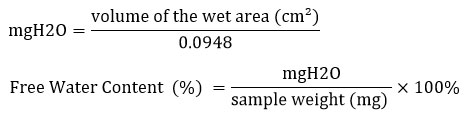
Total water content was evaluated by following the initial weight measurement of the filter paper, a sample weight of approximately 1 g was determined and wrapped around the filter paper. The sample was heated to 110°C for eight hours.

Color measurement
Samples were prepared and the liquid was placed in a glass. The color reader was turned on. The target readings for L*, a*, and b* were determined.
TPA (Texture profile analysis): The Texture Analyzers (Brookfield Engineering Labs, Inc.) were used to measure the mechanical properties of the fermented sausages. Test speed of 2.0 mm/s and 15 mm cylinder probe were the parameters set for the analysis. Hardness, cohesiveness, springiness, adhesiveness, gumminess, and chewiness were obtained. pH, water activity, moisture, protein, fat, ash contents: Fermented sausages were measured water activity analysis (aw) was performed using an aw meter.11
Microstructure of fermented sausages
Samples of fermented sausage with 0 and 1-day fermentation were selected for microstructure and protein profile analysis because samples with 2 and 3-day fermentation might not be acceptable for aroma, taste, and texture. The fermented sausage was assessed for internal structure and surface using a scanning electron microscope (SEM). The sample was uniformly spread out very thinly on the two-sided aluminum plate, and it was then coated for 30 seconds with a layer of gold metal powder. SEM was used to examine the sample at a voltage of 15 kV and a magnification of 2000x.
Protein profile
The three-stage standard method was developed for protein separation using Sodium dodecyl sulfate-polyacrylamide gel electrophoresis (SDS- PAGE) to determine the profile of proteins in fermented sausages. The three steps involved removing the protein from the sample, separating it using electrophoresis techniques, and creating a gel using SDS-PAGE (Bio-Rad). The final step was to identify the protein bands that have been formed. SDS-PAGE process was employed in the 15% separating gel and 4% stacking gel. Molecular weight was determined by comparing the protein distance of fraction electrophoresis with markers. The SDS PAGE gel band was examined using a gel imager (Bio-Rad).
Data Analysis
The study used an analysis of variance arranged in a randomized block design for each starter treatment. Duncan’s multiple range test was used to determine any variation in mean values that was statistically significant (p<0.05).
Results
Cooking loss, WHC, pH, and aw
Table 2 presents the effects of Aspergillus niger (AN) and Lactobacillus plantarum (LP) inoculation on cooking loss, water-holding capacity (WHC), pH, and water activity (aw) of fermented sausages over a 3-day fermentation period. Significant differences were observed between treatments (p<0.05), with notable trends emerging throughout the fermentation.
On day 3, cooking loss in the L. plantarum-treated group reached 4.09%, which was higher than the value observed in A. niger-treated samples (3.24%). In contrast, WHC decreased progressively in all samples but remained consistently higher in the L. plantarum group. Initially, WHC was 62.59% for L. plantarum and 49.11% for A. niger, decreasing to 34.09% and 26.13%, respectively, by day 3.
Regarding pH, both treatments showed a gradual decline over time. The pH of L. plantarum-treated sausages decreased from 5.75 on day 0 to 4.71 on day 3, while A. niger-treated samples showed a similar decrease from 5.73 to 4.70 during the same period.
Table 2: Physical characteristics of fermented sausage
|
Parameter |
Starter | Fermentation Time (Days) | |||
| 0 | 1 | 2 |
3 |
||
|
Cooking loss (%) |
AN | 2.27±0.04e | 2.63±0.10d | 2.60±0.27d | 3.24±0.13b |
| LP | 2.72±0.31cd | 2.93±0.08c | 4.03±0.08a |
4.09±0.10a |
|
|
WHC (%) |
AN | 49.11±0.55c | 44.02±1.62d | 32.84±2.68e | 26.13±2.36f |
| LP | 62.59±0.76a | 54.35±1.63b | 46.59±2.76cd |
34.09±1.53e |
|
|
pH |
AN | 5.73±0.05a | 4.98±0.09c | 4.83±0.03d | 4.70±0.54e |
| LP | 5.75±0.02a | 5.18±0.06b | 4.89±0.09cd |
4.71±0.03e |
|
|
aw |
AN | 0.90±0.01a | 0.89±0.01ab | 0.87±0.01bc | 0.86±0.01cd |
| LP | 0.88±0.01b | 0.85±0.01d | 0.88±0.01b |
0.85±0.01d |
|
AN: Fermented sausage with A. niger stater, LP: Fermented sausage with L. plantarum starter.
abcdef: Values with different superscript letters in the line are significantly different
Color (L*, a*, and b*)
Table 3 presents the changes in color parameters (L*, a*, and b*) of fermented sausages over a 3-day fermentation period, with significant differences observed between samples inoculated with A. niger and L. plantarum (p<0.05). Lightness (L*) values decreased progressively in both groups, although L. plantarum-treated samples consistently exhibited higher L* values. On day 3, L* values were 69.47 and 62.71 for L. plantarum and A. niger-treated samples, respectively. Redness (a*) also declined over time, with L. plantarum maintaining higher values throughout the fermentation. In this group, a* decreased from 2.54 (day 0) to 1.03 (day 3), while A. niger-inoculated samples decreased from 1.17 to 0.62 over the same period. In contrast, yellowness (b*) values increased in both treatments. A. niger-treated sausages showed consistently higher b* values across all time points, reaching 16.27 on day 3 compared to 15.29 in L. plantarum-treated samples.
Table 3: Color measurement of fermented sausage
|
Parameter |
Starter | Fermentation Time (Days) | ||||
| 0 | 1 | 2 |
3 |
|||
|
L* (Lightness) |
AN | 70.81±0.83c | 67.69±1.53e | 66.72±0.40e | 62.71±0.42f | |
| LP | 74.42±0.67a | 72.45±0.88b | 71.35±0.23bc |
69.47±0.24d |
||
|
a* (Redness) |
AN | 1.17±0.17cd | 0.94±0.03e | 0.86±0.02e | 0.62±0.04f | |
| LP | 2.54±0.27a | 1.88±0.09b | 1.27±0.10c |
1.03±0.05de |
||
|
b* (Yellowness) |
AN | 11.70±0.83c | 13.77±0.61c | 14.79±0.72b | 16.27±0.45a | |
| LP | 8.75±0.31f | 10.59±0.13e | 11.35±0.32de |
15.29±0.33b |
||
AN: Fermented sausage with A. niger stater, LP: Fermented sausage with L. plantarum starter.
abcdef: Values with different superscript letters in the line are significantly different
Texture profile analysis (hardness, cohesiveness, springiness, adhesiveness, gumminess, and chewiness)
Table 4 shows the results of the texture profile analysis, where significant differences were observed between treatments and across fermentation days (p<0.05). Hardness decreased progressively in all samples, with a more pronounced reduction observed in the L. plantarum-inoculated group. On day 0, A. niger-treated sausages had the highest hardness (338.17 N), which declined to 105.53 N by day 3. In contrast, L. plantarum-treated sausages began at a lower value (248.80 N) and reached 82.07 N by day 3. Cohesiveness also declined over time in both treatments. A. niger-inoculated samples maintained slightly higher cohesiveness values throughout, decreasing from 0.55 to 0.42, while L. plantarum samples dropped from 0.54 to 0.34. Springiness showed a gradual decrease in both groups. While A. niger-treated samples retained higher springiness across the fermentation period (0.98 to 0.80), L. plantarum samples declined from 0.90 to 0.73. Gumminess increased during fermentation in both treatments. A. niger samples showed a steady rise from 23.73 N to 46.47 N, while L. plantarum-treated sausages increased from 17.30 N to 34.10 N. Chewiness, which reflects the energy required to masticate the product, followed a decreasing trend. A. niger-inoculated sausages showed the most significant reduction, from 168.73 N to 17.62 N, while L. plantarum samples decreased from 105.33 N to 34.37 N. Fig. 1 shows the appearance of the fermented sausage samples.
Table 4: Texture profile analysis of fermented sausage
|
Parameter |
Starter | Fermentation Time (Days) | |||
| 0 | 1 | 2 |
3 |
||
|
Hardness (N) |
AN | 338.17±10.10a | 274.80±20.36b | 146.50±7.29d | 105.53±6.11e |
| LP | 248.80±3.70c | 149.37±8.11d | 105.50±7.53e |
82.07±7.53f |
|
|
Cohesiveness |
AN | 0.55±0.01a | 0.47±0.02b | 0.43±0.01cd | 0.42±0.01d |
| LP | 0.54±0.02a | 0.44±0.01c | 0.38±0.01e |
0.34±0.01f |
|
|
Springiness |
AN | 0.98±0.57a | 0.89±0.01b | 0.85±0.01b | 0.80±0.02c |
| LP | 0.90±0.03b | 0.84±0.01bc | 0.73±0.01d |
0.73±0.03d |
|
|
Adhesiveness
Gumminess (N) |
AN | 23.73±0.66cd | 27.33±1.96c | 38.10±1.40b | 46.47±3.89a |
| LP | 17.30±1.01e | 19.77±0.57de | 27.17±0.93c |
34.10±4.65b |
|
|
AN |
197.23±9.09a | 118.20±14.75b | 57.67±2.34c | 53.83±1.94c | |
| LP | 115.10±6.73b | 58.33±5.772c | 50.40±1.10cd |
40.20±0.79d |
|
|
Chewiness (N) |
AN | 168.73±3.55a | 97.10±6.40c | 27.50±2.26f | 17.62±1.03g |
| LP | 105.33±6.23b | 53.83±4.28d | 44.03±4.28e |
34.37±2.38f |
|
AN: Fermented sausage with A. niger stater, LP: Fermented sausage with L. plantarum starter.
abcdef: Values with different superscript letters in the line are significantly different
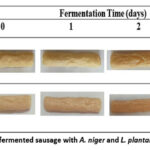 |
Figure 1: The fermented sausage with A. niger and L. plantarum starter |
Moisture, protein, fat, and ash content
Table 5 presents the changes in moisture, protein, fat, and ash content of sausages during the 3-day fermentation period. Significant differences (p<0.05) were observed between samples inoculated with A. niger and L. plantarum, as well as across fermentation days. Moisture content declined over time in all treatments. At day 0, both groups showed similar values (70.83% for A. niger, 72.07% for L. plantarum), but by day 3, moisture content had decreased to 62.23% and 62.28%, respectively. Protein content also decreased in the A. niger-treated samples, from 48.01% at day 0 to 35.69% at day 3. In contrast, L. plantarum-treated sausages maintained relatively high protein content throughout the fermentation period, ranging from 51.89% at day 0 to 47.35% at day 3. Fat content showed a marked reduction during fermentation in both treatments. The L. plantarum group decreased from 12.29% to 4.88%, while the A. niger group dropped from 11.95% to 5.26%. Ash content increased significantly in L. plantarum-inoculated samples, peaking at 14.48% on day 0 and maintaining high levels through day 3. In contrast, A. niger samples fluctuated but remained lower, ranging from 7.29% to 12.53%.
Table 5: Chemical characteristics of fermented sausage
|
Parameter |
Starter | Fermentation Time (Days) | |||
| 0 | 1 | 2 |
3 |
||
|
Moisture (%) |
AN | 70.83±1.26a | 66.84±2.39b | 64.07±1.87cd | 62.23±2.34d |
| LP | 72.07±0.57a | 70.80±1.59a | 66.32±3.40b |
62.28±1.81d |
|
|
Protein (%) |
AN | 48.01±2.38ab | 44.13±0.98bc | 40.45±1.91c | 35.69±1.38d |
| LP | 51.89±4.89a | 47.79±1.05ab | 47.85±2.56ab |
47.35±1.01b |
|
|
Fat (%) |
AN | 11.95±0.17ab | 11.07±0.43bc | 9.80±0.45d | 5.26±0.45f |
| LP | 12.29±1.36a | 10.09±0.35cd | 8.09±0.85e |
4.88±0.36f |
|
|
Ash (%) |
AN | 7.59±0.41c | 12.53±1.48b | 7.29±0.37c | 7.58±0.23c |
| LP | 14.48±0.97a | 13.70±1.07ab | 12.53±1.48b |
13.45±0.99ab |
|
AN: Fermented sausage with A. niger stater, LP: Fermented sausage with L. plantarum starter
abcdef: Values with different superscript letters in the line are significantly different
Microstructures
Fig. 2 presents the microstructure of fermented chicken sausages at 0, 1, 2, and 3 days of fermentation, observed using Scanning Electron Microscopy (SEM) at 2000× magnification. The SEM images revealed clear structural differences over the fermentation period. Four main components were identified in the sausage matrix: (1) microbial cells of A. niger or L. plantarum appearing as small spherical protrusions, (2) fat droplets represented by bright white dots, (3) fibrous meat structure forming the sausage matrix, and (4) dense white granules corresponding to protein-based binding agents. At day 0, the sausage structure appeared compact and dense. By day 1, small voids and slight openings began to form.
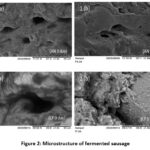 |
Figure 2: Microstructure of fermented sausage |
SEM of fermented sausage (1a) A. niger-inoculated sausage at day 0 of fermentation; (1b) A. niger-inoculated sausage at day 1; (2a) L. plantarum-inoculated sausage at day 0; (2b) L. plantarum-inoculated sausage at day 1.
Protein Profile
As shown in Fig. 3, the electrophoresis results of fermented sausage inoculated with A. niger revealed protein bands in the range of 123–196 kDa and 9–10 kDa, whereas samples with L. plantarum showed bands ranging from 124–192 kDa and 10–12.5 kDa. On day 0, both treatments exhibited thick protein bands in the higher molecular weight range (123–196 kDa for A. niger and 124–192 kDa for L. plantarum), which became thinner by day 1 of fermentation, indicating protein degradation. The red arrow in the Fig. highlights the appearance of a potential protein band below 10 kDa.
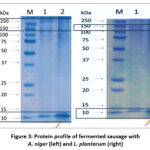 |
Figure 3: Protein profile of fermented sausage with A. niger (left) and L. plantarum (right). |
Lane M: Protein molecular weight marker; Lane 1: sample at fermentation day 0; Lane 2: sample at fermentation day 1.
Discussion
Water-holding capacity (WHC) is an important physicochemical property in fermented meat products, as it affects texture, juiciness, and overall yield. In this study, samples fermented with Lactobacillus plantarum showed higher WHC than those with Aspergillus niger, likely due to protein gelation and matrix stabilization, which are commonly associated with lactic acid fermentation.12,13 WHC is influenced by the integrity of the protein network, pore size, molecular capillarity, and protein conformation.12 Additionally, components such as insoluble dietary fibre had been reported to enhance WHC in meat matrices.12,14 Despite the higher WHC observed in sausages treated with Lactobacillus plantarum, these samples also exhibited increased cooking loss. This apparent contradiction can be attributed to acid-induced protein denaturation and enhanced proteolysis during fermentation, which weakened the protein network’s ability to retain water under heat. The pH decline during fermentation, primarily caused by lactic acid and other organic acids, directly affected both WHC and cooking loss. A lower pH disrupted protein structures, reducing water retention and thereby increasing fluid loss during cooking.15,16
In meat products, WHC played a crucial role in determining textural quality, sensory properties, and shelf life.14,17 Hence, although L. plantarum improved WHC during fermentation, the final product experienced greater cooking loss, likely due to the cumulative effects of acidification and proteolysis. Notably, both A. niger and L. plantarum treatments resulted in similar final pH values; however, samples inoculated with L. plantarum showed a more rapid acidification in the early stages, reflecting the starter’s strong acid-producing capability and its effect on protein structure and water retention.18
Furthermore, during the fermentation process, a reduction in water activity (aw) to below 0.90 was observed. This was significant, as it created an effective microbial hurdle, particularly essential in dry-cured meat products, by limiting the growth of spoilage and pathogenic microorganisms.19 The decrease in both aw and pH enhanced product stability and contributed to extended shelf life. Protein modifications also played a vital role throughout fermentation. Organic acids, primarily lactic acid, contributed to protein denaturation and facilitated gel formation by promoting aggregation of myofibrillar proteins.13,18 During the fermentation process, microbial enzymes, particularly those produced by lactic acid bacteria (LAB), contributed to protein breakdown, leading to the generation of peptides and amino acids that may possess bioactive properties.20 Although LAB was the dominant group in this process, the proteolytic activity of co-inoculated molds and staphylococci had been widely acknowledged, potentially enhancing flavor and texture development through synergistic mechanisms.21,22
Color is a critical quality parameter in fermented meat products, as it directly influences consumer perception and acceptance. In this study, samples treated with L. plantarum showed higher L* values compared to those treated with A. niger. The higher L* (lightness) in L. plantarum-fermented sausages was likely due to reduced pigment oxidation and improved moisture retention, resulting in a brighter appearance. Conversely, the lower L* observed in A. niger-treated samples may have been attributed to stronger proteolytic activity and pigment degradation, leading to a darker surface color. The a* values (redness) were also higher in L. plantarum-treated samples, potentially due to the acidifying effect of lactic acid bacteria, which helped stabilize nitrosomyoglobin and preserve the red color of cured meats. In contrast, the slight increase in redness (a*) in A. niger samples may have resulted from oxidative processes that altered pigment structure and intensity.23 The b* values increased during fermentation, which could be explained by the formation of Maillard reaction products, fat oxidation, and pigment transformation. The Maillard reaction likely occurred between amino groups (especially from α-amino N-terminal amino acids and ε-amino lysine residues) and aldehyde groups of reducing sugars, leading to color changes.24,25 In L. plantarum-fermented samples, carbohydrate fermentation by lactic acid bacteria may have contributed to the enhancement of red color through reduced sugar degradation and pigment interactions.26 The texture profile of fermented sausages was significantly influenced by the type of starter culture used. Overall, sausages fermented with L. plantarum exhibited more rapid textural softening over time, which may be attributed to its higher proteolytic activity and acid production capacity. In contrast, sausages fermented with A. niger maintained firmer structural characteristics throughout the fermentation period. Water activity (aw) and moisture content play a critical role in determining textural parameters such as hardness, cohesiveness, gumminess, and chewiness. As water activity and moisture levels decrease, these textural attributes tend to increase due to the denser protein matrix.19 The observed decline in pH, particularly in L. plantarum-inoculated samples, is known to adversely affect chewiness and hardness, as lower pH promotes protein denaturation and subsequent weakening of muscle structure.27 However, this acidification process also facilitates the aggregation of myofibrillar proteins, contributing to gel formation that enhances sausage firmness and elasticity in the later stages of fermentation.13 Studies have shown that even when the same starter cultures are used, differences in meat type can influence textural outcomes such as hardness and proteolysis, as demonstrated in comparisons between fermented camel and beef sausages.28
The contents of moisture, protein, fat, and ash showed significant variations between A. niger and L. plantarum treatments, as well as over different fermentation periods. The duration of the ripening process significantly influenced moisture content, with prolonged drying and fermentation resulting in reduced water levels.29 Although L. plantarum was more effective in maintaining protein content during the initial fermentation phase, both A. niger and L. plantarum treatments ultimately exhibited reduced protein levels by the end of fermentation, likely due to proteolytic activity by the microorganisms. Protein hydrolysis is driven by the enzymatic activity of starter cultures, which break down myofibrillar and sarcoplasmic proteins into smaller peptides and free amino acids, enhancing digestibility and potentially producing bioactive compounds.9 Similarly, a notable decrease in fat content was observed over time. The average fat content in sausages inoculated with L. plantarum decreased from 13.11% to 9.81%.9 Fat content plays a key role in determining the volatility of sausages, which directly affects the release and concentration of volatile compounds that shape flavor and aroma.30 The reduction in fat is likely linked to the activity of endogenous and microbial lipases, including phospholipases, which hydrolyse fat molecules into free fatty acids during fermentation.31 Lactic acid bacteria (LAB), yeasts, and molds are known to possess lipolytic activity, contributing to the release of these free fatty acids in fermented sausages.32 The lipolytic activity of LAB such as L. sakei, Pediococcus pentosaceus, S. carnosus, and S. xylosus has been reported to influence fat breakdown during fermentation.33 Fermentation also induces pH changes and promotes protein breakdown through the action of microbial enzymes and organic acids.18 In sausages fermented with A. niger, mold growth was associated with extended fermentation times and correlated with enhanced proteolysis and flavor development. Additionally, increases in ash content were observed in some products during fermentation and smoking, such as Macedonian sausage, which reached its highest ash level (5.96%) at the end of the fermentation period.34
The microstructural analysis revealed that sausages fermented with A. niger exhibited a more porous and open structure compared to those inoculated with L. plantarum. This difference may be attributed to the specific interactions between the starter cultures and other sausage components during emulsion formation. On day 0, the sausage matrix appeared compact and dense, indicating limited microbial or enzymatic activity. However, by day 1, small voids and slight openings began to emerge, suggesting the onset of protein denaturation and enzymatic activity from the starter cultures. Fat droplets, often observed as bright white dots under microscopy, appeared smaller and were evenly distributed throughout the matrix.35 The formation of hollow structures in the sausage microstructure may result from the expansion or redistribution of fat, water, and air components during fermentation and drying.36 Sausage formulations with higher sodium content demonstrated denser and more compact microstructures with similar porosity and void space compared to control samples that exhibited a spongier appearance.37 In contrast, bologna sausages with significant sodium reduction formed microstructures that were denser and more regular but exhibited more visible holes and a chewier appearance. In such samples, fat droplets were more apparent, whereas in other sausage types, the emulsion formed was more stable and compact, integrating fat into the matrix.38 Control sausages, characterized by smaller fat droplets and reduced cavity size, showed that emulsion-type sausages tend to form more compact structures with limited void formation.39
SDS-PAGE electrophoresis revealed changes in molecular weight distribution, which indicated proteolytic activity and protein degradation caused by the A. niger and L. plantarum starter cultures. The degradation of both myofibrillar and sarcoplasmic proteins was observed, reflecting one of the key biochemical processes that occurred during sausage fermentation.1 Previous studies reported the gradual disappearance of protein bands at 157, 97, 45, and 29 kDa in sausages inoculated with L. delbrueckii N102 and L. sakei H1-5 throughout fermentation and ripening, suggesting extensive proteolysis. Structural proteins such as actin and myosin, especially the myosin heavy chain (MHC), were significantly degraded. Protein degradation was considered one of the primary biochemical transformations in the sausage fermentation process, contributing to texture development and flavor. Endogenous enzymes such as cathepsins were believed to have initiated the proteolytic process, while microbial enzymes from starter cultures played an important role, particularly during the later stages of ripening.40
Conclusion
In conclusion, L. plantarum accelerated fermentation, lowered pH, improved water-holding capacity, and preserved color, but also caused higher cooking loss and a softer texture due to proteolysis. In contrast, A. niger exhibited slower acidification, firmer texture, and lower cooking loss, but resulted in darker color. Both cultures reduced moisture and fat, promoted protein degradation, and showed distinct microstructural changes. Overall, L. plantarum is preferable for enhancing WHC and color, whereas A. niger is more effective in preserving firmness and reducing cooking loss. These findings help guide the choice of starter cultures to improve sausage quality and support future research on fermentation.
Acknowledgement
The authors are grateful to the Department of Animal Product Technology, Faculty of Animal Science, Universitas Brawijaya, and the Central Laboratory for Tropical Animal Research, Faculty of Animal Science, Universitas Gadjah Mada, for providing facilities and support during the course of this research.
Funding Sources
The author is a recipient of the Indonesian Education Scholarship (BPI) in 2021 and this research was supported by funding from the Indonesia Endowment Fund for Education (LPDP) and the Center for Higher Education Funding (BPPT).
Conflict of Interest
The authors do not have any conflict of interest.
Data Availability Statement
The manuscript incorporates all datasets produced or examined throughout this research study.
Ethics Statement
This research did not involve human participants, animal subjects, or any material that requires ethical approval.
Informed Consent Statement
This study did not involve human participants, and therefore, informed consent was not required.
Clinical Trial Registration
This research does not involve any clinical trials.
Permission to Reproduce Material from Other Sources
Not Applicable.
Author Contributions
- Mulia Winirsya Apriliyani: Conceptualization, Methodology, Data Collection, Analysis, Writing – Review & Editing.
- Yuny Erwanto: Conceptualization, Supervision, Review
- Edi Suryanto: Conceptualization, Supervision
- Rusman: Conceptualization, Supervision
Reference
- Liu Y., Wan Z., Yohannes K. W., et al. Functional Characteristics of Lactobacillus and Yeast Single Starter Cultures in the Ripening Process of Dry Fermented Sausage. Front Microbiol. 2021;11:1-15. DOI: https://10.3389/fmicb.2020.611260
CrossRef - Drosinos E. H., Paramithiotis S., Kolovos G., et al. Phenotypic and Technological Diversity of Lactic Acid Bacteria and Staphylococci Isolated from Traditionally Fermented Sausages in Southern Greece. Food Microbiol. 2007;24(3):260-270. DOI: https://10.1016/j.fm.2006.05.001
CrossRef - da Costa W. K. A., de Souza G. T., Brandão L. R. Exploiting Antagonistic Activity of Fruit-Derived Lactobacillus to Control Pathogenic Bacteria in Fresh Cheese and Chicken Meat. Food Res Int. 2018;108:172-182. DOI: https://10.1016/j.foodres.2018.03.045
CrossRef - Laranjo M., Elias M., Fraqueza M. J. The Use of Starter Cultures in Traditional Meat Products. J Food Qual. 2017;2017:1-18. DOI: https://10.1155/2017/9546026
CrossRef - Sunesen L. O., Stahnke L. H. Mould Starter Cultures for Dry Sausages—Selection, Application and Effects. Meat Sci. 2003;65(3):935-948. DOI: https://10.1016/S0309-1740(02)00281-4
CrossRef - Bruna J. M., Hierro E. M., de la Hoz L., et al. Changes in Selected Biochemical and Sensory Parameters as Affected by the Superficial Inoculation of Penicillium camemberti on dry fermented sausages. Int J Food Microbiol. 2003;85(1-2):111-125. DOI: https://10.1016/S0168-1605(02)00505-6
CrossRef - Bruna J. M., Hierro E. M., de la Hoz L., et al. The Contribution of Penicillium aurantiogriseum to the Volatile Composition and Sensory Quality of Dry Fermented Sausages. Meat Sci. 2001;59(1):97-107. DOI: https://10.1016/S0309-1740(01)00058-4
CrossRef - Guo L., Li Y., Ding S. Effect of Fermentation with Two Molds on Characteristics of Chicken Meat. J Food Qual. 2021;2021:1-9. DOI: https://10.1155/2021/8845552
CrossRef - Susilo A., Widyastuti E. S., Evanuarini H., Apriliyani, M. W. Comparison of the Quality of Fermented Sausages with the Use of Yogurt Starter and Lactobacillus plantarum (pH, aw, and Proximate values). Jurnal Penelitian Pendidikan IPA. 2023;9(5):2319-2324. DOI: https://10.29303/jppipa.v9i5.2463
CrossRef - Lee S. H., Kim G. W., Kim H. Y. Physicochemical Properties Analysis of Bamboo Salt on Chicken Emulsion Sausage. J Anim Sci Technol. 2020;62(1):103-110. DOI: https://10.5187/JAST.2020.62.1.103
CrossRef - Latimer G. W. Official Methods of Analysis of AOAC International. 2023. DOI: https://doi.org/10.1093/9780197610145.001.0001
CrossRef - Ktari N., Smaoui S., Trabelsi I., et al. Chemical Composition, Techno-Functional and Sensory Properties and Effects of Three Dietary Fibers on the Quality Characteristics of Tunisian Beef Sausage. Meat Sci. 2014;96(1):521-525. DOI: https://10.1016/j.meatsci.2013.07.038
CrossRef - Essid I., Hassouna M. Effect of Inoculation of Selected Staphylococcus xylosus and Lactobacillus plantarum Strains on Biochemical, Microbiological and Textural Characteristics of a Tunisian Dry Fermented Sausage. Food Control. 2013;32(2):707-714. DOI: https://10.1016/j.foodcont.2013.02.003
CrossRef - Feng T., Ye R., Zhuang H., et al. Physicochemical Properties and Sensory Evaluation of Mesona Blumes Gum/Rice Starch Mixed Gels as Fat-Substitutes in Chinese Cantonese-Style Sausage. Food Res Int. 2013; 50(1):85-93. DOI: https://10.1016/j.foodres.2012.10.005
CrossRef - Akwetey W. Y., Yaw A. B., Elizabeth Y. Sensory and Physicochemical Characteristics of Semi-dry fermented Beef Sausages produced with Fresh Ripe Plantain. Turkish J Agr – Food Sci and Technol. 2023;11(2):202-206. DOI: https://10.24925/turjaf.v11i2.202-206.5036
CrossRef - Afoakwah N. A., Dong Y., Zhao Y. Characterization of Jerusalem artichoke (Helianthus tuberosus L.) Powder and its Application in Emulsion-Type Sausage. LWT – Food Sci and Technol. 2015;64(1):74-81. DOI: https://10.1016/j.lwt.2015.05.030
CrossRef - Chattopadhyay K., Xavier K. A. M., Layana P., et al. Chitosan Hydrogel Inclusion in Fish Mince Based Emulsion Sausages: Effect of Gel Interaction on Functional and Physicochemical Qualities. Int J Biol Macromol. 2019; 134:1063-1069. DOI: https://10.1016/j.ijbiomac.2019.05.148
CrossRef - Hwang J., Kim Y., Seo Y., et al. Effect of Starter Cultures on Quality of Fermented Sausages. Food Sci Anim Resour. 2023;43(1):1-9. DOI: https://10.5851/kosfa.2022.e75
CrossRef - Lorenzo J. M., Gómez M., Fonseca S. Effect of Commercial Starter Cultures on Physicochemical Characteristics, Microbial Counts and Free Fatty Acid Composition of Dry-Cured Foal Sausage. Food Control. 2014;46:382-389. DOI: https://10.1016/j.foodcont.2014.05.025
CrossRef - Arief I. I., Wulandari Z., Aditia E. L., et al. Physicochemical and Microbiological Properties of Fermented Lamb Sausages Using Probiotic Lactobacillus plantarum IIA-2C12 as Starter Culture. Procedia Environ Sci. 2014;20:352-356. DOI: https://10.1016/j.proenv.2014.03.044
CrossRef - López C. M., Sentandreu M. A., Vignolo G. M., Fadda S. G. Proteomic and Peptidomic Insights on Myofibrillar Protein Hydrolysis in a Sausage Model During Fermentation with Autochthonous Starter Cultures. Food Res Int. 2015;78:41-49. DOI: https://10.1016/j.foodres.2015.11.009
CrossRef - Stavropoulou D. A., Borremans W., De Vuyst L., et al. Amino Acid Conversions by Coagulase-Negative Staphylococci in a Rich Medium: Assessment of Inter- and Intraspecies Heterogeneity. Int J Food Microbiol. 2015;212:34-40. DOI: https://10.1016/j.ijfoodmicro.2015.04.048
CrossRef - Seo J. K., Parvin R., Yim D. G., et al. Effects on Quality Properties of Cooked Pork Sausages with Caesalpinia sappan L. Extract during Cold Storage. J Food Sci Technol. 2019;56(11):4946-4955. DOI: https://10.1007/s13197-019-03965-6
CrossRef - Herlina H., Aji S. B., Purnomo B. H. Physical, Chemical, and Sensory Characteristics of Chicken Sausage with Analog Meat Substitution. Industria: Jurnal Teknologi dan Manajemen Agroindustri. 2021;10(1):67-77. DOI: https://10.21776/ub.industria.2021.010.01.8
CrossRef - Nugrahedi P. Y., Dekker M., Widianarko B., Verkerk R. Quality of Cabbage During Long Term Steaming; Phytochemical, Texture and Colour Evaluation. LWT – Food Sci and Technol. 2016;65:421-427. DOI: https://10.1016/j.lwt.2015.08.034
CrossRef - van Schalkwyk D. L., McMillin K. W., Booyse M., et al. Physico-chemical, Microbiological, Textural and Sensory Attributes of Matured Game Salami Produced from Springbok (Antidorcas Marsupialis), Gemsbok (Oryx Gazella), Kudu (Tragelaphus Strepsiceros) and Zebra (Equus Burchelli) Harvested in Namibia. Meat Sci. 2011;88(1):36-44. DOI: https://10.1016/j.meatsci.2010.11.028
CrossRef - Casaburi A., Aristoy M. C., Cavella S., et al. Biochemical and Sensory Characteristics of Traditional Fermented Sausages of Vallo Di Diano (Southern Italy) as Affected by the Use of Starter Cultures. Meat Sci. 2007;76(2):295-307. DOI: https://10.1016/j.meatsci.2006.11.011
CrossRef - Ayyash M., Olaimat A., Al-Nabulsi A., Liu S. Q. Bioactive Properties of Novel Probiotic Lactococcus lactis Fermented Camel Sausages: Cytotoxicity, Angiotensin Converting Enzyme Inhibition, Antioxidant Capacity, and Antidiabetic Activity. Food Sci Anim Resour. 2020; 40(2):155-171. DOI: https://10.5851/kosfa.2020.e1
CrossRef - Dalmış Ü., Soyer A. Effect of Processing Methods and Starter Culture (Staphylococcus xylosus and Pediococcus pentosaceus) on Proteolytic Changes in Turkish Sausages (Sucuk) during Ripening and Storage. Meat Sci. 2008;80(2):345-354. DOI: https://10.1016/j.meatsci.2007.12.022
CrossRef - Gómez M., Lorenzo J. M. Effect of Fat Level on Physicochemical, Volatile Compounds and Sensory Characteristics of Dry-Ripened “Chorizo” from Celta Pig Breed. Meat Sci. 2013;95(3):658-666. DOI: https://10.1016/j.meatsci.2013.06.005
CrossRef - Visessanguan W., Benjakul S., Smitinont T., et al. Changes in Microbiological, Biochemical and Physico-Chemical Properties of Nham Inoculated with Different Inoculum Levels of Lactobacillus curvatus. LWT – Food Science and Technol. 2006;39(7):814-826. DOI: https://10.1016/j.lwt.2005.05.006
CrossRef - Chen Q., Kong B., Han Q., et al. The Role of Bacterial Fermentation in Lipolysis and Lipid Oxidation in Harbin Dry Sausages and its Flavour Development. LWT. 2017;77:389-396. DOI: https://10.1016/j.lwt.2016.11.075
CrossRef - Meristica G. L., Gumilar J., Suradi K. Characteristics of Beef Sausage Mixed with Modified Bekasam Meat Fermented by Lactobacillus plantarum. Tropical Anim Sci J. 2020;43(3):276-281. DOI: https://10.5398/tasj.2020.43.3.276
CrossRef - Demiri M., Abdullahu X., Sulejmani E. Physical-Chemical and Sensorial Characterization of Macedonian Dry Fermented Sausage (Sucuk). 2018;1:27-33. https://www.researchgate.net/publication/350979261
- Youssef M. K., Barbut S. Fat Reduction in Comminuted Meat Products-Effects of Beef Fat, Regular and Pre-Emulsified Canola Oil. Meat Sci. 2011;87(4):356-360. DOI: https://10.1016/j.meatsci.2010.11.011
CrossRef - Delgado-Pando G., Cofrades S., Ruiz-Capillas C., et al. Low-fat Frankfurters Formulated with a Healthier Lipid Combination as Functional Ingredient: Microstructure, Lipid Oxidation, Nitrite Content, Microbiological Changes and Biogenic Amine Formation. Meat Sci. 2011;89(1):65-71. DOI: https://10.1016/j.meatsci.2011.03.022
CrossRef - Jiménez-Colmenero F., Herrero A., Pintado T., et al. Influence of Emulsified Olive Oil Stabilizing System Used for Pork Backfat Replacement in Frankfurters. Food Res Int. 2010;43(8):2068-2076. DOI: https://10.1016/j.foodres.2010.06.010
CrossRef - Pires M. A., Munekata P. E. S., Baldin J. C. The Effect of Sodium Reduction on the Microstructure, Texture and Sensory Acceptance of Bologna Sausage. Food Structure. 2017;14:1-7. DOI: https://10.1016/j.foostr.2017.05.002
CrossRef - Qi W., Wu J., Shu Y., et al. Microstructure and Physiochemical Properties of Meat Sausages Based on Nanocellulose-Stabilized Emulsions. Int J Biol Macromol. 2020;152:567-575. DOI: https://10.1016/j.ijbiomac.2020.02.285
CrossRef - Berardo A., Devreese B., De Maere H., et al. Actin Proteolysis during Ripening of Dry Fermented Sausages at Different pH Values. Food Chem. 2017;221:1322-1332. DOI: https://10.1016/j.foodchem.2016.11.023
CrossRef
Abbreviations List
AN Aspergillus niger
aw Water activity
LAB Lactic acid bacteria
LP Lactobacillus plantarum
MHC Myosin heavy chain
SEM Scanning electron microscopy
SDS- PAGE Sodium dodecyl sulfate-polyacrylamide gel electrophoresis
TPA Texture profile analysis
 PlumX:
 Views: 98
  PDF Downloads:
180
PDF Downloads:
180 
Accepted on: 01 Oct 2025
Second Review by: Rajpreet Goraya
Final Approval by: Dr. Jeewon Rajesh





Web of Science Coverage
Emerging Sources Citation Index (ESCI)
2024 Journal Impact Factor: 1.1
Scopus Journal Metrics
CiteScore 2024: 1.9
CiteScore Details
Sustainable Nutrition: Food Systems, Nutrient Retention, and Public Health Impact

This journal is a member of, and subscribes to the principles of, the Committee on Publication Ethics (COPE)