
Physicochemical, Antioxidant, and Sensorial Properties of Xylopia aethiopica (Komba) Fruit on Mish Quality
 , Kamal Awad Abdel Razig2, Mohammed Gadallah Elsayed Gadallah1, Ghadah Saleh Alrebdi3, Ammar AL-Farga4and Islam Ragab3*
 1Department of Food Science and Human Nutrition, College of Agriculture and Food, Qassim University, Buraidah, Saudi Arabia
2Department of Food Science and Technology, Alzaiem Alazhari University, Sudan
3Department of Chemistry, College of Science, Qassim University, Buraidah, Saudi Arabia
4Faculty of Science, Department of Biochemistry, University of Jeddah, Saudi Arabia
*Corresponding Author’s Email: Is.Mohamed@qu.edu.sa
DOI : http://dx.doi.org/10.12944/CRNFSJ.13.Special-Issue-July.14
Download this article as:

This study investigated the potential of Xylopia aethiopica (Komba) to enhance the nutritional and functional properties of mish, a traditional Sudanese fermented dairy product. Motivated by the documented nutritional significance of both Xylopia aethiopica and mish, we examined dose-response effects of Komba fruit powder (incorporated at 0.0%, 0.5%, 1.0%, and 1.5% w/w) in mish produced from Dal Dairy Factory yoghurt. Chemical composition (AOAC methods), bioactive properties (DPPH radical scavenging assay), and sensory attributes (9-point structured hedonic scale; 60 panelists) were analyzed. Results demonstrated concentration-dependent improvements: The 1.5% Komba formulation exhibited significantly higher (P < 0.001) values than the control for total solids (17.0% vs. 13.80%), protein (5.95% vs. 4.75%), fat (5.05% vs. 3.94%), ash (2.77% vs. 1.25%), fiber (1.26% vs. 0.00%), and titratable acidity (2.06% vs. 1.70% lactic acid equivalent), alongside reduced pH (5.05 vs. 5.80). Mineral analysis confirmed elevated concentrations (P < 0.001) in the 1.5% sample: calcium (980.22 mg/100g vs. 895.60), potassium (482.61 mg/100g vs. 455.35), magnesium (182.33 mg/100g vs. 115.37), and iron (0.26 mg/100g vs. 0.19). Antioxidant activity increased proportionally to Komba concentration, with the 1.5% sample showing maximal DPPH radical scavenging (84.4% ± 0.001 vs. control: 67.1% ± 0.001), total flavonoids (76.7 ± 0.1 mg QE/100g DW vs. 30.5 ± 0.3), and total phenolics (39.9 ± 0.1 mg GAE/100g DW vs. 14.01 ± 0.1). These findings establish Xylopia aethiopica as a functional enhancer for mish, improving nutritional density and antioxidant capacity, supporting its application in value-added fermented foods and nutraceuticals.
KEYWORDS:Antioxidants; Chemical Composition; Fermented Milk; Xylopia Aethiopica (Komba)
Introduction
Herbal medicine (phytomedicine) represents a cornerstone of global alternative therapeutics.1 Xylopia aethiopica (Dunal) A. Rich, a member of the Annonaceae family commonly known as African pepper, Ethiopian pepper, or “Komba” in Sudan, exemplifies this significance.2 This tree, reaching heights exceeding 20 meters, inhabits diverse ecosystems including forests, riverbanks, and arid regions across Afric.3 Its distinctive fruit consists of slightly curved cylindrical pods that transition from green to brownish-black upon drying. Traditional medicinal practices in Sudan and Nigeria extensively utilize these fruits for treating respiratory ailments (coughs, bronchitis), gastrointestinal disorders (dysentery), edema, and as carminative or purgative agents.4-8 This ethnopharmacological relevance stems from its complex phytochemical profile, documented to include alkaloids, saponins, sterols, tannins, phenols, flavonoids (e.g., rutin), cardiac glycosides, volatile and fixed oils,9-13 complemented by vitamins (A-E), proteins, and essential minerals (copper, manganese, zinc)12-15 While previous research has thoroughly characterized X. aethiopica‘s phytochemistry and in vitro bioactivities,9-13,16-19 a critical knowledge gap persists regarding its functional application within traditional food systems, particularly fermented dairy products. This omission is notable for mish, a nutritionally significant Sudanese fermented milk consumed nationwide with regional variations in spicing intensity (e.g., “Haloom” among Bija tribes)20. Traditionally prepared by adding soured milk to boiled milk with spices (black cumin, salt, fenugreek, red pepper) followed by 2-3 days’ fermentation,20 mish presents an ideal vehicle for nutritional enhancement21-25 and its biofunctional properties (antioxidative, anti-diabetic, and anti-inflammatory).21,22,26-29 To address this research void, our study systematically investigated the novel fortification of mish with X. aethiopica fruit powder. Specifically, we examined the dose-dependent effects (0.0%, 0.5%, 1.0%, and 1.5% w/w) on key parameters: Chemical composition (total solids, protein, fat, fiber, ash, acidity), Mineral content (calcium, potassium, magnesium, iron), Bioactive properties (DPPH radical scavenging, total phenolics, flavonoids) and Sensory acceptability (appearance, texture, flavor, overall preference).
The goal was to establish optimal fortification levels that enhance nutritional and functional properties while maintaining organoleptic quality, thereby leveraging the documented significance of both X. aethiopica and mish within Sudanese dietary culture.
Material and Method
This study was conducted at Alzaeem Al-Azhari University’s food processing lab, which is part of the Department of Food Science and Technology, Faculty of Agriculture, Alzaeem Al-Azhari University, Sudan.
Materials
Yoghurt was sourced from Dal Dairy Factory (Capo), and spices (cumin, salt, and Xylopia aethiopica (Komba)) were procured from the central market in Khartoum, Sudan.
Experimental Design: A total of 6 kg of Capo yoghurt was divided into four treatments, each consisting of 1.25 kg per sample, with five replicates per treatment. The treatments included a control (0%), and three experimental groups with 0.5%, 1.0%, and 1.5% Xylopia aethiopica (Komba). Additionally, cumin (0.5%) and salt (1%) were added to each treatment.
Mish Manufacturing: The mish was prepared using Capo yoghurt produced a day prior. Cumin (0.5%) and salt (1%) were mixed into the yoghurt, which was then divided into four treatments of 1.25 kg each. Each treatment was further divided into six samples of 250 grams each. The levels of Xylopia aethiopica (Komba) used were as follows: the control (0.0%), 0.5% (0.75 g per 250 g of mixture), 1.0% (1.5 g per 250 g), and 1.5% (2.25 g per 250 g). The samples were incubated at room temperature for 24 hours and, then stored at 5°C on the second day. Sensory evaluation and chemical analysis were conducted on the third day of manufacturing.
Chemical Analysis
The total solids content was measured using the drying oven method30 protein content using the Kjeldahl method,30 the fat content using the Gerber method and ash content according to (AOAC, 2000)30. Finally, the mish samples were subjected to sensory evaluation by sixty panelists on the third day of production. The research protocol was previously approved by the Bioethics Committee of Qassim university (24-14-10) The panelists rated the samples on a five-point scale for appearance, texture, flavor, and overall acceptability. Each panelist was provided with water for rinsing between samples. The samples were coded before testing. The Statistical Package for Social Sciences (SPSS, 2004) was used to statistically evaluate the data. For statistical analysis, a completely randomized design was employed, and Duncan’s multiple range test was utilized to separate means at P < 0.001.
Results
Chemical Analysis of Mish Samples
Table (1) presents the total solids, protein, fat, ash, fiber, pH value, and titratable acidity of mish samples. The sample containing 1.5% Xylopia aethiopica (Komba) exhibited the highest total solid content (17.0%), while the control sample (0.0%) had the lowest (13.80%). The other samples fell in between these values (P < 0.001).
Table 1: Impact of Xylopia aethiopica (Komba) fruit levels on physiological properties (%) of Mish.
|
Items |
Levels of Xylopia aethiopica (%) | |||
| 1.5 | 1.0 | 0.5 |
0.0 |
|
|
Total solid |
17.01a±0.16 | 16.61a± 0.13 | 14.92b± 0.18 | 13.80c± 0.15 |
| Protein content | 5.95a ±0.12 | 5.83ab± 0.08 | 5.09b± 0.11 |
4.75c ±0.09 |
|
Fat content |
5.05 ±0.06 | 4.88± 0.03 | 4.66± 0.05 | 3.94 ±0.07 |
| Ash content | 2.77a ±0.03 | 2.35a ±0.07 | 1.86b± 0.04 |
1.25b± 0.05 |
|
Fiber |
1.26a± 0.05 | 0.92b ±0.02 | 0.53c ±0.01 | 0.00d ±0.00 |
| pH value | 5.05b ±0.04 | 5.30ab± 0.07 | 5.60ab ±0.09 |
5.80a ±0.08 |
|
Treatable acidity |
2.06a ±0.05 | 1.95b ±0.04 | 1.85c± 0.07 |
1.70c ±0.06 |
*Mean ± SD. Rows with different superscript letters indicate significant differences (P < 0.001).
Minerals content of Mish samples
Table (2) presents the calcium, potassium, magnesium, and iron content in mish samples. The highest concentrations of calcium (980.22 mg/100g), potassium (482.61 mg/100g), magnesium (182.33 mg/100g), and iron (0.26 mg/100g) were found in the sample containing 1.5% Xylopia aethiopica (Komba). In contrast, the control sample had the lowest concentrations: calcium (895.60 mg/100g), potassium (455.35 mg/100g), magnesium (115.37 mg/100g), and iron (0.19 mg/100g). The other samples ranked in intermediate positions (P < 0.001).
Table 2: Impact of Xylopia aethiopica (Komba) fruit levels on minerals content (mg/100g) of mish.
|
Items |
Levels of Xylopia aethiopica (%) | |||
| 1.5 | 1.0 | 0.5 |
0.0 |
|
|
Calcium |
980.22a ±0.14 | 697.0ab± 0.16 | 931.51b± 0.15 | 895c±0.13 |
| Potassium | 482.61a± 0.13 | 471.70b± 0.14 | 467.40c± 0.19 |
455.35d± 0.17 |
|
Magnesium |
182.33a ±0.12 | 130.74b ±0.15 | 122.50c± 0.16 | 115.37d± 0.11 |
| Iron | 0.26a ±0.05 | 0.24b ±0.09 | 0.21c± 0.06 |
0.19d ±0.08 |
*Mean ± SD. Rows with different superscript letters indicate significant differences (P < 0.001).
Sensory evaluation of Mish samples
Table (3) summarize the mean sensory attributes as evaluated by panelists for the four mish samples, focusing on appearance, texture, flavor, and overall acceptability.
Table 3: Impact of Xylopia aethiopica (Komba) fruit levels on organoleptic quality of mish.
|
Items |
Levels of Xylopia aethiopica (%) | |||
| 1.5 | 1.0 | 0.5 |
0.0 |
|
|
Appearance |
4.3c ±0.05 | 4.7a± 0.03 | 4.5b± 0.04 | 4.2d ±0.08 |
| Texture | 4.6c± 0.01 | 4.8a± 0.02 | 4.7b± 0.03 |
4.4d± 0.06 |
|
Flavor |
4.5c ±0.03 | 4.9a ±0.01 | 4.7b± 0.02 | 4.1d± 0.07 |
| Overall acceptability | 4.4c ±0.06 | 4.8a ±0.02 | 4.6b± 0.04 |
4.2d ±0.05 |
Mean ± SD. Rows with different superscript letters indicate significant differences (P < 0.001).
Antioxidant activity of Mish samples in different concentration of Xylopia aethiopica fruit seeds
The data in Figure 1,2 and figure 3 shows the DPPH radical scavenging activity (mM Trolox equivalent ml-1), TFC (mg quercetin equivalent 100g-1 DW), and TPC (mg gallic acid equivalent 100g-1 DW) for each sample. Demonstrate how the concentration of Xylopia aethiopica fruits seeds affects the DPPH radical scavenging activity percentage, TFC, and TPC. The highest DPPH radical scavenging activity percentage, TFC, and TPC for mish samples with varying concentrations of Xylopia aethiopica fruits and seeds (0.5, 1, and 1.5) was detected by all samples, but the sample containing 1.5% Xylopia aethiopica (Komba) had the highest percentage (.84.4± 0.001-13.0 ±(0.001), (76.7± 0.1) and (39.9± 0.1) while the control sample had the lowest (0.67.1± 0.001-.0.9±0.005), (30.5 ± 0.3) and ( 14.01± 0.1) DPPH radical scavenging activity percentage, TFC, and TPC respectively. The remaining samples were within the range of these values (P < 0.05). However, Onyenibe31 found DPPH % ug/ml) was 52.45± and Mojisola32 found TFC, and TPC (mg/g) were (15.57± 0.20 and 11.71± 0.04) respectively.
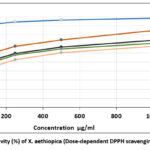 |
Figure 1: Antioxidant activity (%) of X. aethiopica (Dose-dependent DPPH scavenging (84.4% at 1.5% Komba) |
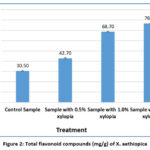 |
Figure 2: Total flavonoid compounds (mg/g) of X. aethiopica |
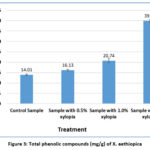 |
Figure 3: Total phenolic compounds (mg/g) of X. aethiopica |
Discussion
Chemical Analysis of Mish Samples
The high total solids content may be attributed to fermentation, flavoring addition, and the concentration and conversion of raw milk from liquid to gel form.33
The highest protein content (5.95%) was also observed in the sample with 1.5% Xylopia aethiopica (Komba), with the control sample having the lowest (4.75%). The remaining samples had intermediate rankings (P < 0.001). These results were higher than those reported by ( El-Zubeir et al, 2005),)34 who found the protein content of mish to be 5.09±2.80 and (Ajibade etal,2025)35 The increased protein content in the mish samples may be due to the varying levels of Xylopia aethiopica (Komba) used during production.
Similarly, the highest fat content (5.05%) was found in the sample with 1.5% Xylopia aethiopica (Komba), while the control sample had the lowest (3.94%). The remaining samples had intermediate rankings (P < 0.001). These values were lower than those reported by (Nassib & El-Gendy, 1974)36 and ( El-Zubeir et al, 2005 and Ajibade et al,2025)34,35 for mish.
The Sudanese Standards and Metrology Organization specifies that the fat content in mish should not exceed 3%, highlighting a discrepancy between the findings of this study and the recommended values.37 The sample with 1.5% Xylopia aethiopica (Komba) had the greatest ash concentration (2.77%), while the control sample (0.0%) had the lowest ash content (1.25%), with other samples falling in between (P < 0.001). These results align with El Zubeir,34who reported an ash content of 1.26% but are higher than those reported by El Erian.38
The highest fiber content (1.26%) was also found in the sample with 1.5% Xylopia aethiopica (Komba), whereas the control sample had no detectable fiber (0.00%). There were several samples that placed in the middle (P < 0.001). These results are lower than those reported by Osabor,35,39 who found a crude fiber content of 3.87% in Xylopia aethiopica (Komba) fruit, which also revealed significant mineral concentrations.
The control sample (0.0% Xylopia aethiopica (Komba)) had the highest pH value (5.80), while the lowest pH value (5.05) was found in the sample with 1.5% Xylopia aethiopica (Komba), with other samples ranking in between (P < 0.001). These pH values are higher than those reported by Osman,40 but similar to those reported by Nassib and El-Gendy.36 The increase in acidity, resulting in lower pH values, is attributed to the fermentation process, which increases acid concentration.
The highest titratable acidity (2.06%) was observed in the sample with 1.5% Xylopia aethiopica (Komba), while the control sample had the lowest (1.70%), with other samples ranking in intermediate positions (P < 0.001). These findings surpass those of,34 who discovered that the titratable acidity of mish samples was 1.24% ± 0.41. The increase in acidity is primarily due to the proliferation of lactic acid bacteria, which convert lactose into lactic acid.41-45
Minerals content of Mish samples
The results indicate a higher concentration of calcium, which is necessary for the healthy development and upkeep of teeth and bones, as well as for nerve transmission.46 The daily recommended intake of calcium is 360-400 mg/day for both children and adults. However, these findings are lower than those reported by39 who found calcium levels of 2.13 mg/100g in Xylopia aethiopica fruit.
This study’s potassium content was also less than what was reported by Osabor,39 who found potassium levels of 4.80 mg/100g in Xylopia aethiopica fruit. Potassium ions help regulate the pH of intracellular fluids and maintain osmotic pressure within cells.47
Similarly, the magnesium content was lower than that reported by Osabor,39 who found magnesium levels of 2.40 mg/100g in Xylopia aethiopica fruit. Magnesium is crucial for various biophysiological processes, including enzyme activation and DNA structure stabilization.48
The iron content in this study was lower than that reported by John-Dewole,11 who found iron levels of 0.690 mg/100g in Xylopia aethiopica fruit through spectroscopic analysis of rare metals.
Sensory evaluation of Mish samples
The highest ratings for overall acceptability (4.8), texture (4.8), flavor (4.9), and appearance (4.7) were given to the sample that contained 1.0% Xylopia aethiopica (Komba) fruit. On the other hand, the sample containing 0.0% Xylopia aethiopica (Komba) scored the lowest in terms of general acceptability (4.2), texture (4.4), flavor (4.1), and appearance (4.2). The other samples ranked in intermediate positions (P < 0.001).
Antioxidant activity of Mish samples in different concentration of Xylopia aethiopica fruit seeds
The rich flavonoids and phenolic compounds found in X. aethiopica fruit position it as a natural remedy for various conditions including cancer, heart disease, atherosclerosis, and peptic ulcers prevention. These compounds, notably flavonoids, act as potent antioxidants crucial in combatting free radicals and preventing degenerative diseases such as heart conditions.49 Moreover, flavonoids play a significant role in regulating the cell cycle, inducing apoptosis, and inhibiting the growth of cancer cells.50 Their multifaceted functions as anti-proliferative agents, estrogen modulators, and antioxidants offer protection against cancer and atherosclerosis. Additionally, phenolic compounds, recognized for their antioxidant properties, exhibit anti-inflammatory, anticancer, and atherosclerotic effect. 51-53 Studies have also highlighted the potential of plant extracts rich in flavonoids in the prevention of peptic ulcers.15,54
Conclusion
In the study, it was investigated that the effects of different levels of Xylopia aethiopica (Komba) on the quality of mish, a vital component of the Sudanese diet. The study utilized yoghurt from the Dal Dairy Factory and Xylopia aethiopica fruits from Khartoum State, Sudan. These fruits were air-dried and manually ground to create four distinct treatment groups: a control group with 0.0% Xylopia aethiopica and experimental groups with concentrations of 0.5%, 1.0%, and 1.5%. Following incubation and storage, thorough assessments were conducted on the third day, including analyses of chemical composition, antioxidant activity (DPPH radical scavenging activity percentage, TFC, TPC), and sensory evaluations. The results revealed that the mish sample containing 1.5% Xylopia aethiopica exhibited superior characteristics, with higher levels of total solids, protein, fat, fiber, and acidity compared to other samples. Additionally, it showed elevated levels of calcium, potassium, magnesium, and iron. In sensory evaluation, the mish sample with 1.0% Xylopia aethiopica was favored for its exceptional appearance, texture, flavor, and overall acceptability. This study highlights the significant improvement in nutritional parameters and antioxidant activity in mish through the inclusion of Xylopia aethiopica. It emphasizes the potential of Xylopia aethiopica as a functional ingredient with nutritional and antioxidant benefits, suggesting its potential for enhancing mish quality in the food industry and potentially in medicinal applications. Future studies should explore encapsulation techniques to optimize sensory acceptance of higher-concentration Xylopia aethiopica-fortified mish while preserving its enhanced nutraceutical properties for commercial scalability.
Acknowledgement
The Researchers would like to thank the Deanship of Graduate Studies and Scientific Research at Qassim University for financial support (QU-APC-2025)
Funding Sources
The author(s) received financial support for the publication of this article.
Conflict of Interest
The authors declare no conflict of interest.
Data Availability Statement
The article contains the information that was utilized to support the study’s conclusions.
Ethics Statement
The research protocol was previously approved by the Bioethics Committee of Qassim University (24-14-10).
Informed Consent Statement
This study did not involve human participants, and therefore, informed consent was not required.
Clinical Trial Registration
This research does not involve any clinical trials.
Permission to Reproduce Material from Other Sources
The manuscript did not contain any materials such as figures, tables, or text excerpts that have been previously published elsewhere.
Author Contributions
- E.Ahmed: Conceptualization, Data curation, Formal analysis, Investigation, Methodology, Writing – original draft, Writing – review & editing
- Kamal Awad Abdel Razig: Conceptualization, Data curation, Investigation, Methodology, Supervision, Resources, Writing – original draft, Writing – review & editing.
- Mohamed G.E. Gadallah: Conceptualization, Formal analysis, Resources, Writing – review & editing
- Ghadah S. Alrebdi : Conceptualization, Formal analysis, Resources, Writing – review & editing
- Ammar AL-Farga: Conceptualization, Formal analysis, Resources, Writing – review & editing
- Islam Ragab: Conceptualization, Data curation, Formal analysis, Investigation, Methodology, Writing – original draft, Writing – review & editing
References
- Ogbonnia SO, Mbaka GO, Anyika EN, Emordi JE, Nwakakwa N. An evaluation of acute and subchronic toxicities of a Nigerian polyherbal tea remedy. Pakistan Journal of Nutrition. 2011;10(11):1022-1028.
CrossRef - Burkill H. The useful plants of West Africa Vol. 1. Royal Botanic Gardens. 1985:386-387.
- Aguoru C, Pilla C, Olasan J. Phytochemical screening of Xylopia aethiopica with emphasis on its medicinally active principles. Journal of Medicinal Plants Research. 2016;10(22):306-309.
- Lajide L, Escoubas P, Mizutani J. Termite antifeedant activity in Xylopia aethiopica. Phytochemistry. 1995;40(4):1105-1112. doi:10.1016/0031-9422(95)92653-P
CrossRef - Burkil HM. The useful plants of west tropical Africa. 4th ed. vol 1. Macmillan Press, London, pp 34-36; 1999.
- Anika O, Unimke A, Tiku D, Isu N. Antibacterial screening of two indigenous Nigerian spices; Piper guineense and Xylopia aethiopica. Microbiology Research Journal International. 2017;22(1):1-11.
CrossRef - El-kamali HH, AbdAlla BM, Al-Magboul AZ. Antibacterial properties of some essential oils against five enterobacteriaceae species. AL-Buhuth. 2007;11(2):11-19.
CrossRef - Oliver-Bever B. Medicinal plants in tropical West Africa. Cambridge university press; 1986.
- Esekhiagbe M, Agatemor M-MU, Agatemor C. Phenolic content and antimicrobial potentials of Xylopia aethiopica and Myristica argentea. Macedonian Journal of Chemistry and Chemical Engineering. 2009;28(2):159-162.
CrossRef - Ezekwesili C, Nwodo O, Eneh F, Ogbunugafor H. Investigation of the chemical composition and biological activity of Xylopia aethiopica Dunal (Annonacae). African Journal of Biotechnology. 2010;9(43):7352-7356.
- John-Dewole O, Agunbiade S, Alao O, Arojojoye O. Phytochemical and antimicrobial studies of extract of the fruit of Xylopia aethiopica for medicinal importance. Journal of Biotechnology and Pharmaceutical Research. 2012;29(6):118-122.
- Nwaichi E, Igbinobaro O. Effects of some selected spices on some biochemical profile of Wister albino rats. American Journal of Environmental Engineering. 2012;2(1):8-11.
- Asekun O, Kunle O. The chemical constituents of the fruit essential oil of Xylopia aethiopica (Dunal) A. RICH from Nigeria. Journal of Essential Oil Bearing Plants. 2004;7(2):186-189.
CrossRef - Ndoye SF, Tine Y, Seck I, et al. Chemical Constituents and Antimicrobial and Antioxidant Activities of Essential Oil from Dried Seeds of Xylopia aethiopica. Biochemistry Research International. 2024;2024(1):3923479.
CrossRef - Arhin RE, Adri-Walters E, Hackman HK, Gordon PK, Appenteng MA, Gordon A. Combinative phytochemical compositions and antimicrobial activities of Xylopia aethiopica and Sida acuta extracts. German Journal of Pharmaceuticals and Biomaterials. 2025;4(1):21-30.
CrossRef - Cameselle C, Zou P, Jia Z, et al. Chemical and nutritional characterization of edible Heinsia crinita, Xylopia aethiopica, Piper guineense, Monodora myristica and Dorstenia convexa plants from Angola. Food Bioscience. 2025;67:106336.
CrossRef - Asanga EE, Ekeleme CM, Udoh IE, et al. Exploring Anti-diabetic Activity of Xylopia aethiopica Compounds as Potential Inhibitors of α-Amylase and α-Glucosidase: Experimental and Computational Approach. Natural Product Communications. 2025;20(3):1934578X251325717.
CrossRef - Ezeobiora CE, Igbokwe NH, Amin DH, Okpalanwa CF, Stephen CM, Mendie UE. Phylogenetic insights and antimicrobial biosynthetic potential of Serratia sp. XAFb12 and Pseudomonas sp. XAFb13 from Xylopia aethiopica. Brazilian Journal of Microbiology. 2024;55(1):201-213.
CrossRef - Nguedia MY, Rebe RN, Bakam BY, Njamen D, Mendimi JMN, Zingue S. Anticancer Potential of Ethanolic Extract of Xylopia aethiopica (Dunal) A. Rich (Annonaceae) Dried Fruits on Breast Adenocarcinoma: In Vitro and In Vivo Evidences. Environmental Toxicology. 2025;
- Dirar HA. Indigenous Fermented Foods of the Sudan. A study of Africa Foods and Nutrition, Sudan Pp 303-304. 1993;
- Bosnea L, Terpou A, Kontogianni V, Mataragas M. Technological Aspects of Bioactive Compounds and Nutraceuticals from Milk/Dairy Products. Bioactive Compounds and Nutraceuticals from Dairy, Marine, and Nonconventional Sources. Apple Academic Press; 2024:131-158.
CrossRef - Soutelino MEM, de Paiva Vieira G, Goulart MB, et al. Natural food dyes on dairy products: A critical approach between 2012-2023 literature regarding the technological and functional aspects, health benefits and future trends. Trends in Food Science & Technology. 2024:104370.
CrossRef - E. M. Soutelino, G. de Paiva Vieira, M. B. Goulart, K. C. Miranda, R. P. da Conceição, T. C. Pimentel, A. G. da Cruz and R. da Silva Rocha, Trends in Food Science & Technology, 2024, 104370.
CrossRef - Wazzan H. Fortification of dairy products using plant-derived bioactive compounds. Current Research in Nutrition and Food Science Journal. 2024;12(2):561-571.
CrossRef - Kober AH. Milk and Dairy Foods: Nutrition, Processing and Healthy Aging. CRC Press; 2024.
CrossRef - Saleem GN, Gu R, Qu H, et al. Therapeutic potential of popular fermented dairy products and its benefits on human health. Frontiers in Nutrition. 2024;11:1328620.
CrossRef - Bhuva B, Sakure AA, Mankad PM, et al. Influence of Lactobacillus and yeast on antioxidative, antidiabetic, and anti‐inflammatory attributes of camel milk and Gir cow milk as well as release of bioactive peptides: A comparative study. Journal of Food Science. 2025;90(3):e70112.
CrossRef - Goitre I. Effects of an innovative dairy product enriched with bioactive compounds derived from milk on the health status of patients with gestational diabetes. A pilot randomized controlled double-blind trial. 2025;
- Maniaci G, Ponte M, Giosuè C, et al. Cladodes of Opuntia ficus-indica (L.) as a Source of Bioactive Compounds in Dairy Products. Journal of Dairy Science. 2024;107(4):1887-1902.
CrossRef - AOAC. Official methods of analysis. 15th ed. Association of Official Analytical Chemists. Washington, DC, USA.; 2000.
- Onyenibe Sarah Nwozo, Enor Magdalene Effiong, Patrick Maduabuchi Aja, Chinaza Godswill Awuchi. Antioxidant, phytochemical, and therapeutic properties of medicinal plants: A review. International Journal of Food Properties. 2023;26(1):359-388.
- Mojisola Adebimpe Fategbe, Oghenetega Jonathan Avwioroko, Emmanuel Olufemi Ibukun. Comparative biochemical evaluation of the proximate, mineral, and phytochemical constituents of Xylopia aethiopica whole fruit, seed, and pericarp. Preventive Nutrition and Food Science. 2021;26(2):219-229.
CrossRef - Kurmann JA, Rasic JL, Kroger M. Encyclopedia of fermented fresh milk products: an international inventory of fermented milk, cream, buttermilk, whey, and related products. Springer Science & Business Media; 1992.
- El Zubeir IE, Abdalla WM, El Owni O. Chemical composition of fermented milk (roub and mish) in Sudan. Food control. 2005;16(7):633-637.
- Audu H, Ajibade G, Dibal D, Magaji Y. Comparative Study of Phytochemicals and Proximate Composition of Parkia biglobosa, Xylopia aethiopica and Aframomum melegueta for Nutraceutical Applications. Sahel Journal of Life Sciences FUDMA. 2025;3(1):87-91.
CrossRef - Nassib TA, El-Gendy SM. Chemical and microbiological studies on Mish. Ann Agric Sci Moshtohor. 1974;1:149.
- SSMO. Sudanese Standards and Metrology Organization.
- El-Erian AFM, Farag AH, Elgindy SM. Chemical studies on mish-cheese. Agricultural Research Review. 1975;53:173-181.
- Osabor V, Bassey F, Ivara S. Chemical profiling of African guinea pepper fruit (Xylopia aethiopica). Journal of Medicinal Plant and Herbal Therapy Research. 2015;3:10-15.
- Osman AO. Mish production-a traditional product commercialized. 1987:2-7.
- Bozanic R, Tratnik L. Quality of cow’s and goat’s fermented bifido milk during storage. Food Technol Biotechnol. 2001;39:109-114.
- Hayaloglu AA, Guven M, Fox P, McSweeney P. Influence of starters on chemical, biochemical, and sensory changes in Turkish white-brined cheese during ripening. Journal of dairy science. 2005;88(10):3460-3474.
CrossRef - Tarakci Z, Kucukoner E. Changes on physicochemical, lipolysis and proteolysis of vacuumpacked Turkish Kashar cheese during ripening. Journal of Central European Agriculture. 2006;7(3):459-464.
- Cais-Sokolińska D, Danków R, Pikul J. Physicochemical and sensory characteristics of sheep kefir during storage. Acta Scientiarum Polonorum Technologia Alimentaria. 2008;7(2):63-73.
- El Owni OAO, Omer IAH. Effect of storage period on weight loss, chemical composition, microbiological and sensory characteristics of Sudanese white cheese (Gibna Bayda). Pakistan Journal of Nutrition. 2008;7(1):75-80.
- Audrey H. Ensminger, Marion Eugene Ensminger. Foods & Nutrition Encyclopedia, Two Volume Set. CRC press; 1993.
- Eldra Pearl Solomon. Introduction and Human anatomy. chapter 16 page 263.; 2015.
- Definition. magnesium from Online Medical Dictionary. Archived from the original on 2007-12-25. Retrieved 17 January 2018.
- Bisio A, De Mieri M, Milella L, et al. Antibacterial and hypoglycemic diterpenoids from Salvia chamaedryoides. Journal of natural products. 2017;80(2):503-514.
CrossRef - Rue EA, Rush MD, van Breemen RB. Procyanidins: A comprehensive review encompassing structure elucidation via mass spectrometry. Phytochemistry Reviews. 2018;17:1-16.
- Sonboli A, Mojarrad M, Ebrahimi SN, Enayat S. Free radical scavenging activity and total phenolic content of methanolic extracts from male inflorescence of Salix aegyptiaca grown in Iran. Iranian Journal of Pharmaceutical Research: IJPR. 2010;9(3):293-296.
- Huang W-Y, Cai Y-Z, Zhang Y. Natural phenolic compounds from medicinal herbs and dietary plants: potential use for cancer prevention. Nutrition and cancer. 2009;62(1):1-20.
CrossRef - Airaodion AI, Olatoyinbo PO, Ogbuagu U, et al. Comparative assessment of phytochemical content and antioxidant potential of Azadirachta indica and Parquetina nigrescens leaves. Asian Plant Research Journal. 2019;2(3):1-14.
CrossRef - Airaodion A, Obajimi OO, Ezebuiro CN, et al. Prophylactic efficacy of aqueous extract of Curcuma longa against indomethacin-induced ulcer in male Wistar rats. International Journal of Research. 2019;6(1):87-91.
 PlumX:
 Views: 220
  PDF Downloads:
363
PDF Downloads:
363 
Accepted on: 09 Jul 2025
Second Review by: Sudhanya Nath
Final Approval by: Dr. Chunpeng Wan





Web of Science Coverage
Emerging Sources Citation Index (ESCI)
2024 Journal Impact Factor: 1.1
Scopus Journal Metrics
CiteScore 2024: 1.9
CiteScore Details
Sustainable Nutrition: Food Systems, Nutrient Retention, and Public Health Impact

This journal is a member of, and subscribes to the principles of, the Committee on Publication Ethics (COPE)