
Evaluating the Nutritional and Microbial Safety of Innovative Heat Treatments on Fermented Fish (Pla Som) using an Air Fryer
 , Wanida Apithanaphong2and Noppakun Pakdeenarong3*
 1Department of Design Innovation, Mahasarakham University, Maha Sarakham, Thailand
2Division of Biotechnology, University of Phayao, Phayao, Thailand
3Department of Biology, Mahasarakham University, Maha Sarakham, Thailand
Corresponding Author Email: noppakun@msu.ac.th
DOI : http://dx.doi.org/10.12944/CRNFSJ.13.3.15
Download this article as:

This study evaluated the effectiveness of thermal processing using an electric oven air fryer at 180 °C for 15 minutes on the microbial safety and nutritional quality of fermented fish (Pla Som). The aim of the study was to compare nutrition values and microbial safety of Pla Som between pre- and post-heat treatment values. Proximate compositions including energy, protein, carbohydrate, total fat, and saturated fat content were analyzed pre- and post-treatment using AOAC standard methods. Nutritional analysis indicated significant increases in energy (12.7%), protein (16.5%), and carbohydrates (547.9%), alongside reductions in fat energy (8.7%), total fat (10.8%), and saturated fat (16.6%). However, sodium and cholesterol levels rose by 29.9% and 15.0%, respectively, ash content increased by 4.9%, and moisture content decreased by 14.1%. Thermal processing effectively improved microbial safety. Microbial analysis revealed complete elimination of Escherichia coli, yeasts, and molds, with initial counts of E. coli at 2.7 × 10⁴ CFU/g and yeasts and molds at 2.5 × 10³ CFU/g, all reduced to less 3 and 10 CFU/g at post-treatment. No proliferation of E. coli occurred over 15 days of refrigerated storage. The certain nutritional aspects, elevated sodium and cholesterol levels may pose health considerations for specific consumer groups, warranting further investigation.
KEYWORDS:Air Fryer; Fermented fish; Food safety; Nutrition profile; Pla Som
Introduction
Fermented fish products are produced in Southeast Asian,1 serving as both cultural heritage foods and sources of beneficial microbes. In response to increasing consumer demand for healthier traditional foods, alternative cooking methods such as air frying have emerged as promising approaches to reduce oil absorption and caloric density while preserving sensory quality; however, their application to fermented fish remains underexplored.2 Pla Som is a traditional fermented fish product in Thailand , typically consumed after deep frying in oil, a practice that enhances flavor and texture but substantially increases caloric content and fat intake, posing potential health risks for individuals with dietary restrictions.3
Air fryers can limit calories have gained popularity due to their ability to reduce cholesterol and lean fat. They have gained significant popularity as a cooking device that reduces calorie content in foods.4 Unlike traditional deep-frying, which immerses food in oil, air frying circulates hot air to achieve a similar crispy texture, resulting in food with 70–80% fewer calories.5 The exterior of air-fried foods retains a familiar crunch, while the interior remains tender, offering a sensory experience comparable to deep-fried dishes.6 For optimal health benefits, the choice of nutritious ingredients, such as lean proteins and vegetables, is critical. One major advantage of air fryers is their ability to eliminate the need for oil, significantly lowering fat and calorie intake.7 This reduction in unhealthy fats, particularly trans fats found in many fast foods, is associated with decreased risks of cardiovascular diseases and other chronic conditions.8 Air frying has been shown to minimize the formation of harmful compounds like acrylamide,9 which can occur during high-temperature cooking processes such as deep frying.10
Pla Som, a traditional Thai fermented fish product11 is prepared by thoroughly cleaned fish to remove scales, gut and impurities and then make frequent incision the flesh with diagonal cuts. The fermentation process involves mixing the prepared fish with cooked sticky rice, garlic, and Rock salt, kneading the mixture by hand for 10–20 minutes, and then packing it into clean containers. The prepared fish is then sealed to avoid contamination and stored in a cool, dark area to ferment for 3–4 days at room temperature, or 5–7 days in cooler climates then called Pla Som, fermented fish.12 Properly fermented Pla Som is safe for consumption13,14 and offers a distinctive sour flavor profile that is widely appreciated in Thai cuisine, moreover, it has been anticancer properties.11 Studies have demonstrated that fermented fish products like Pla Som are microbiologically safe and provide unique nutritional benefits.15 A previous study explored the microbiological safety aspects of Pla Som, a traditional Thai fermented fish product, and highlighted its unique nutritional benefits. Results confirmed that properly fermented Pla Som is safe for consumption and provides distinctive nutritional value.16 Traditional methods of Pla Som preparation and storage carry risks of microbial contamination, particularly from Escherichia coli, yeasts, and molds which can pose significant health hazards to consumers. Previous studies have examined the microbial safety and nutritional profiles of fermented foods17 but limited attention has been given to the impact of thermal processing on both microbial reduction and the nutritional composition of Pla Som. Previous research focused on chemical preservation methods or fermentation processes without exploring the effectiveness of heat treatment as a viable solution.18 This study addressed this research gap by evaluating microbial safety after heat treatment and its associated effects on nutritional composition. By integrating thermal processing as a potential intervention, this study offers insights into improving food safety while balancing the nutritional quality of traditional fermented fish products. This approach fills a critical gap in understanding how air frying can be applied to Pla som to reduce and control calorie intake, microbial safety, and nutritional quality. This study evaluated the effectiveness of thermal processing at 180 °C for 15 minutes in eliminating microbial contaminants in Pla Som while also analyzing the impact on product nutritional composition.
Materials and Methods
Sample Preparation
Fresh fermented fish (Pla Som) was sourced from local producers in Mahasarakham province, northeastern,Thailand. Pla Som was prepared by thoroughly cleaned fish to remove scales, gut and impurities and then make frequent incision the flesh with diagonal cuts. The fermentation process involves mixing the prepared fish with cooked sticky rice, garlic, and rock salt, kneading the mixture by hand for 10–20 minutes, and packing it into clean containers according classical Thai traditional methods.17 The prepared fish is then sealed to avoid contamination and stored in a cool, dark area to ferment for 3–4 days at room temperature. They were stored under refrigerated conditions before processing.
Thermal Processing
An electric oven air fryer (model: Seagull Brand, AF-21-1; 650001243, manufacturer: Thai Stainless-Steel Co., Ltd., Thailand) was preheated to 180 °C. The samples were placed in the oven and subjected to heat treatment for 15 minutes. The internal temperature of the fish was monitored using a calibrated digital thermometer to ensure uniform heating.
Microbiological Analysis
Microbial loads of Escherichia coli, yeasts, and molds were quantified before and after thermal treatment. Standard plating techniques were employed, with samples inoculated on selective media: MacConkey agar for E. coli and Potato Dextrose Agar for yeasts and molds. The plates were incubated at 37 °C for 24 hours (E. coli) and 25 °C for 5 days (yeasts and molds). The microbiological analyses were performed using AOAC standard methods.19
Nutritional Analysis
Proximate compositions including energy, protein, carbohydrate, total fat, and saturated fat content were analyzed pre- and post-treatment using AOAC standard methods.19 Sodium and cholesterol levels were quantified using ion-selective electrode analysis and enzymatic methods, respectively. The nutritional composition of the samples was analyzed according to AOAC-approved methods. Energy content was measured using bomb calorimetry following AOAC (2019) 985.29 guidelines.19 Protein content was determined using the Kjeldahl method following AOAC (2019) 992.06.15 Carbohydrate content was calculated by difference using the method outlined in AOAC (2019) 994.10.15 Total fat and fat energy were analyzed using Soxhlet extraction in accordance with AOAC (2019) 948.15.19 Saturated fat was measured following AOAC (2019) 996.06.19 Cholesterol content was determined using gas chromatography following AOAC (2019) 994.10.19 Moisture and ash contents were determined using AOAC (2019) 942.23 and AOAC (2019) 984.27,19 respectively. Sodium and calcium levels were quantified using atomic absorption spectroscopy, adhering to the protocol in AOAC (2019) 977.20.19
Storage Conditions and Post-Processing Testing
The processed samples were stored at 4 °C for 15 days. E. coli proliferation during storage was monitored on days 0, 5, 10, and 15 using AOAC standard methods.15
Statistical Analysis
Data were analyzed using the Statistical Package for the Social Sciences (IBM SPSS Statistics, Version 25.0 for Windows, 2011; IBM Co., Somers, NY, USA). Microbial reductions and nutritional changes were evaluated using paired t-tests, with significance set at p < 0.05.
Results
Nutritional Composition
Nutritional analyses revealed that heat treatment positively influenced the nutritional profile by increasing energy, protein, and carbohydrate content while reducing total and saturated fats. These findings supported the dual role of thermal processing in enhancing nutritional value and ensuring food safety. However, the sodium and cholesterol levels were increased. Thermal processing altered the nutritional profile of Pla Som. Energy content increased by 8.5%, protein by 12.4%, and carbohydrates by 15.2% (Figure 1) while fat energy, total fat and saturated fat, decreased by 8.7%, 10.8%, and 16.6%, respectively (Figure 2). Sodium levels increased by 29.9% and cholesterol increased by 15.0% (Figure 3). Heat treatment significantly altered the nutritional composition of Pla Som (Table 1). Energy content increased from 208.88 kcal to 235.38 kcal (+12.7%), protein from 16.73 g to 19.50 g (+16.5%), and carbohydrate from 1.17 g to 7.57 g (+547.9%). Conversely, fat energy decreased from 137.46 kcal to 125.50 kcal (-8.7%), total fat from 15.40 g to 13.73 g (-10.8%), and saturated fat from 6.45 g to 5.38 g (-16.6%). Sodium levels increased from 1108.19 mg in raw Pla Som to 1439.09 mg in cooked Pla Som (+29.9%), cholesterol rose from 91.00 mg to 104.68 mg (+15.0%), and ash content increased from 3.67% to 3.85% (+4.9%) while moisture content decreased from 63.32% to 54.38% (-14.1%). The texture was crispy outside and soft inside with lean fat.
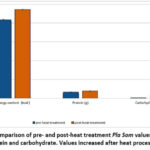 |
Figure 1: Comparison of pre- and post-heat treatment Pla Som values for energy, protein and carbohydrate. Values increased after heat processing. |
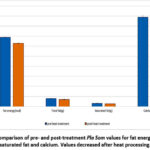 |
Figure 2: Comparison of pre- and post-treatment Pla Som values for fat energy, total fat, saturated fat and calcium. Values decreased after heat processing. |
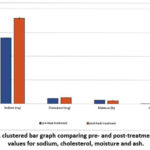 |
Figure 3: A clustered bar graph comparing pre- and post-treatment Pla Som values for sodium, cholesterol, moisture and ash. |
Table 1. Nutritional composition Pla Som pre- and post-treatment showing the paired t-test results for each nutrient along with their significance.
|
Nutrient |
Pre-heat treatment (Mean ± SD) |
Post- heat treatment (Mean ± SD) |
|
Energy (kcal) |
208.88 ± 0.79b | 235.38 ± 1.13a |
| Protein (g) | 16.73 ± 0.58b |
19.50 ± 0.63a |
|
Carbohydrate (g) |
1.17 ± 0.01b | 7.57 ± 0.46a |
| Fat energy (kcal) | 137.46 ± 0.61a |
125.50 ± 0.78b |
|
Total fat (g) |
15.40 ± 0.48a | 13.73 ± 0.56b |
| Saturated fat (g) | 6.45 ± 0.44a |
5.38 ± 0.10b |
|
Calcium (mg) |
177.72 ± 2.39a | 36.03 ± 0.67b |
| Sodium (mg) | 780 ± 3.67b |
925 ± 11.42a |
|
Cholesterol (mg) |
52 ± 0.67b | 58 ± 0.74a |
| Ash (%) | 3.67 ± 0.87ns |
3.85 ± 0.75ns |
|
Moisture content (%) |
63.32 ± 0.07a |
54.38 ± 0.07b |
a, b different superscripts between columns indicate significant difference (p < 0.05).
ns indicates non-significant difference (p > 0.05).
Microbiological Analysis
The heat treatment effectively eliminated Escherichia coli, yeasts, and molds (Table 2). Initial microbial counts of E. coli were 2.7 × 10⁴ CFU/g, which reduced to less than 3 CFU/g to undetectable levels post-treatment. Yeasts and molds reduced from 2.5 × 10³ CFU/g to less than 10 CFU/g. No E. coli proliferation was observed during the 15-day storage period.
Table 2: Comparison between pre-treatment and post-treatment values of Escherichia coli, yeast, and mold counts in fermented fish (Pla Som).
|
Microorganism |
Initial count (CFU/g) |
Post-processing count (CFU/g) |
|
E. coli |
2.7 × 10⁴ | <3 |
| Yeasts and molds | 2.5 × 10³ |
<10 |
Discussion
The findings demonstrated that thermal processing at 180 °C for 15 minutes eliminated microbial contaminants such as Escherichia coli, yeasts, and molds in fermented fish (Pla Som). This outcome concurred with previous research highlighting the susceptibility of these microorganisms to high-temperature treatments.20 The absence of E. coli after 15 days of refrigerated storage emphasized the reliability of this method in enhancing microbial safety in ready-to-eat products.21
From a nutritional perspective, the heat treatment resulted in significant changes to the nutrient profile. Energy, protein, and carbohydrate levels increased, while total and saturated fat contents reduced. These improvements concurred with Choopan et al.22 (2021) who reported similar outcomes in other thermally processed Thai fermented fish viscera, Tai-Pla. The observed increase in carbohydrates was attributed to the enzymatic or thermal breakdown of complex carbohydrates into simpler, more bioavailable forms, as documented in previous studies.
Air fryer technology is known for its ability to reduce calorie content and has gained widespread adoption. Our findings concurred with Ferreira et al. (2015)23 who reported reductions in fat content through minimal oil usage during thermal processing, with cholesterol levels increasing by 15.0%, contradicting reports suggesting that air frying generally leads to cholesterol reductions due to reduced oil absorption. This discrepancy resulted from unique thermal interactions within the Pla Som, necessitating further investigations to elucidate the underlying mechanisms.
The 29.9% increase in sodium content aligned with observations by Nurmilah et al. (2022),24 who noted that heat treatment increased salt concentration due to moisture loss. This finding underscores the need for cautious sodium intake and also highlights an opportunity to optimize fermentation and processing techniques to mitigate sodium content. Excessive sodium and cholesterol levels are well-documented risk factors for cardiovascular health,25,26 emphasizing the importance of addressing these issues in future research.27
The broader implications of this study suggest that while thermal processing enhanced the nutritional value and safety of Pla Som, the accompanying increases in sodium and cholesterol warrant careful consideration. Strategies such as reducing baking time, modifying the fermentation process, or incorporating natural preservatives may offer potential solutions. Combining thermal processing with other preservation methods such as vacuum packaging or natural antimicrobial agents could improve safety without compromising nutritional quality. Future research should also examine the long-term health impacts of elevated cholesterol levels after eating thermally processed Pla Som.
Conclusion
This study highlighted the efficacy of thermal processing at 180 °C for 15 minutes as a robust method for ensuring microbial safety and reducing fat energy, total fat, and saturated fat but notably increasing cholesterol levels of fermented fish (Pla Som). The complete elimination of Escherichia coli, yeasts, and molds alongside the absence of E. coli proliferation during a 15-day refrigerated storage period underscored the reliability of this approach in mitigating foodborne risks in ready-to-eat products. Heat treatment also enhanced the nutritional profile of Pla Som by increasing energy, protein, and carbohydrate contents while reducing total and saturated fats. These changes suggested that thermal processing serves the dual purpose of improving both safety and nutritional value. However, the observed increases in sodium and cholesterol levels present potential health risks, particularly for consumers with dietary restrictions. Strategies to optimize the fermentation process and mitigate these drawbacks should be considered for broader applicability and improved product healthfulness. Despite its benefits, thermal processing alone may not address all pathogenic microorganisms, toxins, or oxidative changes in Pla Som. Future research should explore the synergistic effects of thermal treatments combined with complementary preservation methods such as vacuum packaging, natural antimicrobials, or modified fermentation techniques to further enhance the safety, nutritional quality, and shelf-life of Pla Som. This study contributes valuable insights into the optimization of fermented fish production, bridging microbial safety and nutritional enhancements, and underscores the importance of holistic approaches to improving traditional fermented foods for modern dietary needs.
Acknowledgement
This research project was financially supported by Mahasarakham University, Thailand.
Funding Sources
This research Article was financially supported by Mahasarakham University, Thailand. (Grant No.6802240).
Conflict of Interest
The authors do not have any conflict of interest.
Data Availability Statement
This statement does not apply to this article.
Ethics Statement
This research did not involve human participants, animal subjects, or any materials that require
ethical approval.
Informed Consent Statement
This study did not involve human participants, and therefore, informed consent was not required.
Clinical Trail Registration
This research does not involve any clinical trials.
Permission to Reproduce Materials from Other Sources
Not applicable
Author Contributions
- Noppakun Pakdeenarong: Conceptualization, Methodology,Data analysis, Writing-review and editing, Supervision, Visualization, Project Administration, Funding Acquisition, Resources.
- Wanida Apithanaphong: Conceptualization, Writing – Review and Editing.
- Thanyarat Asawanonda: Data Collection, Analysis, Writing – Review and Editing.
References
- Setiarto R. H. B., Herlina V. T. Exploring bekasam, an indigenous fermented fish product of Indonesia: original South Sumatra region. J Ethn Foods. 2024; 11(1). org/10.1186/s42779-024-00230-w
CrossRef - Atun M.B., Julmohammad N., Huda N., et al. Exploring the nutritional value, health benefits and concerns associates in selected fermented fish product in Southeast Asia: A review. Canrea Journal. 2024; 94–112. doi.org/10.20956/canrea. v7i2.1270.
CrossRef - Valle C., Echeverría F., Chávez V., et al. Deep‐frying impact on food and oil chemical composition: Strategies to reduce oil absorption in the final product. Food Saf Health. 2024; 2(4): 414-428. doi.org/10.1002/fsh3.12056
CrossRef - Asha M.R., Susheelamma N.S., Guha M. Rheological properties of black gram (Phaseolus mungo) batter: characterisation of flour from native and modified rice and their effect on batter viscosity. IJFST. 2007; 42(6): 669-677.doi.org/10.1111/j.1365-2621.2006. 01459.x
CrossRef - Santos C.S., Cunha S.C., Casal, S. Deep or air frying? A comparative study with different vegetable oils. Eur J Lipid Sci Technol. 2017; 119(6): 1600375. doi.org/10.1002/ejlt.201600375
CrossRef - Devi S., Zhang M., Ju R., Bhandari B. Recent development of innovative methods for efficient frying technology. Crit Rev Food Sci Nutr.2021; 61(22): 3709-3724. doi.org/10.1080/10408398.2020.1804319
CrossRef - Téllez-Morales J.A., Rodríguez-Miranda J., Aguilar-Garay R. Review of the influence of hot air frying on food quality. Measurement: Food .2024; 100153.doi.org/10.1016/j.meafoo.2024.100153
CrossRef - Grundy S.M., Pasternak R., Greenland P., et al. Assessment of cardiovascular risk by use of multiple-risk-factor assessment equations: a statement for healthcare professionals from the American Heart Association and the American College of Cardiology. J Am Coll Cardiol. 1999; 34(4): 1348-1359. org/10.1016/S0735-1097(99)00387-3
CrossRef - Maan A.A., Anjum M.A., Khan M.K.I., et al. Acrylamide formation and different mitigation strategies during food processing–a review. Food Res Int. 2020; 38(1): 70-87. doi.org/10.1080/87559129.2020.1719505
CrossRef - Wang Y., Wu X., McClements D.J et al. Effect of new frying technology on starchy food quality. Foods.2021;10(8), 1852. doi.org/10.3390/foods10081852
CrossRef - Kopermsub P., Yunchalard S. Safety control indices for plaa-som, a Thai fermented fish product. Afr J Microbiol Res. 2008; 2(2):18-25.
- Li H., Li G., Bi Y., et al. Fermented fish products: Balancing tradition and innovation for improved quality. 2024; 13(16):2565. doi.org/10.3390/foods13162565
CrossRef - Artchayasawat A., Sriraj P., Boonmars T, et al. Reduction of carcinogens in fermented fish (pla-ra and pla-som) by heating. Vet World. 2023; 16(8), 1727. doi: 10.14202/vetworld.2023.1727-1735
CrossRef - Singh S.S., Mandal S.D., Mathipi V., et al. Traditional fermented fish harbors bacteria with potent probiotic and anticancer properties. Biocatal Agric Biotechnol. 2018; 15, 283–290. doi.org/10.1016/j.bcab.2018.07.007
CrossRef - Zang J., Xu Y., Xia W., et al. Quality, functionality, and microbiology of fermented fish: a review. Crit Rev Food Sci. Nutr. 2020; 60(7), 1228-1242.
CrossRef - Rattanasena, P., Chaikham, P. Physical, Chemical and Microbiological Qualities of Plaa-Som as Commercialized in Phranakhon Si Ayutthaya Province on Consumer Acceptance. BUU SCI J. 2018;753-766.
- Kopermsub, P., Yunchalard, S. Safety control indices for plaa-som, a Thai fermented fish product. Afr J Microbiol. Res. 2008;2(2), 18–25.
- Jittrepotch, Rojsuntornkitti K., Kongbangkerd T. Physico-chemical and sensory properties of Plaa-som, a Thai fermented fish product prepared by using low sodium chloride substitutes. Int Food Res J 2015; 22(2).
- AOAC International. Official Methods of Analysis of AOAC INTERNATIONAL, 21st Edition (2019). AOAC International.
- Chandrasekaran S., Ramanathan S., Basak, T. Microwave food processing—A review. Food Res Int. 2013; 52(1): 243-261. doi.org/10.1016/j.foodres.2013.02.033
CrossRef - de Oliveira V.S., Viana D.S.B., Keller L.M., et al. Impact of air frying on food lipids: Oxidative evidence, current research, and insights into domestic mitigation by natural antioxidants. Trends Food Sci Technol. 2024; 104465. doi.org/10.1016/j.tifs.2024.104465
CrossRef - Choopan W, Panpipat W, Nisoa M, et al. Physico-chemical aspects of Thai fermented fish viscera, Tai-Pla, curry powder processed by hot air drying and hybrid microwave-infrared drying. PLoS ONE. 2021; 16: e0253834. doi.org/10.1371/journal. pone.0253834
CrossRef - Ferreira F.S., Sampaio G.R., Keller L.M et al. Impact of Air Frying on Cholesterol and Fatty Acids Oxidation in Sardines: Protective Effects of Aromatic Herbs. J Food Sci. 2017 ;82(12):2823-2831. doi: 10.1111/1750-3841.13967.
CrossRef - Nurmilah S, Cahyana Y, Utama GL, et al. Strategies to Reduce Salt Content and Its Effect on Food Characteristics and Acceptance: A Review. Foods. 2022; 11(19):3120. doi: 10.3390/foods11193120.
CrossRef - Vaskonen, T. Dietary minerals and modification of cardiovascular risk factors. J Nutr Biochem 2003; 14(9): 492-506. doi.org/10.1016/S0955-2863(03)00074-3
CrossRef - Appel L.J., Frohlich E.D., Hall J.E., et al. The importance of population-wide sodium reduction as a means to prevent cardiovascular disease and stroke: A call to action from the American Heart Association. Circulation. 2011; 123(10):1138-1143. org/10.1161/CIR.0b013e31820d0793
CrossRef - Chan S.X.Y., Fitri N., Mio Asni N.S., et al. A comprehensive review with future insights on the processing and safety of fermented fish and the associated changes. Foods. 2023; 12(3): 558. doi.org/10.3390/foods12030558
CrossRef
 PlumX:
 Views: 3543
  PDF Downloads:
900
PDF Downloads:
900 
Accepted on: 19 Aug 2025
Second Review by: Celile Aylin OLUK
Final Approval by: Dr. Rajesh Jeewon





Web of Science Coverage
Emerging Sources Citation Index (ESCI)
2024 Journal Impact Factor: 1.1
Scopus Journal Metrics
CiteScore 2025: 2.6
CiteScore Details
Sustainable Nutrition: Food Systems, Nutrient Retention, and Public Health Impact

This journal is a member of, and subscribes to the principles of, the Committee on Publication Ethics (COPE)