
Osmotic Dehydration Pretreatment with Panela for the Production of Apple Snacks
 , Manuel Jesus Sanchez-Chero1*, Lesly Carolina Flores-Mendoza1, William Rolando Miranda-Zamora1, Jose Antonio Sanchez-Chero1, William Vera-Jimenez1, Flabio Gutierrez-Segura1, Cristhiam Alberto Moscol-Calderon1 and Lucerito Katherine Ortiz-García2
 1Faculty of Food Industry Engineering and Biotechnology, National University of Frontera, Sullana, Peru
2Faculty of Chemical Engineering and Food Industry, Pedro Ruiz Gallo National University, Lambayeque, Peru
Corresponding Author Email: msanchezch@unf.edu.pe
DOI : http://dx.doi.org/10.12944/CRNFSJ.13.2.30
Download this article as:

Osmotic dehydration removes water from fruits using hypertonic solutions, enhancing shelf life and quality. However, little research explores natural sweeteners like panela as osmotic agents in developing nutritious, acceptable apple-based snack products. The objective of this research was to evaluate the effect of osmodehydration pretreatment with panela in development of apple snacks (Malus domestica). The methodology evaluated was through an osmotic dehydration process of apple. Panela syrups were used at concentrations of 45 ºBrix and 50 ºBrix with immersion times of 120 and 180 minutes and followed by drying for 8 hours at 55 ºC. Sensory evaluation was performed with student as participants using five-point hedonic scale. For the previously mentioned data analysis, a completely randomized design (CRD) with a 2x2 factorial setup was employed, whereas a five-point hedonic scale was utilized for the sensory evaluation. Using a 2x2 factorial statistical design, it was possible to determine p-values < 0.05, indicating a significant level of confidence in the effects of concentration and temperature on water loss (WL), weight reduction (WR), and solids gain (SG). Results showed weight loss (WR) which was 30.28% and water losses (WL) of up to 31.87%. On the other hand, the lowest solids gain was 2.60% while the highest was 5.64 Finally, the sensory analysis showed that the samples pretreated with osmodehydration T4 (50 ºBrix–180 min) and T3 (45 ºBrix–180 min) had higher acceptability, likewise the least accepted by the panela were T1, S/T (without treatment) and T2 in descending order.
KEYWORDS:Apple; Osmotic Dehydration; Osmodehydration; Panela; Sensory Analysis
Introduction
Snacks are often associated with unhealthy, high-calorie, low-nutrient foods, and are commonly perceived as junk food. 1 On the other hand, there is currently a trend towards the consumption of healthy foods, with minimal processing that maintains their nutritional properties.2 Currently, a type of healthy snack that is becoming more popular is fruit snacks, which are considered to be natural and high in nutritional value.3 These snacks are produced by drying fruits using high temperature air. Fruits such as grapes, berries, plums or apricots are dried whole, while other fruits such as mangoes, papayas, apples, kiwis are sliced for further drying.4 Regarding the use of fruits such as apple to obtain healthy snacks, several researches have been reported5–8 where different methods such as hot air drying, freeze-drying and vacuum frying have been employed.
The most commonly used method for obtaining snacks has been hot air drying; however, prolonged exposure to elevated temperatures can generate the loss of some nutrients and high energy costs.9 Therefore, the search for a drying pretreatment that helps to reduce the time of exposure to heat is necessary, being an alternative to it osmotic dehydration, which can reduce moisture by up to 50%.10 Osmotic dehydration of fruits is a process that consists of immersing fruit cuts (slices, cubes, cylinders) in highly concentrated sugar syrups or also called as osmotic solution.11 During this process, mass transfer is created by generating osmotic pressure on the feed tissue, which causes the water inside the feed to be expelled from the feed, as well as the migration of solids from the syrup into the fruit.12
One of the most important process factors during the process is the type of osmotic agent, since it must be compatible with the food to be osmotically dehydrated, for example, in the case of vegetables, the osmotic agents to be used are salts, while for fruits, sugars are employed. For osmotic dehydrated fruit processing, several researches such as Chandra and Kumari13 and Ispir and Toǧrul14 state that a wide variety of sugar types have been used for the osmotic dehydration process, among these sugars are sucrose, maltodextrin, fructose, glucose, sorbitol, maltose, dextrose, among others. However, among this variety of available sugars, sucrose is the most widely used, because it is easy to obtain, cheap and has a high osmotic power.11 On the other hand, an alternative to the use of common sugar is panela, which is a natural sugar obtained by dehydrating sugarcane juice and contains various bioactive compounds with antioxidant activity. Panela is considered a food and one of the healthiest sugars, because its nutritional properties such as sugars (sucrose, fructose, glucose), vitamins (A, B, C, D, E) and minerals such as potassium, calcium, iron, magnesium, copper, among others, are maintained during processing.15
In this context, it was proposed to use panela as an osmotic agent for the osmotic dehydration of apples and it’s subsequent drying to obtain snacks from this fruit, contributing to the production of healthier snacks with better organoleptic characteristics.
Materials and Methods
Osmotic dehydration was carried out following method by Flores-Mendoza et al.16 with modifications. The methodology consists of two phases: initially, the apple undergoes osmotic dehydration, followed by a second stage involving hot air drying of the pretreated fruit as shown in Figure 1.
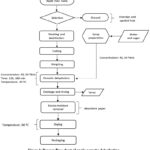 |
Figure 1: Process flow chart of apple osmotic dehydration. |
Preparations of samples
Fifteen kilograms of apples (Var. Gala) were selected from a grocery store located in Sullana, taking into account the quality of the product, selecting apples in good physical condition that did not show signs of deterioration or over-ripeness. The selected fruit was washed with water to remove possible remains of dirt and then immersed in chlorine solution, according to FDA,17 which recommends that post-harvest treatments for fresh produce should use total chlorine concentrations between 50 and 200 ppm, maintained at a pH range of 6.0 to 7.5, with a contact time of 1 to 2 minutes.The fruit was sliced using an industrial slicer, which allowed 5 mm thick slices to be obtained. The fruit was also subjected to moisture analysis using an AND MX-50 moisture balance (0.01%) and °Brix measurement by refractometry.
The apple slices were handled following hygienic practices based on food safety guidelines. Equipment and surfaces were sanitized before each test. Although microbial counts were not performed, all experiments were carried out within a food-grade laboratory environment, using potable water and fresh raw materials, and the products were consumed immediately after preparation to minimize microbiological risk.
Osmotic Dehydration
The osmodehydration was performed using custom-built equipment developed at the Universidad Nacional de Frontera, featuring temperature regulation, solution recirculation, and real-time concentration monitoring. The system includes an 18 L stainless steel tank (1.65 m height × 0.485 m width), two water pumps for continuous solution flow, and a Bluetooth-enabled Tilt Float hydrometer for °Brix measurement. Temperature is controlled via a thermostat connected to a bulb sensor and heating resistor, with an operational range from 0 to 100 °C. The procedure followed the methodology described by Flores-Mendoza et al.16
Syrups were prepared by diluting panela in water to concentrations of 45 and 50 °Brix. The amount of syrup was prepared taking into account the fruit: syrup ratio of 1:4, which was chosen because it is the ratio most commonly used in the literature.18–20 The apples were immersed in the panela syrups for 120 and 180 minutes under conditions of agitation and constant temperature of 35 °C. This temperature was selected to preserve the nutritional and sensory quality of the fruit, as higher temperatures—particularly above 50 °C—have been associated with the degradation of thermolabile nutrients such as vitamin C and polyphenols.21 After osmodehydration, the apple slices were removed from the solution and allowed to drain for 2 minutes. To eliminate visible residues of the osmotic solution and prevent surface caramelization during drying, the samples were rinsed with potable water at room temperature (approximately 22 °C) for 30 seconds. A water volume of 500 mL per 100 g of fruit was used to ensure adequate rinsing. Subsequently, the fruit was placed on sterile absorbent paper towels and gently patted dry to remove excess surface moisture from the rinsing process.
Mass Transfer during Osmotic Dehydration
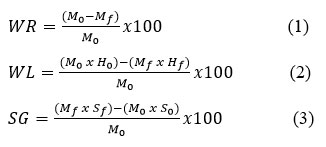
Mass transfer during the osmotic dehydration process is measured by weight loss (WR), water loss (WL) and solids gain (SG) values. These can be calculated by considering the initial and final values of mass (M0, Mf), °Brix (S0, Sf), and moisture (H0, Hf), as shown in Equations (1) to (3). The formulas provided by García et al.22 were used to perform the calculations.
Drying
The osmotically dehydrated apple slices were dried using a modified Homas-brand air fryer, which was adapted for improved process control. The device operated at a fixed drying temperature of 60 °C for 120 minutes, with a power output of 1500 W. To enhance airflow and monitoring, a small auxiliary fan was installed, and a DHT11 humidity sensor was integrated and connected to an Arduino microcontroller to record relative humidity inside the drying chamber in real time. Although the system lacks automated humidity regulation, this setup enabled better control and documentation of drying conditions. The process continued until the fruit reached a moisture content below 15%, as higher levels can favor fungal growth, compromising product stability and shelf life.23
Statistical analysis
Data were analyzed using a completely randomized design (CRD) with a 2×2 factorial structure (Table 1), where the first factor was the panela syrup concentration (°Brix), and the second was the immersion time. Weight reduction (WR), water loss (WL), and solids gain (SG) were the response variables assessed. All treatments were performed three times (n=3), and the data were subjected to ANOVA analysis.
Table 1: Experimental design
|
Treatment |
Concentration (°Brix) | Time (min) |
| T1 | 45 |
120 |
|
T2 |
50 | 120 |
| T3 | 45 |
180 |
|
T4 |
50 |
180 |
Sensorial analysis
The samples of dehydrated apple snacks were delivered to the evaluators in random order, identified with three-digit codes to ensure a blind evaluation, following procedures recognized in sensory studies.24 Each sample was served on disposable plates, and stable lighting and temperature conditions were maintained during the evaluation. Participants were instructed to rinse their mouths with water between each sample in order to eliminate residual flavors and avoid sensory fatigue.25
Thirty people participated as untrained judges, selected for their regular consumption of fruit snacks and willingness to volunteer. All evaluators were informed of the objectives of the test and signed an informed consent form, in accordance with ethical recommendations for studies involving human subject.26
The sensory analysis was carried out in accordance with ethical principles governing research involving human participants. All participants were volunteers over the age of 18 and provided informed consent. No personal data were collected, and the activity posed no risk to health or safety.
Sensory evaluation was performed as proposed by Da Cunha et al.27 using a mixed facial hedonic scale with five “faces” representing the classifications “hated it”, “disliked it”, “indifferent”, “liked it” and “loved it” and the corresponding number from 1 to 5.
Results
Pretreatment of osmotic dehydration
Water loss (WL) and weight reduction (WR)
To evaluate the effectiveness of osmotic dehydration treatments, statistical comparisons were made between untreated apple samples (initial conditions) and those subjected to different combinations of solute concentration and immersion time. All samples had an initial standardized weight of 50.00 g. The initial moisture content and soluble solids were 85.20 ± 0.25% and 11.2 ± 0.15 °Brix, respectively.
A two-way ANOVA was conducted to evaluate the effects of sucrose concentration (45 and 50 °Brix) and processing time (120 and 180 minutes) on the osmotic dehydration of apple slices, considering both water loss (WL) and weight reduction (WR) as response variables. Prior to the ANOVA, data normality was verified using the Shapiro-Wilk test (p > 0.05), which confirmed that parametric analysis was appropriate. The results revealed that both main factors significantly influenced the dehydration process. For WR (Table 2), significant effects were found for concentration (F(1,8) = 268.39, p < 0.001, η²ₚ = 0.971) and processing time (F(1,8) = 79.06, p < 0.001, η²ₚ = 0.908), with a notable interaction effect (F(1,8) = 5.98, p = 0.040, η²ₚ = 0.428).
Table 2: Two-way ANOVA Summary for Water Loss (WL)
|
Source |
df | Sum of Squares | F | p-value | Partial η² |
| Concentration | 1 | 86.833 | 268.39 | < 0.001 |
0.971 |
|
Processing time |
1 | 25.579 | 79.06 | < 0.001 | 0.908 |
| Concentration x Processing time | 1 | 1.936 | 5.98 | 0.040 |
0.428 |
|
Error |
8 | 2.588 | — | — | — |
| Total corrected | 11 | 116.937 | — | — |
— |
Similarly, for WL (Table 3), both concentration (F(1,8) = 208.89, p < 0.001, η²ₚ = 0.963) and immersion time (F(1,8) = 224.08, p < 0.001, η²ₚ = 0.966) had significant effects, along with a strong interaction (F(1,8) = 30.72, p = 0.001, η²ₚ = 0.793). In both cases, increasing the sucrose concentration and extending the processing time of treatment led to greater dehydration. The highest values of WL and WR were observed at 50 °Brix and 180 minutes, while the lowest were recorded at 45 °Brix and 120 minutes. A post hoc test was not applied because the 2×2 factorial design involves only four treatment combinations, and the ANOVA directly assesses the main and interaction effects without requiring further pairwise comparisons.28
Table 3: Two-way ANOVA Summary for Weight Reduction (WR)
|
Source |
df | Sum of Squares | F | p-value | Partial η² |
| Concentration | 1 | 37.737 | 208.89 | < 0.001 |
0.963 |
|
Processing time |
1 | 40.480 | 224.08 | < 0.001 | 0.966 |
| Concentration x Processing time | 1 | 5.549 | 30.72 | 0.001 |
0.793 |
|
Error |
8 | 1.445 | — | — | — |
|
Total corrected |
11 | 85.211 | — | — | — |
On the other hand, the average results of water loss and weight reduction in Table 4 show notable differences between treatments. The highest losses were observed at 50 ºBrix and 180 minutes of immersion, with water loss and weight reduction percentages of 31.87% and 30.28%, respectively. In contrast, the lowest losses occurred at 45 ºBrix and 120 minutes of immersion, with values of 24.65% for water loss and 21.98% for weight reduction. In addition, paired t-tests were used to assess the significance of changes from untreated to treated samples. Results showed statistically significant differences (p < 0.05) between the untreated samples and those subjected to osmotic pretreatments, confirming the impact of both factors on the mass transfer process.
Table 4: Average water loss (WL) and weight reduction (WR) of osmodehydrated apples with panela
|
Mass transfer coefficient |
Variable A: Concentration | Variable B: Immersion time | |
| 120 min |
180 min |
||
|
WL |
45 ºBrix | 24.65 ± 0.26 | 26.96 ± 0.67 |
| 50 ºBrix | 26.84 ± 0.44 |
31.87 ± 0.11 |
|
|
WR |
45 ºBrix | 21.98 ± 0.30 | 24.10 ± 0.92 |
| 50 ºBrix | 26.55 ± 0.58 |
30.28 ± 0.16 |
|
On the other hand, Figure 2 and Figure 3 shows the interaction graph of the variable’s concentration and immersion time, where it can be observed that, for the same immersion time, the increase in concentration generated greater water loss and weight reduction, while for the same concentration, the increase in immersion time generated greater losses. It was also observed that, in general, the treatments carried out at 50ºBrix were the ones that obtained better results with respect to water loss and weight reduction when compared to those carried out at 45ºBrix.
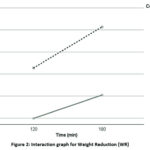 |
Figure 2: Interaction graph for Weight Reduction (WR) |
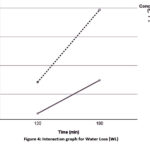 |
Figure 3: Interaction graph for Water Loss (WL) |
Solid Gain (SG)
The ANOVA results for SG (Table 5) demonstrated that both concentration (F(1,8) = 97.15, p < 0.001, η²ₚ = 0.924) and immersion time (F(1,8) = 20.91, p = 0.002, η²ₚ = 0.723) had statistically significant effects on SG. Moreover, a significant interaction effect between the two factors was found (F(1,8) = 11.90, p = 0.009, η²ₚ = 0.598), indicating that the effect of one variable depended on the level of the other.
The descriptive data confirmed these findings, showing a consistent increase in SG with both higher concentration and longer immersion. The combination of 50 °Brix and 180 minutes produced the greatest solid gain (5.64 ± 0.22), whereas the lowest value was registered at 45 °Brix and 120 minutes (2.60 ± 0.46). Due to the limited number of levels in each factor, post hoc comparisons were not applicable. Nonetheless, the pattern observed in the means and the significant interaction provide clear evidence of differential responses among the treatment conditions.
Table 5: Average solid gain (SG) of osmodehydrated apples with panela.
|
Variable A: Concentration |
Variable B: Immersion time | |
| 120 min |
180 min |
|
|
45 ºBrix |
2.60 ± 0.46 | 4.29 ± 0.45 |
| 50 ºBrix | 5.40 ± 0.28 |
5.64 ± 0.21 |
On the other hand, Figure 4 shows the interaction graph of the variable’s concentration and immersion time, where it can be observed that, for the same immersion time, the increase in concentration generated a greater solid gain. In a similar way, for the same concentration, the increase in immersion time generated greater gains in solids. It was also observed that, in general, the greatest solid gains occurred when using the highest concentration of 50ºBrix.
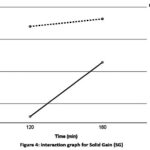 |
Figure 4: Interaction graph for Solid Gain (SG) |
Sensory analysis
The Friedman test (Table 6) determined with a value of p<0.05 that there are significant differences between the treatments applied with respect to sensory analysis.
Table 6: Summary of Friedman’s test
|
Total N |
30 |
|
Test statistic |
19,438 |
|
Degree of freedom |
4 |
|
Asymptotic sig. (bilateral test) )/P-value |
,001 |
Table 7 shows the comparisons by means, where it was found that treatments T2 and T4 are the only treatments that are statistically different from each other, while the rest of the comparisons do not show statistical differences.
Table 7: Pairwise comparisons of the general appreciation of the panelists
|
Sample 1-Sample 2 |
Test statistic | Desv. Error | Desv. Test statistic | Sig. |
Sig. adjusteda |
| T2-ST | 0,450 | 0,408 | 1,102 | 0,270 | 1,000 |
|
T2-T3 |
-0,600 | 0,408 | -1,470 | 0,142 | 1,000 |
| T2-T1 | 0,750 | 0,408 | 1,837 | 0,066 |
0,662 |
|
T2-T4 |
-1,450 | 0,408 | -3,552 | 0,000 | 0,004 |
| ST-T3 | -0,150 | 0,408 | -0,367 | 0,713 |
1,000 |
|
ST-T1 |
-0,300 | 0,408 | -0,735 | 0,462 | 1,000 |
| ST-T4 | -1,000 | 0,408 | -2,449 | 0,014 |
0,143 |
|
T3-T1 |
0,150 | 0,408 | 0,367 | 0,713 |
1,000 |
|
T3-T4 |
-0,850 | 0,408 | -2,082 | 0,037 | 0,373 |
| T1-T4 | -0,700 | 0,408 | -1,715 | 0,086 |
0,864 |
Note: Each row tests the null hypothesis that the distributions of Sample 1 and Sample 2 are equal. Asymptotic significances (bilateral tests) are displayed. The significance level is .05.
Table 8 shows the averages obtained for each attribute analyzed to determine acceptability, where it is observed that the treatments with the highest average acceptability of 3,6 and 3,9 were T3 and T4 respectively, while T2 was the treatment with the lowest acceptability with 3,3. On the other hand, apple snacks without osmodehydration pretreatment and T1 obtained the same average acceptability of 3,5.
Table 8: Averages obtained by attribute in the sensory analysis
|
Attributes |
Treatment | ||||
| S/T | T1 | T2 | T3 |
T4 |
|
|
Aroma |
3,6 | 3,5 | 3,6 | 3,7 | 3,9 |
| Flavor | 3,9 | 3,9 | 3,7 | 3,9 |
4,3 |
|
Color |
3,4 | 3,2 | 3,1 | 3,5 | 3,6 |
| Texture | 3,0 | 3,1 | 3,0 | 3,0 |
3,7 |
|
Overall acceptability |
3,6 | 3,8 | 3,4 | 3,7 | 4,1 |
| Average | 3,5 | 3,5 | 3,3 | 3,6 |
3,9 |
On the other hand, Figure 5 shows the results of the sensory analysis graphically, where it can be clearly observed that the most acceptable treatment with respect to all the sensory attributes evaluated is T4, which was carried out under osmodehydration conditions at 50ºBrix for 180 minutes of immersion.
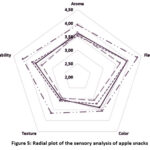 |
Figure 5: Radial plot of the sensory analysis of apple snacks. |
Regarding the observations presented by the panelists during the sensory test, 62% of them indicated that they perceived the apple snacks without osmodehydration pretreatment to have a lesser flavor than the snacks pretreated with osmodehydration with panela syrup, which 38% of the panelists found to be more palatable. On the other hand, regarding texture, 47% of panelists suggested that the snacks should have been crunchier, while 53% agreed with the presented conditions of the snack.
Discussion
Osmodehydration Process
Weight reduction (WR), water loss (WL) and solid gain (SG)
The ANOVA results indicated that concentration, processing time, and their interaction had significant effects (p < 0.05) on both water loss and weight loss and solid gains. These findings suggest that the combined influence of concentration and processing time plays a critical role in controlling water and weight loss in the studied process. A similar statistical result was found by Marceliano-Sánchez and Vegas-Niño29 in the case of osmodehydrated of aguaymanto (Physalis peruviana) where they also found that concentration and immersion time were significant for the process. Additionally, Herrera et al.30 who observed significant effects of osmotic concentration and drying temperature on water loss (WL) and solids gain (SG) during osmotic dehydration of aguaymanto, with the highest water loss (12.52%) at 60 °Brix and significant differences confirmed by ANOVA at p < 0.05. They also reported that the treatment with 65 °Brix and 40 °C had the highest acceptance, highlighting the importance of optimizing these parameters.
On the other hand, the results show the highest weight and water losses occurred at 50ºBrix and 180 minutes of immersion (31.87% and 30.28%), while the lowest losses were at 45ºBrix and 120 minutes (24.65% and 21.98%). Vegas and Baltazar31 found a similar trend when osmodehydrating maca using panela syrup, where using the highest concentrations between 54 and 61 °Brix resulted in greater water loss compared to treatments treated at concentrations between 30 and 50 °Brix. Other authors observed the same behavior when osmodehydrating aguaymanto fruits with panela, where by using the highest concentration of 60 ºBrix and extending the immersion time, the highest water and weight losses were achieved.29 On the other hand, authors who have used different types of osmotic solutions such as beet syrups or concentrated fruit juices have also emphasized that increasing variables such as temperature, concentration and immersion time during the process generated better WR and WL values.11,32 Therefore, it can be said that regardless the type of osmotic agent used, increasing the concentration of the syrup will always generate an improvement in mass transfer. However, the results obtained when using different osmotic agents can differ from each other, as in the case of Chambi et al.33 showed that for osmotic dehydration of yellow melon, the use of concentrated grape juice obtained better results in mass loss compared to fruits treated with sucrose syrups.
On the other hand, the results showed that both the increase in concentration and immersion time favored the gain of solids, with the highest values being observed with the highest concentration (50 ºBrix). Similar results were found by Marceliano-Sánchez and Vegas-Niño29 in the case of osmodehydration of aguaymanto (Physalis peruviana) and Vegas & Baltazar31 in the osmodehydration of maca, using agitation and ultrasound where for both cases they found that the concentration and immersion time were significant for the process with a p<0.05, the authors emphasized that the use of ultrasound generated a considerable increase in the SG, exceeding 14% and 18%, respectively. Other authors, such as Kudri et al.,34 who compared the osmotic dehydration of melon (Cucumis melo) using three different osmotic agents: molasses, sugar and honey, managed to determine that regardless of the osmotic agent, the increase in concentration and processing time will generate greater gains in solids; however, among the osmotic agents used, the use of sugar and molasses generated greater gains in solids with 4.390% and 5.618% respectively, while the samples osmodehydrated with honey generated a gain in solids of 4.383%.
Although the results of this study follow the general pattern observed in previous research, where higher concentrations and longer treatment times lead to greater water loss and solid uptake during osmotic dehydration, some variation in the extent of these effects is evident when compared with findings from other works. These discrepancies may be due to differences in the physical and structural characteristics of the fruit used. For example, the dense cellular arrangement and texture of apples can influence diffusion behavior differently than softer fruits such as mangoes or papayas.35,36 Another factor contributing to variability is the type of osmotic agent applied. In this case, panela, which contains a mix of sucrose, reducing sugars, and minerals, was used instead of the pure sucrose commonly employed in other studies. This more complex composition likely modifies the osmotic potential and mass transfer kinetics.37 Furthermore, variations in processing parameters, such as temperature settings, agitation conditions, the fruit-to-syrup ratio, and slice thickness, can also affect outcomes and may account for differences between studies. Taking these elements into account helps to better interpret inconsistencies in the literature and underscores the importance of standardizing experimental protocols for future research.
Sensory analysis
The results obtained in the sensory evaluation indicate that treatments T3 (45 °Brix, 180 min) and T4 (50 °Brix, 180 min) presented the highest average acceptability scores, with values of 3.6 and 3.9, respectively. This suggests that longer immersion time in the osmotic solution, regardless of sucrose concentration, has a positive effect on the sensory perception of the final product.
This finding coincides with that reported by Ma et al.,38 who observed that longer osmotic dehydration time in apples increases water loss and solids gain, resulting in a firmer texture and balanced sweetness, attributes positively valued by consumers.
In contrast, treatment T2 (50 °Brix, 120 min) obtained the lowest acceptability score (3.3). Despite using a more concentrated solution, the shorter soaking time may have been insufficient to achieve adequate mass transfer, resulting in a less palatable texture or inhomogeneous sweetness. This result is consistent with that found by Tyagi et al.,39 who highlighted that both solution concentration and immersion time are critical factors affecting the efficiency of osmotic dehydration and, thus, the sensory quality of the product.
On the other hand, treatment T1 (45 °Brix, 120 min) and apples without osmotic pretreatment showed similar acceptability (3.5). This indicates that mild osmotic dehydration may not be sufficient to significantly improve the sensory characteristics of the product. In previous studies, it has been shown that more intense treatments, in terms of concentration and time, are necessary to achieve perceptible improvements in the texture and flavor of dehydrated apples.40
Authors such as Kudri et al.34 found in sensory analysis of osmodehydrated melon snacks at concentrations of 50 ºBrix and 60 ºBrix of sucrose syrups, honey and molasses, that panelists preferred the sample treated with sucrose syrup at 50 ºBrix, a condition similar to the T4 treatment of the present research. This trend of increased acceptance of previously osmodehydrated dried products was also observed by Koprivica et al.,41 who also points out that osmodehydration not only improves the sensory quality of dried products, but also improves the microbiological profile of the product making it safer for the consumer.
In summary, the results suggest that the combination of an adequate sucrose concentration (45 °Brix or 50 °Brix) with a prolonged immersion time (180 min) optimizes the sensory quality of apple snacks. This combination allows a more effective mass transfer, improving the texture and flavor of the final product, which is reflected in higher consumer acceptability.
Future directions
Future research should explore a broader range of process variables, including temperature, osmotic solution composition, and slice geometry, to develop predictive models. Comparative studies between different osmotic agents, including artificial sweeteners or plant-based syrups, could further elucidate the impact of solute composition on mass transfer. It is also recommended to conduct microbiological and nutritional analyses to assess safety and retention of bioactive compounds. Expanding the sensory panel and using trained panelists would enhance reliability and applicability in product development.
Conclusion
Apple slices were osmotically dehydrated using panela syrups at concentrations of 45ºBrix and 50ºBrix, and immersion times of 120 min and 180 min were evaluated. With respect to mass transfer, weight loss (WR) values of up to 30.28%, water loss (WL) of up to 31.87%, and solids gains of 5.64% were obtained. The statistical analysis showed that concentration, temperature, and their interaction significantly influenced the process (p < 0.05). In the sensory analysis, it was possible to identify that the use of panela as an osmotic agent influenced the perception of the snack flavor and general sensory characteristics, since the preference of the panelists was greater for the samples pretreated with osmodehydration, with T4 (50 ºBrix-180 min) and T3 (45 ºBrix-180 min) being the most acceptable. In conclusion, osmotic dehydration emerges as a promising technique for the production of healthy snacks, since it allows preserving the nutrients and sensory characteristics of the treated fruits. Moreover, this process offers a unique opportunity to evaluate the possibility of fortifying foods in future research. Through the phenomenon of mass transfer, nutrients of interest can be added to the osmotic solutions used, or concentrated fruit juices can be used, whose natural nutrients could be absorbed by the fruit. This would not only improve the nutritional profile of the final products, but also enhance their added value in terms of health and well-being.
Acknowledgement
The authors would like to thank the Research, Development and Innovation Group in Food Industries (GIDIIA) of the Universidad Nacional de Frontera for their support with the use of the osmodehydration equipment for the study.
Funding Sources
The author(s) received no financial support for the research, authorship, and/or publication of this article
Conflict of Interest
The authors do not have any conflict of interest.
Data Availability Statement
The manuscript includes all data produced during the course of this research, for further information please contact the corresponding author.
Ethics Statement
This research did not involve human participants, animal subjects, or any material that requires ethical approval.
Informed Consent Statement
This study did not involve human participants, and therefore, informed consent was not required.
Clinical Trial Registration
This research does not involve any clinical trials.
Permission to Reproduce Material from Other Sources
Not Applicable
Author Contributions
- Henry Jesús Quinde-Montero: Study conception and design, data collection and analysis, preparation of the original draft, and critical revision of the manuscript.
- Manuel Jesús Sanchez-Chero: Collaboration in the design of the study, participation in data collection, and contribution to the review and editing of the article.
- Lesly Carolina Flores-Mendoza: Participation in data collection and analysis, assistance in the preparation of tables and graphs, and translation of the manuscript.
- William Rolando Miranda-Zamora: Collaboration in data collection and literature review.
- Jose Antonio Sanchez-Chero: Support in literature review and validation of calculations.
- William Vera-Jimenez: Contribution in the formal revision of the manuscript and general supervision.
- Flabio Gutierrez-Segura: Assistance in the curation of the data used and in the visualization of graphs.
- Cristhiam Alberto Moscol-Calderon: Participation in the revision and final editing of the article.
- Lucerito Katherine Ortiz-García: Participation in the revision and final editing of the article.
References
- Ciurzyńska A, Cieśluk P, Barwińska M, et al. Eating habits and sustainable food production in the development of innovative “healthy” snacks. Sustainability. 2019;11(10):2800. doi: 3390/su11102800
CrossRef - Pipliya S, Kumar S, Babar N, Srivastav PP. Recent trends in non-thermal plasma and plasma activated water: Effect on quality attributes, mechanism of interaction and potential application in food & agriculture. Food Chemistry Advances. 2023;2:100249. doi:10.1016/j.focha.2023.100249
CrossRef - Tylewicz U, Oliveira G, Alminger M, et al. Antioxidant and antimicrobial properties of organic fruits subjected to PEF-assisted osmotic dehydration. Innovative Food Science and Emerging Technologies. 2020;62:102341. doi:10.1016/j.ifset.2020.102341
CrossRef - Donno D, Mellano MG, Riondato I, et al. Traditional and Unconventional Dried Fruit Snacks as a Source of Health-Promoting Compounds. Antioxidants 2019, Vol 8, Page 396. 2019;8(9):396. doi:10.3390/ANTIOX8090396
CrossRef - Albertos I, Rico D, Martin-Diana AB. Improving the texture of healthy apple snacks by combining processing and technology (high pressure and vacuum frying). Journal of Food Processing and Preservation. 2020;44(3):e14352. doi:10.1111/JFPP.14352
CrossRef - Cui L, Niu L, Li jing, et al. Effects of different drying methods on quality, bacterial viability and storage stability of probiotic enriched apple snacks. Journal of Integrative Agriculture. 2018;17(1):247-255. doi:10.1016/S2095-3119(17)61742-8
CrossRef - Galvão A, Rodrigues S, Fernandes F. Probiotic dried apple snacks: Development of probiotic coating and shelf-life studies. Journal of Food Processing and Preservation. 2020;44(12):e14974. doi:10.1111/JFPP.14974
CrossRef - Karwacka M, Gumkowska M, Rybak K, Ciurzyńska A, Janowicz M. Impact of sodium alginate and dried apple pomace powder as a carrier agent on the properties of freeze-dried vegetable snacks. Polish Journal of Food and Nutrition Sciences. 2021;71(4):451-461. https://doi.org/10.31883/pjfns/143584
CrossRef - Atungulu GG, Teh HE, Wang T, et al. Infrared pre-drying and dry-dehulling of walnuts for improved processing efficiency and product quality. Applied Engineering in Agriculture. 2013;29(6):961-971. doi:13031/aea.29.10195
CrossRef - Bekele Y, Ramaswamy H. Going beyond conventional osmotic dehydration for quality advantage and energy savings. Ethiopian Journal of Applied Science and Technology. 2010;1(1):1-15. https://journals.ju.edu.et/ index.php/ ejast/article/view/798
- Ahmed I, Qazi IM, Jamal S. Developments in osmotic dehydration technique for the preservation of fruits and vegetables. Innovative Food Science and Emerging Technologies. 2016;34:29-43. doi:10.1016/j.ifset.2016.01.003
CrossRef - Yadav AK, Singh SV. Osmotic dehydration of fruits and vegetables: a review. J Food Sci Technol. 2014;51(9):1654-1673. doi:10.1007/S13197-012-0659-2/METRICS
CrossRef - Chandra S, Kumari D. Recent Development in Osmotic Dehydration of Fruit and Vegetables: A Review. Critical reviews in food science and nutrition. 2015;55(4):552-561. doi:10.1080/10408398.2012.664830
CrossRef - Ispir A, Toǧrul IT. Osmotic dehydration of apricot: Kinetics and the effect of process parameters. Chemical Engineering Research and Design. 2009;87(2):166-180. doi:10.1016/j.cherd.2008.07.011
CrossRef - Quezada-Moreno WF, Quezada-Torres WD, Proaño-Molina M, et al. Evaluación del impacto ambiental en el proceso de elaboración de panela mediante el análisis de ciclo de vida. 2021;78:592. https://www.uteg.edu.ec/wp-content/uploads/2022/01/02_art.2021.pdf
- Flores-Mendoza LC, Calle-Berru EM, Sanchez-Chero M. IoT Implemented Osmotic Dehydrator. Current Research in Nutrition and Food Science. 2023;11(3):1204-1217. doi:10.12944/CRNFSJ.11.3.25
CrossRef - Guidance for Industry: Guide to Minimize Microbial Food Safety Hazards for Fresh Fruits and Vegetables.; 1998. Accessed May 15, 2025. https://www.fda.gov/regulatory-information/search-fda-guidance-documents/guidance-industry-guide-minimize-microbial-food-safety-hazards-fresh-fruits-and-vegetables.
- Tortoe C. A review of osmodehydration for food industry. African Journal of Food Science. 2010;4(6):303-324. http://www.academicjournals.org/ajfs.
- Kabir KB, Choudhury MA. Food Process Design: Overview. In: Ahmed J, Rahman MS, eds. Handbook of Food Process Design. John Wiley & Sons; 2012:18-23. doi:1002/9781444398274
CrossRef - Abrahão FR, Corrêa JLG. Osmotic dehydration: More than water loss and solid gain. Critical Reviews in Food Science and Nutrition. 2023;63(17):2970-2989. doi:10.1080/10408398.2021.1983764
CrossRef - Rastogi NK, Raghavarao KSMS, Niranjan K, et al. Recent developments in osmotic dehydration: methods to enhance mass transfer. Trends in Food Science & Technology. 2002;13(2):48-59. doi:10.1016/S0924-2244(02)00032-8
CrossRef - García F, Bejarano D, Paredes L, et al. Osmotic dehydration improves the quality of dehydrated Ananas comosus. Scientia Agropecuaria. 2018;9(3):349-357. doi:10.17268/sci.agropecu.2018.03.06
CrossRef - Badui D Salvador. Química de Los Alimentos. 5th ed. PEARSON EDUCAClÓN; 2013.
- Stone H, Bleibaum R, Thomas H. Sensory Evaluation Practices. Sensory Evaluation Practices. Published online 2012. doi:10.1016/C2009-0-63404-8
CrossRef - Meilgaard MC, Carr BT, Carr BT. Sensory Evaluation Techniques. Published online December 13, 2006. doi:10.1201/B16452
CrossRef - ISO 11136:2014. Sensory Analysis -Methodology-General Guidance for Conducting Hedonic Tests with Consumers in a Controlled Area.; 2014. Accessed June 16, 2025. https://www.iso.org/standard/50125.html
- Da Cunha DT, Assunção Botelho RB, Ribeiro de Brito R, et al. Methods for applying the tests of acceptability for school feeding: the validation of playful cards. Revista chilena de nutrición. 2013;40(4):357-363. doi:10.4067/S0717-75182013000400005
CrossRef - Marceliano-Sannchez L, Vegas-Niño R. Osmodeshidratación de Physalis peruviana L. utilizando panela con aplicación de ultrasonido y agitación. Biotecnología en el Sector Agropecuario y Agroindustrial. 2023;21(2):17-31. doi:https://doi.org/10.18684/rbsaa.v21.n2.2023.2205
CrossRef - Herrera LB, Tarrillo RY. Deshidratación Osmótica En Aguaymanto (Physalis Peruviana l.) Y El Efecto En Sus Características Fisicoquímicas y Organolépticas. Tesis de titulación. Universidad Nacional Autónoma de Chota; 2023. Accessed May 15, 2025. http://hdl.handle.net/20.500.14142/452
- Vegas RM, Baltazar YR. Efecto de la temperatura y concentración de panela en la osmodeshidratación de maca asistido por ultrasonido. Ambiente, Comportamiento y Sociedad. 2021;4(1):82-101. doi:10.51343/RACS.V4I1.820
CrossRef - Danijela ŠZ, Filipović VS, Lončar BL, et al. Modeling of mushrooms (Agaricus bisporus) osmotic dehydration process in sugar beet molasses. Food and Feed Research. 2020;47(2):175-187. doi:10.5937/ffr47-28436
CrossRef - Chambi HNM, Lim WCV, Schmidt FL. Osmotic dehydration of yellow melon using red grape juice concentrate. Food Science and Technology. 2016;36(3):468-475. doi:10.1590/1678-457X.01416
CrossRef - Kudri S, Harshitha T, Hegde PG, et al. Effect of molasses, honey, and sugar on osmotic dehydration of muskmelon (Cucumis melo L.). The Pharma Innovation Journal. 2022;11(2):162-166.
- Giraldo G, Talens P, Fito P, et al. Influence of sucrose solution concentration on kinetics and yield during osmotic dehydration of mango. Journal of food Engineering. 2003;58(1):33-43. doi:10.1016/S0260-8774(02)00331-X
CrossRef - Shi J, Le Maguer M. Osmotic dehydration of foods: Mass transfer and modeling aspects. Food Reviews International. 2002;18(4):305-335. doi:10.1081/FRI-120016208
CrossRef - Rastogi NK, Raghavarao KSMS. Mass transfer during osmotic dehydration of pineapple: considering Fickian diffusion in cubical configuration. LWT – Food Science and Technology. 2004;37(1):43-47. doi:10.1016/S0023-6438(03)00131-2
CrossRef - Ma Y, Yi J, Bi J, et al. Understanding of osmotic dehydration on mass transfer and physical properties of freeze-dried apple slices: A comparative study of five saccharides osmotic agents. Journal of Food Processing and Preservation. 2022;46(3):e16328. doi:10.1111/JFPP.16328
CrossRef - Tyagi P, ReddyK J, KumarChauhan A. A study on optimization of process variables for osmotic dehydration of apple slices by the application of response surface methodology. International Journal of Advanced Research. 2017;5(4):1642-1651. doi:10.21474/IJAR01/3992
CrossRef - Bunger A, Moyano PC, Vega RE, et al. Osmotic dehydration and freezing as combined processes on apple preservation. Food Science Technology International. 2004;10(3):163-170. doi:10.1177/1082013204044828
CrossRef - Koprivica GB, Mišljenović NM, Lević LB, et al. Changes in nutritive and textural quality of apple osmodehydrated in sugar beet molasses and saccharose solutions. Acta Periodica Technologica. 2009;(40):35-46. doi:10.2298/APT0940035K
CrossRef
 PlumX:
 Views: 2984
  PDF Downloads:
727
PDF Downloads:
727 
Accepted on: 28 Jul 2025
Second Review by: Nikita Mishra
Final Approval by: Dr. Cheng Lai Hoong





Web of Science Coverage
Emerging Sources Citation Index (ESCI)
2024 Journal Impact Factor: 1.1
Scopus Journal Metrics
CiteScore 2025: 2.6
CiteScore Details
Sustainable Nutrition: Food Systems, Nutrient Retention, and Public Health Impact
This journal is a member of, and subscribes to the principles of, the Committee on Publication Ethics (COPE)